June 19, 2026
Venugopal Ganganna
AI-powered personalization in marketing refers to the use of machine learning and behavioral data to dynamically tailor content, offers, and experiences to individual users at scale. Unlike rule-based personalisation (first name in email), AI personalisation responds to real-time signals, browsing behavior, purchase history, engagement patterns, to deliver the right message to the right person at the right moment. In India, where digital consumers interact across five or more channels and expect brands to know them without being asked, AI personalization has moved from competitive advantage to table stakes.
Personalisation is one of several AI capabilities transforming Indian marketing in 2026. See our broader guide on how to use AI in digital marketing for the full landscape — content, paid media, SEO, and customer experience.
Key Takeaways
- AI personalisation uses machine learning to deliver dynamically tailored experiences to individual users at scale, going far beyond segment-based or rule-based approaches.
- The step from segment-based to AI-driven personalisation typically yields 15–30% improvement in conversion rates and meaningful gains in customer lifetime value.
- AI personalisation engines work by ingesting and weighting behavioural, transactional, and engagement signals to predict what each individual user will respond to most.
- In India, mobile-first behaviour, WhatsApp as a primary channel, and festival purchase cycles create unique personalisation opportunities that require India-specific model training.
- First-party data is the foundation. A Customer Data Platform (CDP) that unifies behavioural and transactional data into a single customer profile is the prerequisite for effective AI personalisation.
- India's DPDP Act requires explicit, purpose-specific consent before using personal data for personalisation. Consent management must be granular and integrated into the data infrastructure.
- AI personalisation must be governed carefully to avoid creepiness, frequency overload, and recommendation loops that reduce discovery.
- Measure personalisation against commercial outcomes: conversion lift, revenue per session, customer LTV, and churn reduction, not just engagement metrics.
What is AI personalization in marketing?
AI personalization in marketing is the application of machine learning models to analyse individual user behaviour, in real time and historically, and use those signals to serve customised content, product recommendations, messages, and offers without human intervention at each step.
The distinction between traditional personalisation matters. Traditional personalisation is rule-based: if a user is in Tier 2 city, show this variant; if they download the whitepaper, send this email sequence. Rules are static. They reflect the assumptions of the marketer who wrote them, not the actual behaviour of the individual customer.
AI personalisation is dynamic. A machine learning model trained on thousands of behavioural signals can identify that a particular user who visited the pricing page three times, read the comparison article, and clicked an email link on a Friday afternoon at 7pm is showing a pattern that historically precedes purchase, and can trigger the right intervention without anyone setting that rule manually.
In the Indian market context, AI personalisation has three particularly important applications:
- E-commerce and D2C brands use AI to drive product discovery and repeat purchase across highly price-sensitive, high-intent mobile audiences.
- B2B SaaS and enterprise technology companies using AI to personalise content and nurture journeys for buying committees across long 6–18-month sales cycles.
- BFSI brands use AI to surface the right product, loan, insurance, investment, to the right customer segment now, when they are most receptive.
For B2B enterprises specifically, personalisation often converges with account-based marketing — see our A well-implemented CDP is also the foundation for AI-driven marketing automation. Our B2B marketing automation guide covers how identity resolution feeds lead scoring and nurture sequencing. for how Tier 1 accounts receive fully personalised content programmes.
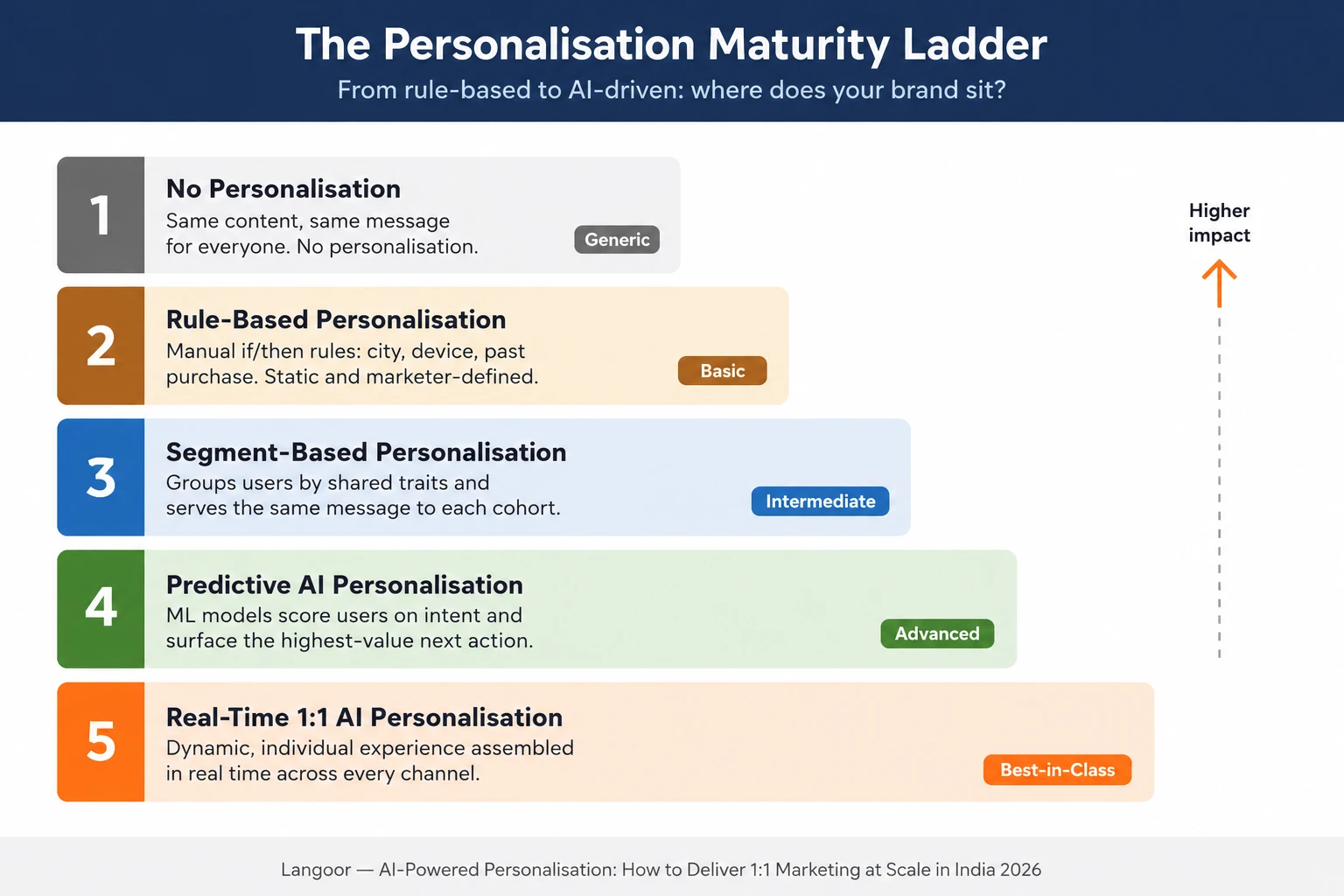
The difference between basic personalisation and AI-driven personalisation
Most Indian brands already do some form of personalisation. The question is where it sits on the maturity curve.
The jump from segment-based to AI-driven personalisation is not just technical; it is commercial. Brands that move from segment-level to individual-level personalisation typically see 15–30% improvement in conversion rates and meaningful gains in customer lifetime value, driven by showing customers products and content that are actually relevant to them rather than relevant to the average person who looks like them.
How AI reads behavioural signals to predict intent
AI personalisation engines work by ingesting, weighting, and acting on signals, data points that indicate what a user is interested in, where they are in their decision journey, and what they are most likely to do next.
The most valuable signals for Indian marketing contexts include:
- Session behaviour: Pages visited, time on page, scroll depth, search queries within site, product views, price comparisons.
- Transactional history: Past purchases, average order value, product categories, frequency and recency of purchase, payment method preferences.
- Engagement patterns: Email open and click patterns, push notification response rates, WhatsApp message engagement, time of day and day of week patterns.
- Cross-channel signals: Whether a user has seen a paid ad, visited from organic search, or been referred from a comparison portal, and how each entry point correlates with conversion likelihood.
- Explicit preferences: Wish lists, saved items, preference centre inputs, survey responses.
An AI personalisation model does not read these signals individually; it weights combinations. A user who visits a product page twice from mobile, adds to cart, abandons, and then opens a price drop email is sending a very specific pattern. A model trained on thousands of similar journeys can identify that pattern and determine whether a WhatsApp reminder, a discount offer, or a social proof nudge is the highest-probability next action.
In India, mobile-first behaviour and WhatsApp as a primary customer communication channel create unique personalisation opportunities that Western playbooks underserve. Brands that optimise for the Indian behavioural context, including the role of EMI options, regional language preferences, and festival purchase cycles, will outperform those that import global personalisation frameworks wholesale.
Personalisation across channels: Website, email, WhatsApp, and ads
Effective AI personalisation is not a single-channel tactic. It operates across every touchpoint in the customer journey, with the AI model ensuring consistency of signal and relevance of message regardless of where the customer is.
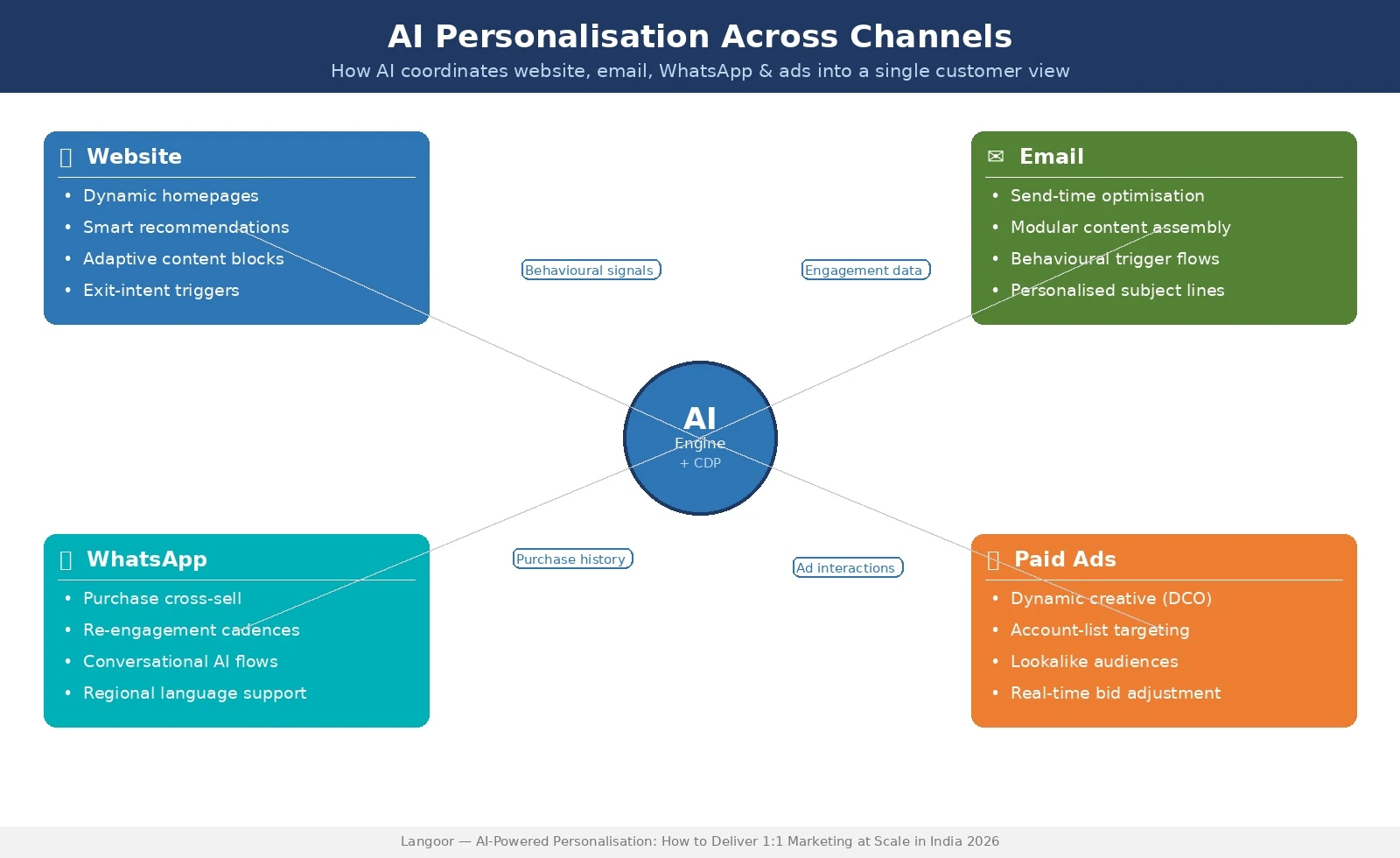
Website personalisation
The website is the highest-value personalisation surface for most brands. AI-powered website personalisation includes:
- Dynamic homepage content that changes based on return visitor history, showing a first-time visitor a brand introduction and showing a repeat visitor the category they purchased from last.
- Personalised product recommendations driven by collaborative filtering ("users like you also bought") and individual history.
- Adaptive content blocks that surface different value propositions depending on the visitor's industry, company size, or behavioural segment.
- Exit-intent personalisation, surfacing the right offer or content asset to a visitor about to leave, calibrated to their behaviour in the current session.
Email personalisation
Beyond name merge tags and birthday emails, AI email personalisation involves:
- Send-time optimisation: using individual engagement history to determine the exact hour at which each subscriber is most likely to open and click.
- Content assembly: dynamically building email content from modular blocks, selecting the right product, article, or offer for each recipient based on their predicted interest.
- Behavioural trigger sequences: automated email journeys triggered not by time elapsed but by specific user actions (or inactions), with follow-up content calibrated to the behavioural signal.
WhatsApp personalisation
With over 500 million WhatsApp users in India, WhatsApp Business API has become a critical personalisation surface. AI enables:
- Purchase confirmation and cross-sell messages personalised to the specific product bought and the customer's historical category affinity.
- Re-engagement messages calibrated to lapsed purchase patterns — a customer who buys quarterly should be messaged differently from one who buys monthly.
- Conversational AI flows that adapt responses based on individual query history and stated preferences.
Paid advertising personalisation
Dynamic creative optimisation (DCO) uses AI to assemble ad creative, headline, image, offer, call to action, from a library of components, testing combinations in real time and serving each user the highest-predicted-relevance version. For Indian brands running performance campaigns on Google, Meta, and programmatic exchanges, DCO typically delivers 20–40% improvement in click-through and conversion rates versus static creative.
First-party data and personalisation: How to build your data foundation under the DPDP Act
AI personalisation is only as good as the data it runs on. And in 2026, the data environment in India has changed significantly. The Digital Personal Data Protection (DPDP) Act requires brands to collect explicit, informed consent before processing personal data for marketing purposes. Third-party cookies are no longer the bedrock of digital advertising targeting. The implication is clear: brands that have built strong first-party data foundations will outcompete those that rely on third-party data infrastructure.
Building a first-party data foundation for AI personalisation in India involves four layers:
- Consent architecture: Every data collection point, website forms, app onboarding, WhatsApp opt-ins, must be underpinned by clear, purpose-specific consent under the DPDP framework. Consent is not a compliance checkbox; it is the foundation on which personalisation is legally built.
- Identity resolution: First-party data is only valuable if you can stitch together a user's behaviour across sessions and channels. A Customer Data Platform (CDP) creates a unified customer profile by resolving multiple identifiers, email, phone number, device ID, CRM record, into a single persistent customer ID. A well-implemented CDP is also the foundation for AI-driven marketing automation. B2B marketing automation guide covers how identity resolution feeds lead scoring and nurture sequencing.
- Data enrichment: Raw behavioural data needs to be enriched with transactional, CRM, and third-party contextual data to give the AI model enough signal to work with. For B2B brands, firmographic enrichment (company size, industry, tech stack) is particularly valuable.
- Model training: AI personalisation models require training data; historical examples of what actions users took after seeing what content. The more complete and clean the first-party data, the more accurate the model. Brands with fragmented data infrastructure will hit a ceiling on personalisation performance regardless of the tool they use.
One important implication of the DPDP Act that Indian marketers must understand: consent given for one purpose cannot be used for another. A user who consented to receive transactional emails has not consented to personalised marketing. Consent management must be granular, auditable, and woven into the data infrastructure, not bolted as an afterthought.
AI personalisation tools for Indian marketers in 2026
The AI personalisation tool landscape has matured significantly. Indian brands now have access to a range of platforms from enterprise-grade full-stack solutions to modular tools that can be layered onto an existing marketing stack.
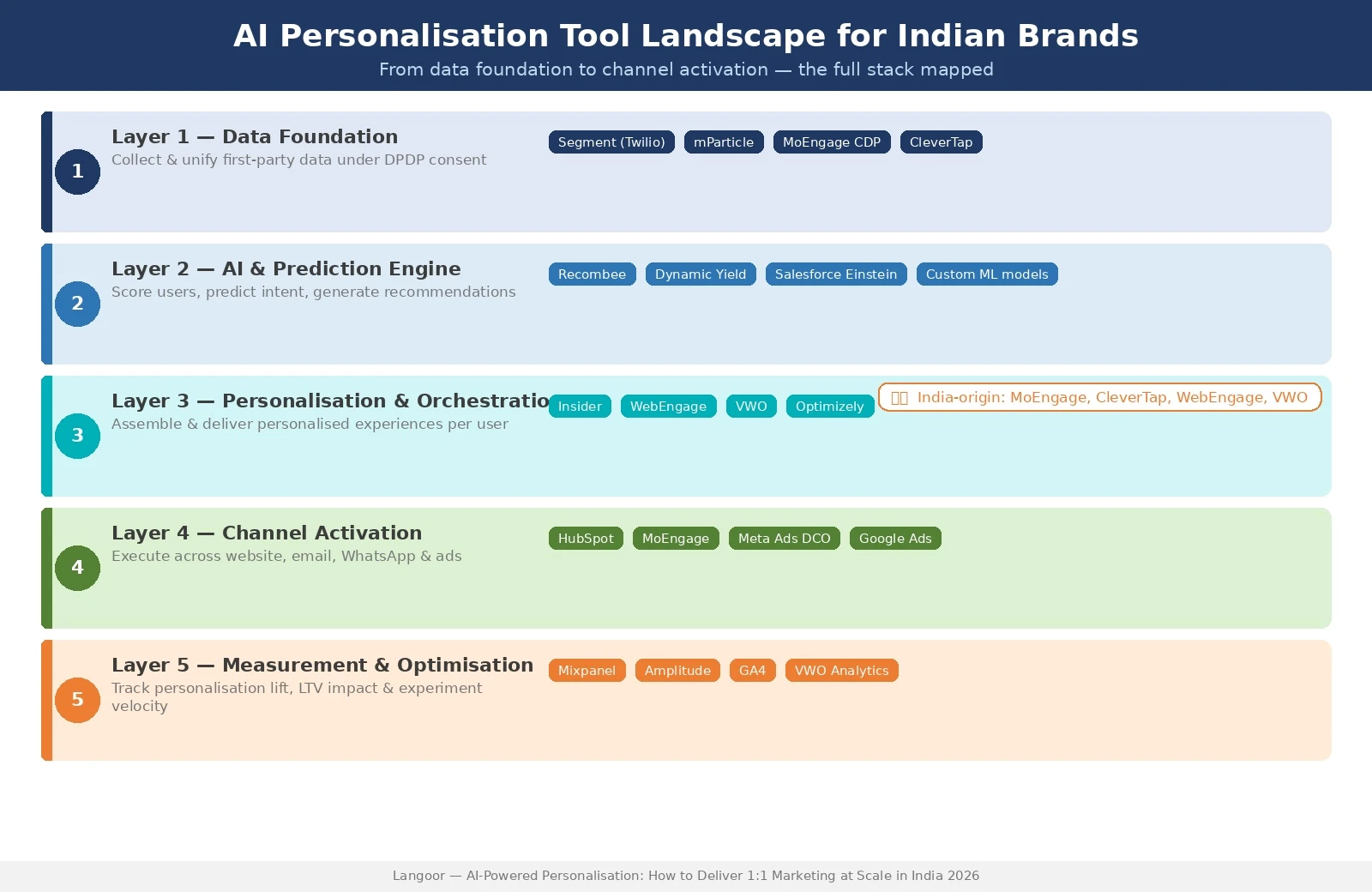
Customer Data Platforms (CDPs)
- Segment (now part of Twilio): market-leading CDP for data unification and; audience activation. Strong integrations with Indian martech stack.
- MParticle: strong mobile-first CDP; well-suited to D2C brands with high app traffic.
- MoEngage: founded in India, strong WhatsApp and push notification personalisation capabilities; significant adoption among Indian consumer brands.
- CleverTap: Indian-origin platform with strong mobile engagement and retention personalisation features.
Website personalisation
- Optimizely: enterprise-grade experimentation and personalisation platform.
- VWO (Visual Website Optimizer): Indian-origin platform with strong A/B testing and personalisation capabilities; popular with Indian e-commerce brands.
- Insider: personalisation platform with strong cross-channel capabilities and good India support.
Email and cross-channel personalisation
- Salesforce Marketing Cloud: enterprise scale, strong AI-driven send-time optimisation and content personalisation.
- HubSpot: accessible for mid-market B2B brands with strong CRM integration and smart content personalisation.
- WebEngage: Indian platform with strong event-based personalisation and journey orchestration across email, push, and WhatsApp.
AI recommendation engines
- Recombee: AI-powered product and content recommendation engine with API-first integration.
- Dynamic Yield (now part of Mastercard): enterprise recommendation and personalisation; used by large Indian retail and BFSI brands.
The right stack depends on your scale, existing infrastructure, and personalisation maturity. Brands beginning their AI personalisation journey should prioritise getting the data layer right (CDP) before investing in sophisticated personalisation engines. Personalisation on bad data produces bad personalisation at speed, which is worse than no personalisation at all.
Personalisation pitfalls: When it feels creepy vs helpful
Not all personalisation is good personalisation. Indian consumers are increasingly aware of how their data is being used, and the line between personalisation that feels helpful and personalisation that feels intrusive is thinner than most marketers assume.
The most common personalisation pitfalls and how to avoid them:
- Oversharing what you know: Showing a user an ad that references a product they searched for in a private browsing session, or a message that implies you know their location too precisely, triggers immediate discomfort. Personalisation should feel like the brand understands your interests, not like you are being watched.
- Personalisation without consent context: Under India's DPDP Act, users who have not opted into marketing personalisation should not receive it. Beyond legal compliance, brands that personalise based on implicit data without disclosed consent will face growing consumer backlash.
- Recommendation loops: AI recommendation engines that only serve content similar to what a user already consumed can create filter bubbles that reduce discovery and frustrate users who want to explore. Building serendipity and diversity into recommendation logic is important for long-term engagement.
- Frequency mismanagement: Even a highly personalised message loses its value if it arrives too often. AI personalisation systems must be governed by frequency capping and cross-channel message coordination to prevent the same user from receiving personalised emails, WhatsApp messages, push notifications, and retargeting ads simultaneously.
- Static models on dynamic users: A model trained on a user's behaviour six months ago may be serving irrelevant personalisation today. People's interests, circumstances, and intent change. AI models must be retrained, and preferences refreshed to remain accurate.
Measuring personalisation impact: Metrics that matter
Personalisation is an investment, and like any investment, it needs to be measured against commercial outcomes, not just engagement metrics.
The metrics Indian brands should track for AI personalisation programmes:
- Lift in conversion rate: The primary commercial indicator. Compare conversion rates between personalised and non-personalised experiences (via A/B testing or control groups). A well-implemented personalisation programme typically delivers a 15–30% conversion lift.
- Revenue per session: Personalised product recommendations increase average order value by surfacing complementary or higher-margin products. Tracking revenue per session against a holdout group quantifies recommendation impact.
- Email and WhatsApp engagement rates: Send-time optimisation and content personalisation should improve open rates, click-through rates, and conversion rates from messaging channels. Benchmark against pre-personalisation baselines to isolate impact.
- Customer lifetime value (LTV): The long-term measure of personalisation success. Brands that consistently serve relevant experiences build stronger relationships, higher repeat purchase rates, and longer customer relationships. LTV improvement is the north star metric for mature personalisation programmes.
- Churn rate reduction: For subscription and BFSI products, AI personalisation that identifies pre-churn signals and triggers timely; relevant interventions can meaningfully reduce voluntary churn. Track this as a specific personalisation outcome.
- Experiment Velocity: How many personalisation tests are you running per month? The brands that learn fastest compound their personalisation advantage most quickly. Experiment velocity is a leading indicator of future performance.
This outcomes-first measurement approach mirrors how AEO and GEO performance should be tracked — see our guides on measuring AEO success and tracking GEO citation performance.
Conclusion
In 2026, personalisation is not a nice-to-have, it is what customers expect. Indian consumers interact with brands across five or more channels, generate rich behavioural signals at every touchpoint, and have become increasingly skilled at ignoring messages that are not relevant to them.
AI personalisation gives brands the capability to meet that expectation: to understand individual intent, to respond in real time, and to deliver the right experience across every channel without a team of humans manually managing rules for every user segment.
AI personalisation works best as part of a connected B2B strategy. Pair it with the approaches in our guides on marketing automation and account-based marketing to extend 1:1 relevance from your highest-value accounts to your entire funnel.
Technology is accessible. The data infrastructure is built. The regulatory framework, while requiring careful consent management, is workable. The competitive advantage goes to the brands that act first. Those that wait will find themselves in an environment where consumers have been trained to expect personalisation by their competitors and are increasingly unresponsive to the generic experiences that remain.
Ready to build an AI personalisation programme that delivers measurable lift in conversion and lifetime value? Get a Langoor personalisation audit.
Frequently Asked Questions
1) What is AI personalisation in marketing?
AI personalisation in marketing is the use of machine learning models to analyse individual user behaviour, in real time and historically, and deliver dynamically tailored content, product recommendations, messages, and offers to each user without manual rule-setting for every scenario. Unlike traditional segment-based personalisation, AI personalisation responds to individual signals rather than the average characteristics of a group, enabling brands to deliver genuinely 1:1 experience at scale.
2) How does AI personalisation differ from traditional segmentation?
Traditional segmentation groups users into buckets based on shared characteristics, age, location, purchase history and serves the same message to everyone in the bucket. AI personalisation treats each user as an individual, dynamically adjusting what they see based on their specific behaviour, stated preferences, and predicted intent. Segmentation is static and averages individual differences. AI personalisation is dynamic and captures individual variation. The commercial difference is significant: AI personalisation typically outperforms segment-based approaches by 15–30% on conversion metrics.
3) What data do you need for AI personalisation?
Effective AI personalisation requires three categories of data: behavioural data (what users do on your website, app, and in your communications channels), transactional data (what they have purchased, when, and at what value), and identity data (the ability to stitch these signals together into a unified customer profile across sessions and devices). A Customer Data Platform (CDP) is the infrastructure that enables this unification. The quality and completeness of first-party data is the single biggest determinant of how well AI personalisation performs.
4) How does India's DPDP Act affect personalisation marketing?
India's Digital Personal Data Protection (DPDP) Act requires that brands collect explicit, purpose-specific consent before using personal data for marketing personalisation. Consent given for transactional communications cannot be repurposed for marketing personalisation without separate consent. Brands must implement consent management infrastructure that is granular, auditable, and integrated into their data collection systems. Personalisation built on non-consensual data creates legal exposure and, increasingly, consumer backlash. DPDP compliance is not a constraint on AI personalisation, it is the foundation on which trustworthy personalisation is built.
5) What AI personalisation tools are available in India?
Indian marketers have access to a growing range of AI personalisation platforms. For mobile and app personalisation: MoEngage and CleverTap (both India-origin platforms with strong local support). For website personalisation: VWO (Indian origin), Optimizely, and Insider. For cross-channel personalisation and CDPs: Segment, mParticle, and WebEngage. For email and CRM-based personalisation: HubSpot, Salesforce Marketing Cloud, and WebEngage. For AI product recommendations: Recombee and Dynamic Yield. The right choice depends on your channel mix, data infrastructure maturity, and budget.
You may also like this