August 4, 2026
Medini Mangala
AI Overview
First-party data refers to information collected directly from customers through owned channels, website interactions, CRM records, purchase history, email engagement, and app usage. As third-party cookies are eliminated and India's Digital Personal Data Protection (DPDP) Act tightens consent requirements, first-party data strategy has become the foundation of digital marketing in 2026. Brands using first-party data see 2.9x higher revenue growth, 50% lower customer acquisition costs, and up to 50% higher campaign ROI compared to those relying on third-party data.
Introduction
For years, Indian marketers could target ads at people who had never heard of them, by buying data collected by someone else, or by following users across the internet using tracking technology called third-party cookies. That era is ending. Google is phasing out cookies from Chrome, Apple has already blocked cross-app tracking, and India's new DPDP Act requires explicit consent for data collection.
The brands scrambling to respond are the ones that built their marketing on borrowed data. The brands that will thrive are the ones investing in first-party data, information they collect directly from customers who have chosen to share it.
This guide explains what first-party data is, why it matters more than ever in India, what the DPDP Act means for your marketing, and how to practically build a first-party data strategy that makes your marketing more personalized, more measurable, and more profitable than what came before.
Key Takeaways
- First-party data, information collected directly from your own customers, is 2 to 3 times more accurate than data bought from third parties (sci-tech-today 2026)
- Brands using first-party data see 2.9x higher revenue growth and 50% lower customer acquisition costs compared to competitors without it (TechRT / Avaus 2026)
- 70% of digital advertising spend will be powered by first-party data by end of 2026, the shift is already underway (sci-tech-today 2026)
- India's DPDP Act is now live. Full enforcement begins May 2027, with penalties of up to ₹250 crore for non-compliance, making data consent a business-critical issue, not just a legal one
- 82% of consumers will share their personal data in exchange for a better experience, but 73% will leave a brand they feel has misused it (TechRT / Twilio 2026)
- Email campaigns powered by first-party data deliver up to 6x higher return than generic campaigns, and personalised email achieves a 43:1 ROI versus 12:1 for brands that don't personalise (TechRT / Litmus 2026)
- Only 6% of marketing teams have fully embedded data-driven workflows, meaning most Indian brands are sitting on untapped value from data they already own (Supermetrics 2026)
What is first-party data and why does it matter in 2026?
First-party data is the information your customers share with you directly, by visiting your website, signing up to your newsletter, buying your product, or filling in a form. It belongs to you. You collected it. Your customers know you have it.
This is different from third-party data, which is information about people collected by someone else and sold to you, usually without those people knowing much about it. Think of the data brokers who compile profiles on millions of consumers and sell them to advertisers for ad targeting.
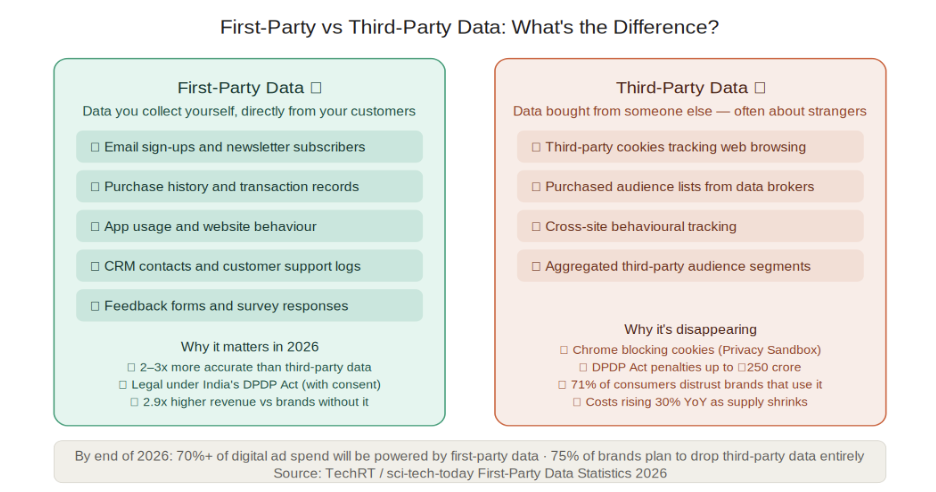
The reason first-party data has become so important in 2026 comes down to three things happening at once:
- Cookies are going away: Third-party cookies, the tiny files that let companies track you across different websites, are being blocked by browsers. Apple blocked them years ago. Google is implementing its Privacy Sandbox in Chrome. When these tracking tools disappear, any marketing that relied on them stops working.
- Privacy laws are tightening: India's DPDP Act now requires explicit consent before you can collect or use personal data. Using data without consent could cost your business up to ₹250 crore in penalties. Marketing built on data people didn't knowingly share is no longer legally safe.
- Customers are paying attention: 71% of consumers now distrust brands they feel are using their data in opaque ways. Trust has become a commercial asset. Brands that collect data transparently, use it to deliver genuinely better experiences, and handle it respectfully are building a relationship advantage that translates to revenue.
The flip side: the brands that invest in first-party data now are gaining an advantage that is very hard to replicate. Because first-party data is earned, through relationships, content, value exchanges, and consistent engagement, it cannot simply be purchased by a competitor.
Our guide to AI-powered personalisation explains how first-party data feeds individual-level personalisation at scale — including the CDP architecture, identity resolution, and DPDP Act compliance requirements.
Not sure where to start with first-party data? Langoor helps Indian brands audit their current data collection, identify the highest-value gaps, and build a first-party data strategy that is both commercially impactful and DPDP-compliant. Talk to the Langoor team at langoor.com/contact →
The end of third-party cookies: What changes for Indian marketers
Third-party cookies made it possible to do three things that most Indian digital marketing teams have come to rely on: follow someone across the internet after they visited your site, build a profile of their interests based on everywhere they've been, and target them with ads based on that profile.
With cookies disappearing, each of these becomes harder or impossible in a traditional way. Here is what this means in practice:
- Retargeting gets more limited: You can no longer reliably follow someone who visited your website to other sites and show them your ads. Cookie-based retargeting, one of the most widely used tools in Indian digital marketing, no longer works the way it used to. The replacement is retargeted based on your own customer lists, which only works if you have those lists in the first place.
- Audience targeting becomes less precise: Many Indian brands run Facebook and Google ads targeted at audiences built using third-party data, 'people interested in enterprise software in Mumbai,' for example. As third-party signals disappear, these audiences become less accurate. First-party audiences, built from your own customer and prospect data, will outperform them.
- Measuring results get harder: When cookies tracked users across the internet, it was relatively straightforward to see a user click an ad and then buy. Without that cross-site tracking, you lose the ability to connect those dots using simple tag-based tools. This is solvable, but it requires different measurement approaches that we cover in the final section.
The key insight is that these challenges are primarily problems for brands without strong first-party data. If you have a rich, consented customer database, a well-maintained CRM, and strong direct channels like email and WhatsApp, the cookie deprecation affects you far less than it affects brands that built their marketing on rented data.
75% of companies plan to reduce or fully drop their reliance on third-party data by 2026. The brands moving fastest are those treating this not as a problem to manage but as an opportunity to build something more durable.
India's DPDP Act: What consent requirements mean for your marketing
India's Digital Personal Data Protection Act, commonly called the DPDP Act, is the country's first comprehensive data privacy law. It received Presidential assent in August 2023, and the implementing rules came into effect in November 2025. Full enforcement of all provisions begins in May 2027.
The core principle is straightforward: if you collect personal information about someone, you need their explicit, informed consent; you can only use it for the purpose they agreed to, and you must delete it when it is no longer needed.
What this means specifically for Indian marketers:
- One 'I agree' is no longer enough: A single tick-box covering your privacy policy, marketing emails, analytics, and third-party sharing is not valid for consent under the DPDP Act. Each purpose must be consented separately. If someone signs up for your newsletter, that does not mean you can automatically add them to your retargeting audiences.
- You must tell people why you're collecting data: Before collecting any personal information, you must clearly explain what you're collecting, what you'll use it for, and how the person can withdraw consent or request deletion. The notice must be in plain language, not buried in legal terms.
- People can ask you to delete their data: Under the DPDP Act, individuals have the right to have their personal data deleted when it is no longer needed for the purpose they consented to. Your systems must be capable of handling these requests within 90 days.
- Children's data requires extra care: Any processing of data relating to people under 18 requires verifiable parental consent. Targeting, profiling, or behavioural advertising directed at children is expressly prohibited.
- Penalties are real: Non-compliance carries penalties of up to ₹250 crore for serious violations like security breaches, and up to ₹50 crore for other compliance failures. These are not theoretical risks.
The DPDP Act's enforcement timeline in plain terms: the Data Protection Board is being set up now (November 2025). Consent manager registration opens November 2026. Full enforcement, including the consent, privacy notice, and data rights requirements, begins May 2027.
The practical implication for marketing teams: you have time to prepare, but not much. Any data you collect between now and May 2027 that is not properly consented to becomes a compliance liability on enforcement day. Building consent infrastructure now is the responsible and commercially sensible choice.
Need to make your marketing data practices DPDP-compliant? Langoor's team helps Indian brands design consent mechanisms, update data collection workflows, and build marketing infrastructure that is both legally sound and commercially effective from day one. Speak to Langoor about DPDP-ready marketing at langoor.com/contact →
How to build a first-party data collection strategy
Building first-party data is not a technology project; it is a relationship project. The question is not 'what tracking tools can we deploy?' But what value can we offer that makes customers want to share information with us?
The most effective first-party data strategies are built on a simple exchange: the brand provides something genuinely useful, better content, personalised recommendations, a smoother experience, exclusive access, and the customer provide data that makes that possible.
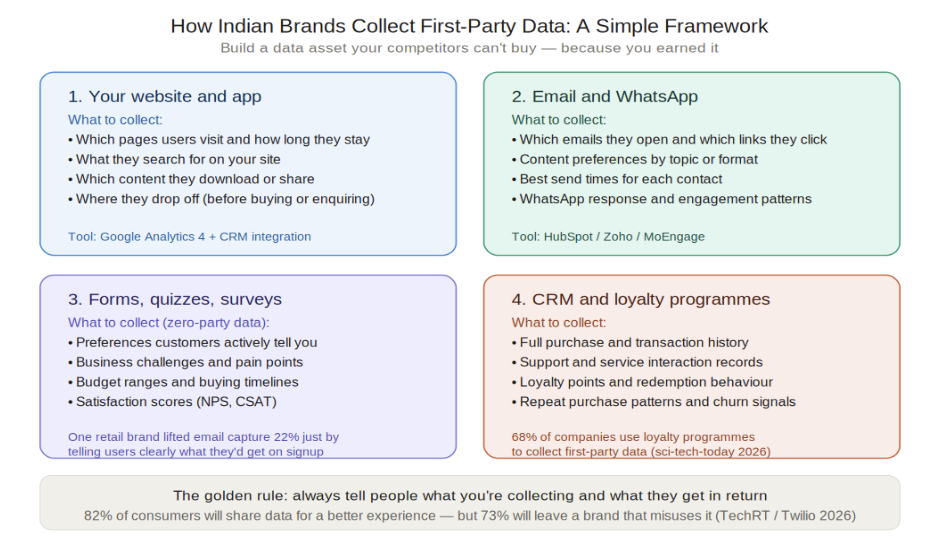
The four most productive first-party data sources for Indian brands:
- Your website and app: Every visit to your website is a data point — which pages someone reads, what they search for, where they spend time, and where they leave. With tools like Google Analytics 4 and a connected CRM, this behavioural data becomes a rich signal of what your visitors are interested in and how close they are to deciding. The key is connecting that anonymous behaviour to a named contact once someone identifies themselves.
- Email, WhatsApp, and direct channels: Email remains the most reliable, owned channel for first-party data. Every email send generates engagement signals, who opens, who clicks, which topics they respond to. WhatsApp, used by over 500 million Indians, adds another direct layer for preference signals and response behaviour. These channels are already generating valuable first-party data for most Indian brands, the gap is usually in whether that data is being captured, connected, and used.
- Quizzes, surveys, and preference centers: This is sometimes called zero-party data, information customers actively volunteer rather than information you observe. A product recommendation quiz, a preference centre where someone tells you what content they want, or a simple onboarding survey asking about their business challenges produces extraordinarily high-quality data because the person chose to share it. One retail brand lifted its email sign-up rate by 22% simply by being clearer on the sign-up form about what subscribers would receive and how often.
- Loyalty programmes and CRM: Purchase history, service interactions, and loyalty activity are among the most commercially valuable data you can hold. 68% of companies use loyalty programmes specifically to collect this kind of first-party data. If you have a CRM, you already have significant first-party data, the question is whether it is structured, maintained, and connected to your marketing platform in a way that makes it usable.
The most common mistake Indian brands make in first-party data collection is treating it as a back-end infrastructure project rather than a customer experience question. Data collection only works when the value exchange is clear and fair. 82% of consumers say they will share data in exchange for a better experience, but only when they understand what they're sharing and feel the exchange is worthwhile. Be explicit. Be specific. Be genuinely useful.
CRM, CDP, and DMP: The data infrastructure explained simply
Most conversations about first-party data strategy get complicated fast by acronyms - CRM, CDP, DMP, DMP. Here is what each actually does, explained plainly.
- CRM (Customer Relationship Management System): Your CRM: think Salesforce, HubSpot, or Zoho CRM, is where you store information about your customers and prospects. It holds contact details, conversation history, deals in progress, and the full timeline of every interaction your sales and marketing teams have had with a person. It is your primary record of who your customers are. If you only have one data system, this should be it.
- CDP (Customer Data Platform): A CDP goes further than a CRM. Where a CRM records structured data entered by your team, a CDP automatically collects and connects data from every digital touchpoint, your website, app, email, WhatsApp, paid ads, in-store purchases, and builds a single, real-time profile for each customer. This unified profile enables truly personalised marketing on scale.
The marketing automation infrastructure that activates CDP data — lead scoring, nurture sequences, and behavioural triggers — is covered in our B2B marketing automation guide. The global CDP market is growing at 34% CAGR and will reach $10.3 billion in 2026. For most Indian brands, a CDP becomes relevant once you are operating across multiple channels and want to deliver consistent, personalised experiences across all of them. Platforms like MoEngage, Segment, and Salesforce CDP are commonly used.
- DMP (Data Management Platform): A DMP was traditionally used to manage third-party audience data for programmatic advertising. With third-party data declining, DMPs are becoming less relevant for most Indian brands. You probably do not need one unless you run large-scale programmatic campaigns.
- The practical question for most Indian brands is not 'which platform do I need?' but 'what am I trying to do with the data I collect?'
If the goal is to know your customers and manage relationships, a well-maintained CRM is enough. If the goal is to deliver personalised experiences across multiple channels in real time, a CDP adds significant value. If the goal is to run better paid media campaigns using your own customer data, connecting your CRM to Google and Meta's customer matching tools achieves most of what you need without additional infrastructure.
Start with the CRM. Get that data clean, comprehensive, and connected to your marketing platform. Add a CDP when the complexity of your customer data across multiple channels exceeds what a CRM can handle cleanly. Do not let platform discussions distract from the more important question: how are we making data collection a genuine part of how we build customer relationships?
Using first-party data for personalisation
The reason first-party data matters commercially are not just compliance, it is personalisation. And personalisation, done well, has a direct and significant impact on revenue.
The numbers are compelling: brands using first-party data for personalisation see up to 50% higher campaign return. Personalised email achieves a 43:1 return on investment compared to 12:1 for brands that don't personalise, a difference of 258% driven almost entirely by relevance. Consumers who receive personalised experiences are 80% more likely to buy, and 60% are more likely to become repeat customers.
Practically, first-party data enables three levels of personalisation that generic marketing cannot:
- Content personalisation: Showing the right content to the right person based on what you know about them. A first-time visitor to your website sees introductory content. A returning visitor who has previously downloaded a case study about BFSI sees your BFSI-specific thought leadership. A contact who attended your recent webinar on ABM gets a follow-up email specifically about ABM tools. None of this requires guessing; it uses what you already know.
- Offer and timing personalisation: Sending a renewal offer to a customer whose annual contract is due in 30 days. Promoting a complementary product to someone who bought a specific item three months ago. Re-engaging a contact who has not opened an email in 90 days with your highest-performing content rather than your most recent newsletter. Each of these is straightforward to automate if your CRM and email platform are properly connected.
- Channel personalisation: Different people prefer different channels. Some of your contacts respond immediately to WhatsApp. Others open every email but ignore WhatsApp. A few call sales directly. First-party data tells you which channel works for which person, and smart automation routes each communication accordingly.
One important caution: personalisation done poorly is worse than no personalisation at all. Gartner found that 53% of B2B buyers have had negative experiences with traditional personalisation, where recommendations felt intrusive, inaccurate, or based on incorrect assumptions. The goal is not to demonstrate that you have data; it is to use data to be genuinely more useful to the customer. When in doubt, err toward being helpful rather than demonstrating how much you know.
Using first-party data for paid advertising on Google and Meta
One of the most immediately valuable applications of first-party data for Indian brands is in paid advertising. As third-party targeting becomes less reliable, your own customer data becomes your most powerful targeting asset.
The three main ways first-party data improve paid advertising:
- Customer Match and Custom Audiences: Both Google and Meta allow you to upload a list of email addresses or phone numbers from your CRM, and they will match those to their users and show ads specifically to that audience. This is more accurate than any third-party audience because it is based on people who have already had a real relationship with your brand. You can use this to re-engage past customers, show different ads to prospects versus customers, or exclude existing customers from acquisition campaigns.
- Lookalike audiences from first-party data: Once you upload your customer list, Google and Meta can find other users on their platforms who look like your best customers, in terms of demographics, interests, and behaviour. A lookalike audience built from your top 500 customers is significantly more effective than a generic audience segment, because it is seeded with people who bought from you rather than people who fit a rough demographic profile.
- Better conversion tracking: Google's Enhanced Conversions and Meta's Conversions API allow you to send conversion data, purchases, form fills, sign-ups, directly from your server to the advertising platform, rather than relying on browser-based tracking that cookies once made possible. This improves the accuracy of campaign optimisation and gives the algorithms better data to work with. Brands implementing Enhanced Conversions typically see 10 to 20% improvement in measured conversions from the same spend.
The practical starting point for most Indian brands: export your most valuable customer segment from your CRM, upload it to Google and Meta as a Custom Audience, and run a campaign specifically targeting that audience with your most relevant message. This alone typically outperforms broad third-party targeted campaigns, and it requires no new technology, just the customer data you already have.
Measuring marketing performance without third-party cookies
The hardest thing about losing third-party cookies is not the target; it is the measurement. Marketers have spent years building attribution models that relied on following individual users across sessions and devices. Without that cross-site tracking, those models break.
The good news is that better alternatives now exist. They are different from what most teams are used to, but they are also more accurate.
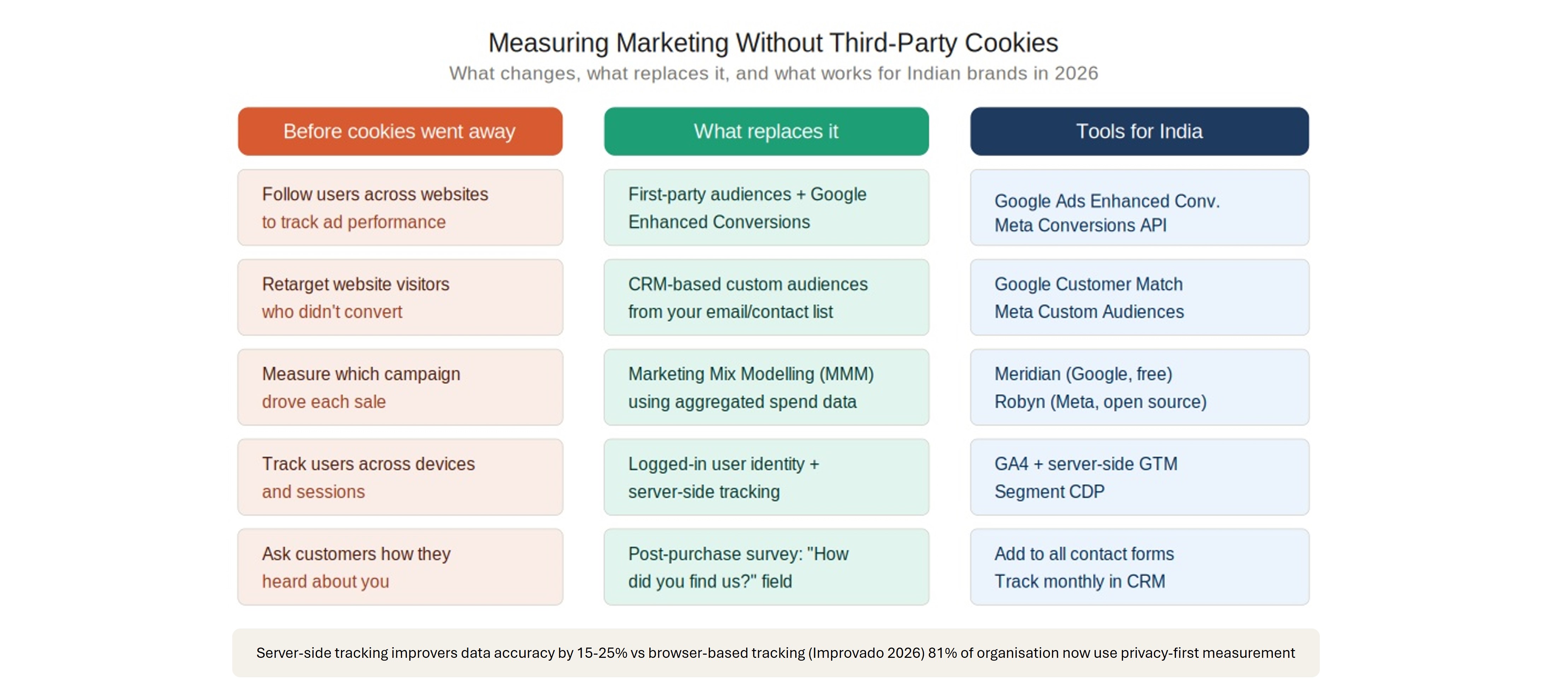
The measurement approaches that work without cookies:
- Focus on what happened, not just who did it: Instead of trying to track individual users across their entire journey, shift emphasis to measuring outcomes. Did revenue go up when you spent more on a channel? Did leads increase after a content investment? These aggregate patterns, measured through Marketing Mix Modelling (MMM), tell you what is working without needing to track individuals at all. Google's Meridian and Meta's Robyn are both free, open-source tools that make this approach accessible to Indian brands without large analytics teams.
- Server-side tracking: When a user visits your website, traditional tracking fires a small piece of code in their browser that sends data to analytics and advertising platforms. Ad blockers and privacy features in browsers can block this. Server-side tracking sends that data from your server instead, bypassing blockers and improving measurement accuracy by 15 to 25%. It requires a technical setup but is increasingly standard practice. Server-side tracking adoption reached 43% in 2026 and is projected to hit 65% by 2027 (Improvado).
- Ask your customers directly: The simplest and most underused measurement tool available to Indian brands is a single question on every contact form and post-purchase page: 'How did you hear about us?' The answers reveal which channels are driving real awareness and decisions, often showing very different results from what attribution models suggest. This approach, sometimes called self-reported attribution, captures the 'dark funnel', the LinkedIn posts someone read, the podcast they listened to, the conversation they had, that digital tracking entirely misses.
- Lean on Google Analytics 4: GA4 was built for a cookieless world. Its modelled data fills in gaps where tracking is blocked, and its integration with Google Ads provides the best available view of campaign performance without relying on third-party cookies. If you are still using Universal Analytics data as a reference point, now is the time to invest fully in GA4 as your primary measurement source.
The truth about marketing measurement in 2026: no single system gives you perfect, complete attribution. The brands that navigate this best are the ones that use multiple measurement methods, GA4 for daily performance monitoring, MMM for budget planning, and direct customer surveys for qualitative understanding, and triangulate across them rather than expecting one number to tell the whole story.
Struggling to understand what your marketing is actually driving? Langoor builds measurement frameworks for Indian brands that combine first-party data, server-side tracking, and Marketing Mix Modelling — giving you a clear view of what is generating revenue, even in a cookieless world. Book a measurement strategy session at langoor.com/contact →
Conclusion
First-party data is the most valuable marketing asset a brand can build in 2026 — more valuable than any technology platform or creative campaign. It is also the only data asset that gets more valuable over time, because every customer interaction adds to it.
The brands that invest now in building genuine, consensual relationships with their customers, collecting data transparently, using it to deliver better experiences, and maintaining it in a DPDP-compliant way, will have a structural advantage that compounds year after year. The brands that delay are not just missing a marketing opportunity. They are accumulating a compliance of liability.
The cookie-less world is not something happening in the future. It is happening now. The question is whether your marketing infrastructure is ready for it.
Ready to build a first-party data strategy that drives real commercial results? Langoor has helped Indian brands across BFSI, SaaS, retail, and enterprise technology build DPDP-compliant first-party data programmes from the ground up, improving campaign performance, reducing acquisition costs, and unlocking personalisation at scale. We start with a data audit: what you already have, where the gaps are, and what to build next. Get in touch with the Langoor team at langoor.com/contact →
Frequently Asked Questions
1) What is first-party data?
First-party data is information you collect directly from your own customers and prospects through channels you own and control. This includes data from your website (which pages people visit, what they search for), your email list (who subscribes, what they click on), your app (how people use it), your CRM (purchase history, contact records), and any forms or surveys you run. Because it comes directly from people who have chosen to interact with your brand, it is more accurate, more relevant, and more legally secure than data purchased from outside sources. In 2026, first-party data is the foundation of effective, compliant digital marketing in India.
2) How does the DPDP Act affect marketing in India?
India's Digital Personal Data Protection Act (DPDP Act) requires Indian businesses to obtain clear, specific consent before collecting or using personal data for marketing purposes. A single generic 'I agree' checkbox is not sufficient; consent must be given separately for each purpose (e.g., email marketing, analytics, personalisation). People must be told exactly what data is being collected, why, and how to withdraw consent or request deletion. Penalties for serious violations can reach ₹250 crore. Full enforcement begins in May 2027, giving brands time to prepare, but any data collected without proper consent before that date becomes a compliance liability when enforcement starts.
3) What is the difference between first party, second party, and third-party data?
First-party data is information you collect directly from your own customers, website visits, email sign-ups, purchase history, and CRM records. You own it and collect it with the customer's knowledge. Second-party data is first-party data from another brand that has agreed to share it with you directly, for example, a partner company sharing their customer list with you for a joint campaign. Third-party data is information collected by someone else (data brokers, publishers, ad networks) and sold to advertisers for targeting. It is the least accurate, the most legally risky under the DPDP Act, and the most affected by cookie deprecation. In 2026, the clear direction is toward first-party data as the primary foundation of marketing strategy.
4) How can brands collect first-party data ethically?
The foundation of ethical first-party data collection is a clear value exchange: the customer shares information, and in return they receive something genuinely useful, better content, personalised recommendations, exclusive offers, a smoother experience. Practically, this means being transparent about what you are collecting and why before asking for it; making consent specific (separate consent for each purpose); making it easy for people to withdraw consent or request data deletion; and only collecting what you actually need. Brands that are honest and useful in their data collection consistently see better sign-up rates and stronger customer trust than those that obscure their data practices behind complex legal language.
5) What is a Customer Data Platform (CDP) and do I need one?
A Customer Data Platform (CDP) is a software system that collects customer data from every channel you operate website, app, email, WhatsApp, paid ads, in-store, and connects it into a single, real-time profile for each customer. This unified view enables genuine personalisation at a scale. You probably need a CDP if you are operating across multiple channels and struggling to connect the data from each one into a coherent customer picture. You probably do not need one yet if your CRM is well-maintained and connected to your email platform, a good CRM can handle the data needs of most Indian brands until their multi-channel complexity grows. Popular CDPs used by Indian brands include MoEngage, Segment, and Salesforce CD
You may also like this