September 9, 2026
Manmohan Singh
For a large Indian e-commerce business, appointing an SEO partner is not a choice between a “technical” agency and a “content” agency. The real decision is whether a provider can improve organic discovery across a complex, continually changing commerce estate - while coordinating with product, engineering, merchandising, content, analytics and commercial teams.
That distinction matters because an enterprise catalogue can generate thousands, or even millions, of URLs through filters, product variants, search pages, campaign landing pages and seasonal collections. A keyword report cannot resolve duplicate-page patterns, weak category architecture, delayed development tickets or unclear revenue attribution. Effective SEO services need an operating model that connects technical health, demand generation, content production, implementation and measurement.
This guide gives digital commerce and technology leaders a practical way to assess agencies, consultants and integrated partners before committing to an engagement.
Define what end-to-end SEO support should include
End-to-end SEO is not a fixed list of monthly deliverables. It is an accountable programme that prioritises the work most likely to improve how search engines understand the site and how high-intent customers discover its category and product pages. Google itself frames SEO as helping search engines understand content and helping users decide whether to visit a site, rather than as a shortcut to rankings. Its SEO starter guide is useful context for procurement teams: the work extends beyond inserting keywords into page copy.
A capable partner should explain how every workstream connects to the commerce estate, who owns implementation and how priorities will change as evidence emerges.
Workstream | What an end-to-end engagement should cover | Evidence to request from the provider |
|---|---|---|
Technical audit | Crawlability, rendering, performance, redirects, canonicalisation, XML sitemaps, robots directives, structured data and site migration risks | A sample prioritised audit showing issue severity, affected templates, business impact and implementation acceptance criteria |
Site architecture | Navigation, internal linking, category hierarchy, search-result pages and how authority flows to commercial landing pages | An example architecture recommendation that addresses user journeys as well as crawl efficiency |
Indexation management | Identifying index bloat, duplicate URLs, parameter handling, thin pages and canonical conflicts | A method for comparing crawled, indexed and organic-landing-page URL sets over time |
Category and product optimisation | Category intent mapping, metadata, on-page copy, product attributes, availability states, reviews and internal linking | Before-and-after page examples, including how recommendations differed for categories and products |
Content operations | Editorial briefs, expert review, merchandising inputs, publishing workflows and content refreshes | A content governance model with named approvers, turnaround times and quality controls |
Reporting and analytics | Search Console, web analytics, product data, conversion context and revenue analysis | A sample executive dashboard plus a detailed delivery report |
Implementation coordination | Ticket creation, sprint planning, QA, release validation and escalation | A RACI matrix that makes agency, client and development responsibilities explicit |
The scope should include structured data where it is applicable and technically supportable, but it should not treat markup as a guaranteed visibility mechanism. Google explains that structured data helps it understand page information and may make pages eligible for richer search appearances; eligibility is not a promise of display. A credible agency will distinguish between sound implementation, validation and the outcome of search-result presentation.
For enterprise commerce teams, implementation coordination is often the most revealing item in the table. An agency may correctly identify 200 issues, but its contribution is limited if recommendations cannot enter the backlog, survive prioritisation and be validated after deployment. Ask how the provider writes tickets, works with release calendars and confirms that a production change has solved the original problem.
Test whether the provider can handle enterprise commerce complexity
Large catalogues are dynamic systems. Price changes, stock status, marketplace feeds, seasonal collections and new campaign pages can affect discoverability every day. The partner you select should demonstrate that it can work with this reality without recommending broad, risky changes based on a single crawl.
Use this checklist in discovery calls and proposal reviews:
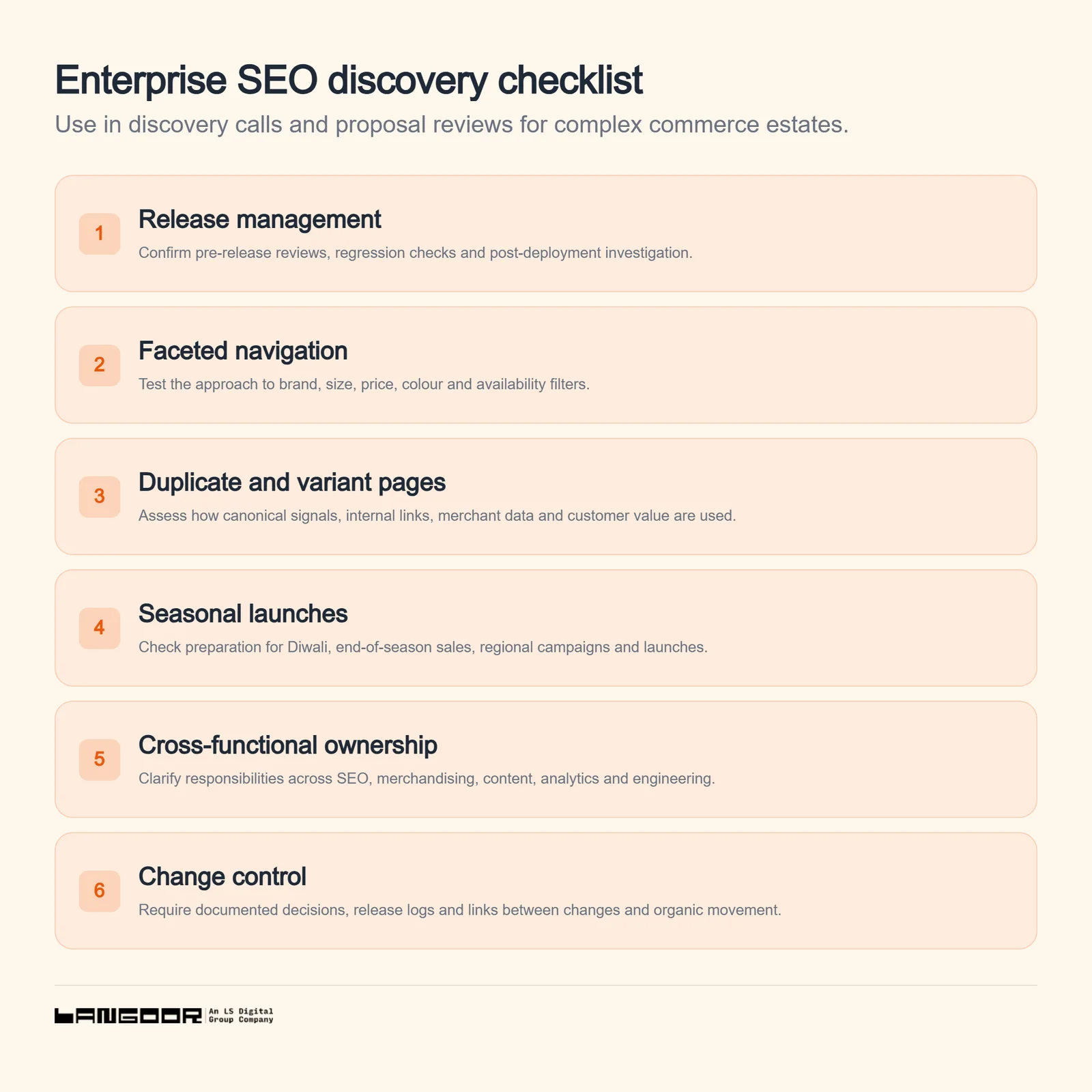
Six checks for assessing enterprise SEO delivery capability.
Technical expertise also has a customer-experience dimension. Core Web Vitals are a set of metrics centred on loading performance, responsiveness and visual stability, and web.dev documents the assessment thresholds and their rationale. An enterprise SEO partner should be able to translate those findings into template-level priorities for engineering, rather than treating performance as an isolated marketing metric.
This is where integrated thinking becomes valuable. Search journeys increasingly begin with broad category questions and progress to comparison, evaluation and purchase. Langoor’s perspective on SEO as a contributor to customer experience is relevant: a well-structured category journey can reduce friction for both crawlers and prospective buyers.
Measure commercial organic growth, not just short-term signals
Rankings can be useful diagnostic signals, but they are not the business outcome. A category may rank for an informational query that drives low-value visits, while a commercially important category loses impressions because it is competing with duplicate filtered URLs. The measurement model must show what is changing, why it may be changing and whether it is contributing to qualified demand.

A connected measurement framework for enterprise e-commerce SEO.
Avoid selecting a provider that promises first-page rankings or revenue on a preset timetable. Google states that it uses multiple ranking systems designed to surface helpful and reliable information, and no agency controls those systems, competitor activity or consumer demand. Better proposals state the leading indicators they will monitor, the assumptions behind commercial measurement and the actions they will take when data challenges the initial hypothesis.
Content quality is equally important. Teams should ask whether category copy, buying guides and product information genuinely help a customer decide. Google’s guidance on creating helpful, reliable, people-first content reinforces the principle that content should serve a real audience, rather than exist solely to attract search traffic.
Compare agency models by the work that must get done
There is no universally correct model. The right arrangement depends on whether the business has in-house search leadership, a capable content operation, reliable development access and a mature analytics function. Procurement should compare models by responsibility coverage - not by the number of slides in a proposal.
Consider a hypothetical national fashion retailer planning a platform upgrade before festive trading. It has 80,000 product URLs, several regional fulfilment rules, a small in-house content team and a development partner that works in fortnightly sprints.
Model | Strongest use case | Likely responsibility split | Main risk |
|---|---|---|---|
SEO firm | The internal team needs dedicated organic-search execution and defined deliverables | Firm leads audits, optimisation plans and reporting; client coordinates content and development | Recommendations stall if the firm lacks access to implementation teams |
Specialist consultants | The business has experienced in-house delivery teams but needs independent expertise for a migration or complex diagnosis | Consultant provides strategy, QA and governance; client teams execute | Insight remains advisory if internal capacity is constrained |
Integrated digital partner | Search, experience, content, data and technology decisions are interdependent | Partner coordinates strategy, content, analytics and implementation with client teams | The scope can become broad unless ownership and milestones are explicit |
For the fashion retailer, an SEO firm could be the right choice if its product and engineering teams already have clear owners who can execute tickets. A specialist consultant may be best if its in-house SEO lead needs migration assurance and an independent review of platform decisions. An integrated partner is more suitable when category strategy, platform experience, data intelligence and content operations require coordinated delivery across teams.
The key question is simple: who is accountable for moving a recommendation into a validated production change? For many enterprise brands, that is more important than whether the provider calls itself an SEO agency, consultancy or digital transformation partner. Langoor’s enterprise SEO perspective for India explores why scale, governance and implementation need to be considered together.
Build a procurement scorecard before the pitch process
A scorecard prevents selection by familiarity, low cost or an attractive deliverables list. It also gives marketing, commerce, technology and procurement stakeholders a shared language for assessing proposals. Score each criterion from one to five, require written evidence and weight implementation capability heavily where internal delivery capacity is limited.
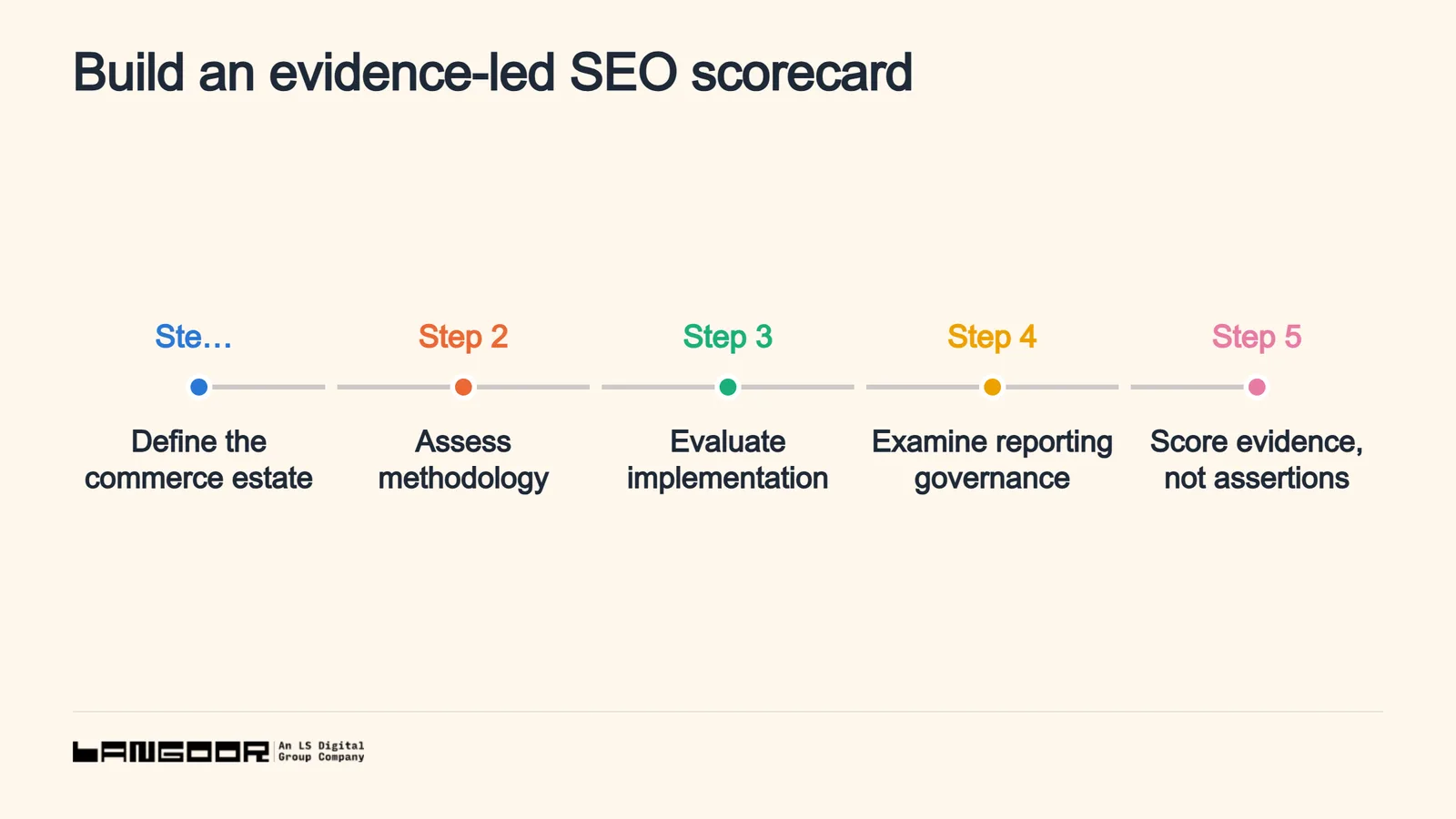
Five steps for assessing end-to-end SEO partners with transparent evidence.
Step 1: define the commerce estate
Document domains and subdomains, platforms, catalogue size, markets, languages, major templates, historic migrations, release cadence and known technical constraints. Include your first-party data sources and the conversion events that matter to the business. This creates a common baseline, so agencies do not make assumptions about the scale or shape of the opportunity.
Step 2: assess methodology and prioritisation
Ask providers to show how they move from audit findings to a quarterly roadmap. Strong responses explain how they estimate impact, effort, confidence, dependencies and risk. They should also explain how they will revisit priorities after releases, demand shifts or new evidence, rather than mechanically executing an initial task list.
Step 3: evaluate implementation and team access
Request a proposed RACI, meeting cadence and escalation route. Ask who will attend technical workshops, who can speak directly to developers and whether senior specialists will remain involved after the sales process. A programme that depends on a monthly account-management call is unlikely to keep pace with a fast-changing e-commerce estate.
Step 4: examine reporting and governance
The reporting approach should connect work completed, implementation status, organic performance and commercial context. Require the provider to separate controllable delivery measures - such as tickets submitted, resolved and QA-approved - from outcome measures that may be influenced by factors beyond SEO. Establish escalation triggers for major indexation loss, migration risk or tracking failures.
Step 5: score evidence, not assertions
Ask for anonymised examples of enterprise work with the original problem, constraints, actions, implementation pathway and measured outcomes. A useful case example will show trade-offs and setbacks, not just charts with unexplained growth. Also ask how the agency avoids practices that contravene Google’s spam policies for search, particularly when discussing links, scaled content or automated pages.
Compare packages and statements of work beyond deliverables
Two proposals may both promise an audit, keyword research, content briefs and monthly reporting, yet represent very different levels of accountability. The evaluation should focus on assumptions, access and execution pathways.
Use the following checklist when comparing statements of work:
Does the scope state the number and type of templates, categories, products and markets included?
Are technical recommendations limited to identification, or does the agency provide tickets, QA and post-release validation?
How are urgent issues, site migrations and unplanned releases handled?
Is content production included, and who supplies product expertise, approvals and publishing access?
Are data setup, dashboard development and attribution analysis included or excluded?
Which senior specialists are committed, how many hours are allocated and when are they available?
Is the cadence aligned with your sprint cycle and commercial calendar?
Are exclusions explicit, including development, copywriting, translation, digital PR, feed management or platform changes?
A lower-cost package may be appropriate when the client has a strong internal SEO, content and engineering operation. It is not equivalent to end-to-end support if it excludes the coordination needed to make recommendations real. Conversely, a broad package should clearly define where the partner’s accountability ends and where client approvals or platform limitations determine delivery speed.
Common procurement questions
What evidence should an enterprise e-commerce brand request before appointing an SEO provider?
Request a relevant case example, a sample technical audit, a prioritised roadmap, a reporting example, a proposed RACI and the biographies of the people who will work on the account. Ask for examples of release QA, migration support and complex indexation decisions. The most persuasive evidence shows repeatable execution across technical, content and analytical work - not an isolated ranking improvement.
How long should an evaluation process take?
Allow enough time for the provider to understand your site architecture, catalogue dynamics, data availability and internal constraints. A shortlisting process can move quickly, but selecting a partner without a structured discovery discussion invites mismatched assumptions. It is better to appoint against a clear 90-day mobilisation plan than against a generic monthly deliverables schedule.
Should we require guaranteed rankings or traffic targets?
No. Guarantees encourage superficial reporting and can obscure the variables that affect organic performance, including demand, inventory, competitor investment and site releases. Instead, agree on delivery commitments, implementation service levels, measurement definitions and the leading indicators that will inform future decisions.
Can an agency work effectively if development is outsourced?
Yes, provided governance is designed for it. The agency needs a route to technical stakeholders, a clear ticketing workflow, access to staging or release evidence where appropriate, and a named client owner who can resolve competing priorities. Without those conditions, even excellent SEO recommendations may not reach production.
Make the operating model the deciding factor
Large Indian e-commerce brands should assess SEO services by their ability to create an auditable chain from diagnosis to implementation to commercial learning. Technical audits, content briefs and dashboards matter, but their value depends on whether they improve category and product discovery across the full commerce estate.
Before issuing a brief, use Langoor’s evaluation scorecard to map your site complexity, internal implementation capacity, measurement requirements and governance gaps. When you are ready to define a partner model built around data intelligence and accountable delivery, explore Langoor’s digital services and turn that assessment into a practical SEO services brief.
You may also like this