September 4, 2026
Medini Mangala
Enterprise teams evaluating a performance marketing agency often receive similar promises: lower acquisition costs, more leads, better ROAS and faster scale. The harder question is whether the agency can show exactly how these outcomes will be governed, measured and improved when performance changes.
That distinction matters in digital marketing India, where audience scale, platform complexity and buying journeys vary sharply across sectors. India’s digital environment continues to expand, with hundreds of millions of internet users and substantial social media reach, while search, video, marketplaces, creator ecosystems and connected TV create more paths to conversion. More media choice does not automatically create more accountable growth.
The right performance marketing partner should not begin with channel recommendations or projected lead volumes. It should begin with the commercial outcome, the available data, the constraints around sales conversion and a clear operating model for optimisation. This guide provides a practical framework for making that assessment before expanding paid media investment.
Define the commercial outcome before choosing channels
A performance agency should be accountable for outcomes that matter to the business, not merely for media delivery metrics such as impressions, clicks or platform-reported conversions. Those indicators have value, but they are inputs to business performance rather than proof of it.
Before appointing an agency, agree on one primary commercial outcome and a small number of diagnostic metrics. The primary outcome should align with the company’s growth model, sales cycle and financial priorities. For a B2B enterprise, that may be qualified pipeline or sales-accepted opportunities. For a retail or D2C business, it may be profitable new-customer acquisition, revenue or repeat purchase.
| Commercial outcome | What the agency should optimise towards | Role of paid channels |
|---|---|---|
| Revenue | Incremental sales, revenue quality and contribution margin where data permits | Search captures high-intent demand; social and display create consideration; remarketing helps convert known audiences |
| Qualified pipeline | Marketing-qualified leads, sales-accepted leads, opportunities and pipeline value | Search supports active research; LinkedIn or other social platforms support account and role targeting; remarketing reinforces evaluation |
| Customer acquisition | New customers, acquisition cost and early customer value | Search captures demand; social tests new audiences and propositions; remarketing reduces abandonment |
| Repeat purchase | Reorder rate, customer retention and customer lifetime value signals | CRM audience activation, product reminders, loyalty messaging and dynamic remarketing become more important |
| Lead quality | Qualified-lead rate, contactability, sales acceptance and conversion to opportunity | Channel mix is secondary to targeting precision, forms, landing pages, lead validation and routing |
A worked example: qualified pipeline rather than lead volume
Consider an enterprise technology company selling a high-value solution with a six-month buying cycle. A media-focused agency might set a target of 2,000 form fills per month and report a falling cost per lead. However, if most respondents are students, small businesses outside the ideal customer profile or contacts with no active project, the apparent efficiency creates additional pressure on the sales team without improving pipeline.
A measurable performance engagement would define a qualified lead using firmographic, geographic and intent criteria. It would connect campaign-source data to CRM stages such as marketing-qualified lead, sales-accepted lead, opportunity and won revenue. The agency could then use search for solution-specific, high-intent terms; use professional social platforms to reach buying committees; deploy display selectively for account awareness; and use remarketing to bring known evaluators back to content or conversion pages.
The channel plan is therefore a consequence of the outcome, not the starting point. This is particularly important when evaluating the differences between B2B and B2C digital marketing, because a fast retail transaction and a multi-stakeholder enterprise purchase require different conversion definitions, creative journeys and reporting windows.
Compare agencies by their operating model, not media claims
Platform certifications, access to advertising tools and a list of channels can be useful signals, but they do not explain how an agency works when performance is uncertain. Enterprise buyers should assess the agency’s operating model: who owns decisions, how insight becomes action and how the team connects media activity with customer experience and sales outcomes.
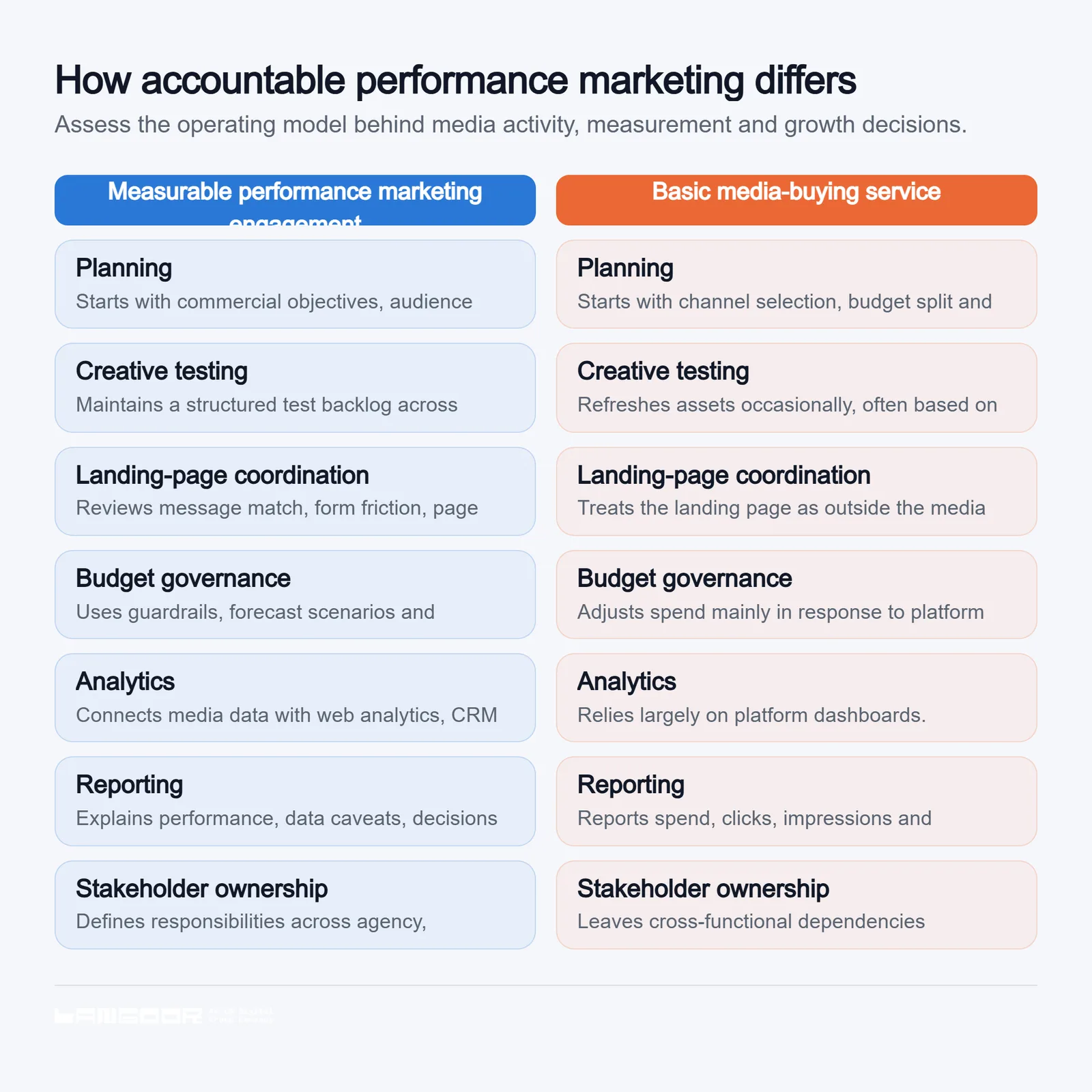
The table below distinguishes an accountable performance marketing engagement from a service focused primarily on buying media inventory.
Ask who owns the gaps between teams
Paid growth rarely fails because an ad platform cannot serve an impression. It more often loses value at the handoffs: a landing page loads slowly, a lead form does not match the offer, consent data is missing, sales does not follow up quickly enough or an executive cannot see pipeline quality by source.
A capable agency should identify these dependencies during discovery and document which team owns each one. It does not need to control every system, but it should be able to explain how media, analytics, marketing automation and CRM processes affect one another. For enterprises using nurture programmes, a strong understanding of marketing automation as a foundation for personalised digital marketing is especially relevant because paid leads often require coordinated follow-up before they are sales-ready.
Look for disciplined experimentation
Creative and audience testing should not be presented as a vague promise to “optimise continuously.” Ask the agency how it prioritises tests, what it considers a valid learning and how it prevents multiple simultaneous changes from obscuring the cause of a result.
For example, an agency may test one proposition against another within the same defined audience, then carry the winning message into a landing-page test. That creates a useful learning sequence. Changing targeting, bid strategy, creative and page design at the same time may change results, but it provides little confidence about why.
Inspect the attribution and measurement plan
No attribution model offers perfect certainty, particularly for enterprise purchases involving multiple sessions, decision-makers and offline sales conversations. The objective is not to claim that every conversion belongs to one channel. It is to build a transparent measurement framework that is consistent enough to guide investment decisions.
This requires early agreement on definitions, data sources and limitations. An agency that promises precise ROI before inspecting CRM fields, conversion tracking and sales processes should be challenged on its assumptions.
Use this measurement checklist
Define the conversion hierarchy. Document primary conversions, such as completed purchase or sales-accepted lead, and secondary conversions, such as demo requests, brochure downloads or pricing-page visits. Each conversion should have an owner, a clear event definition and a business rationale.
Map the required CRM and sales-data inputs. For lead generation, media data alone is insufficient. The agency should specify which CRM fields it needs, including lead source, campaign identifier, qualification status, opportunity value, disqualification reason and closed-won status where available.
Agree channel-attribution assumptions. Establish how the organisation will interpret platform attribution, web analytics attribution and CRM-sourced outcomes. Platform reporting can help optimise within a channel, but business reporting should acknowledge cross-channel influence, conversion lag and offline follow-up.
Specify dashboard views for different stakeholders. Marketing teams may need visibility into spend, conversion rate and audience performance. Sales leaders need lead quality, response time and opportunity progression. Executives need a concise view of commercial contribution, trends, risks and decisions required.
Build data-quality checks into the routine. Confirm that tags fire once, campaign naming is consistent, forms pass source parameters into the CRM and duplicate leads are handled correctly. Reconcile sample records from ad click to form submission, CRM creation and sales status before treating the dashboard as decision-ready.
Set a reporting cadence that matches the buying cycle. Weekly reviews should focus on delivery, experiment results and operational issues. Monthly business reviews should assess qualified pipeline, revenue signals, budget decisions and strategic changes. Longer sales cycles may also require cohort views that show how lead quality develops over time.
India’s transaction ecosystem can support more connected measurement for businesses with direct payment flows. The UPI ecosystem publishes ongoing transaction statistics, but enterprises should still avoid treating payment completion as the only measure of marketing value. New-customer status, refund behaviour, repeat purchase and contribution margin may materially change the interpretation of a campaign’s performance.
Test the optimisation process with a real scenario
The most revealing agency interview question is not “What ROAS can you deliver?” It is: “What would you do if spend increased, leads increased, but lead quality fell?” A credible answer should describe a sequence of diagnosis and decisions rather than a generic commitment to optimise.
Scenario: spend rises but lead quality declines
Imagine a financial-services enterprise increases monthly paid media spend by 30%. The campaign dashboard shows more leads and a stable cost per lead, but the CRM shows that fewer leads meet eligibility criteria and sales acceptance has declined.
The first step is to validate the data. The agency should check whether conversion tracking changed, whether CRM statuses are being updated consistently and whether duplicate or spam submissions have increased. It should also compare lead quality by campaign, audience, geography, device, placement, creative variation and landing page rather than diagnosing the account as one aggregate.
Next, the agency should review audience targeting. Expansion may have reached users outside the ideal profile, or automated targeting may have shifted delivery toward cheaper but lower-intent inventory. The response could include excluding weak segments, tightening geographic or demographic conditions where appropriate, building stronger first-party audience signals or separating prospecting from remarketing budgets.
Creative and offer quality should then be tested. An overly broad promise, such as “Get expert advice,” may attract more responses than a specific proposition that sets expectations around product fit, eligibility or intended customer type. Adding qualifying language can raise cost per lead while improving the rate at which leads become sales opportunities. That is often a rational trade-off.
Landing pages and forms are the next diagnostic layer. A short form may maximise completions but omit the information sales teams need to qualify interest. The team might test progressive profiling, clearer product information, eligibility questions or confirmation messaging that explains the next step. These changes should be evaluated against qualified-lead rate, not form completion alone.
Finally, inspect lead routing and follow-up. A genuinely qualified lead can look poor if it is routed slowly, assigned incorrectly or contacted after intent has faded. The agency should work with sales and marketing operations to monitor time to first contact, disposition quality and feedback loops. Budget should then be reallocated toward campaigns and audiences that produce stronger downstream signals, while controlled tests address the causes of underperformance.
Request proof that supports an enterprise buying decision
Case studies can be useful, but enterprise teams should be wary of evidence that presents impressive percentages without the context needed to assess relevance. A credible agency will be comfortable explaining the starting point, the limits of the engagement and the measurement method used.
Request approved, reviewable evidence rather than relying on a presentation claim. Where relevant to your sector and challenge, ask Langoor to share approved context around its Epson and Unilever work, including what can be disclosed about scope and delivery. The purpose is not to seek a copied playbook; it is to determine whether the agency can apply data intelligence, customer experience thinking and strategic innovation to a comparable level of complexity.
Evidence checklist for agency evaluation
Business challenge: What commercial problem was the client attempting to solve?
Timeframe: Over what period did the work run, and were there seasonal or market factors?
Channel scope: Which paid, owned and earned channels were within the agency’s responsibility?
Baseline: What was happening before the intervention, and how was that baseline established?
KPI definitions: How were leads, qualified leads, revenue, acquisition cost or return defined?
Measurement method: Which data sources informed the reported outcome, and what attribution assumptions applied?
Constraints: Were there limitations involving creative approval, website changes, inventory, CRM access or sales follow-up?
Optimisation story: What was tested, what did not work and what decision followed?
Client-review signals: Can the agency provide an appropriate reference, testimonial or account-team continuity evidence?
This type of evidence helps distinguish a repeatable operating capability from a one-time platform result. It also creates a more productive procurement conversation because both parties can discuss risk, dependencies and governance before contracts are signed.
Prepare the agency brief and first-quarter governance plan
An agency can only be accountable for what the enterprise has made possible to measure and influence. Before onboarding begins, internal teams should prepare a concise brief that gives the partner enough context to build an informed plan without turning discovery into a document-heavy exercise.
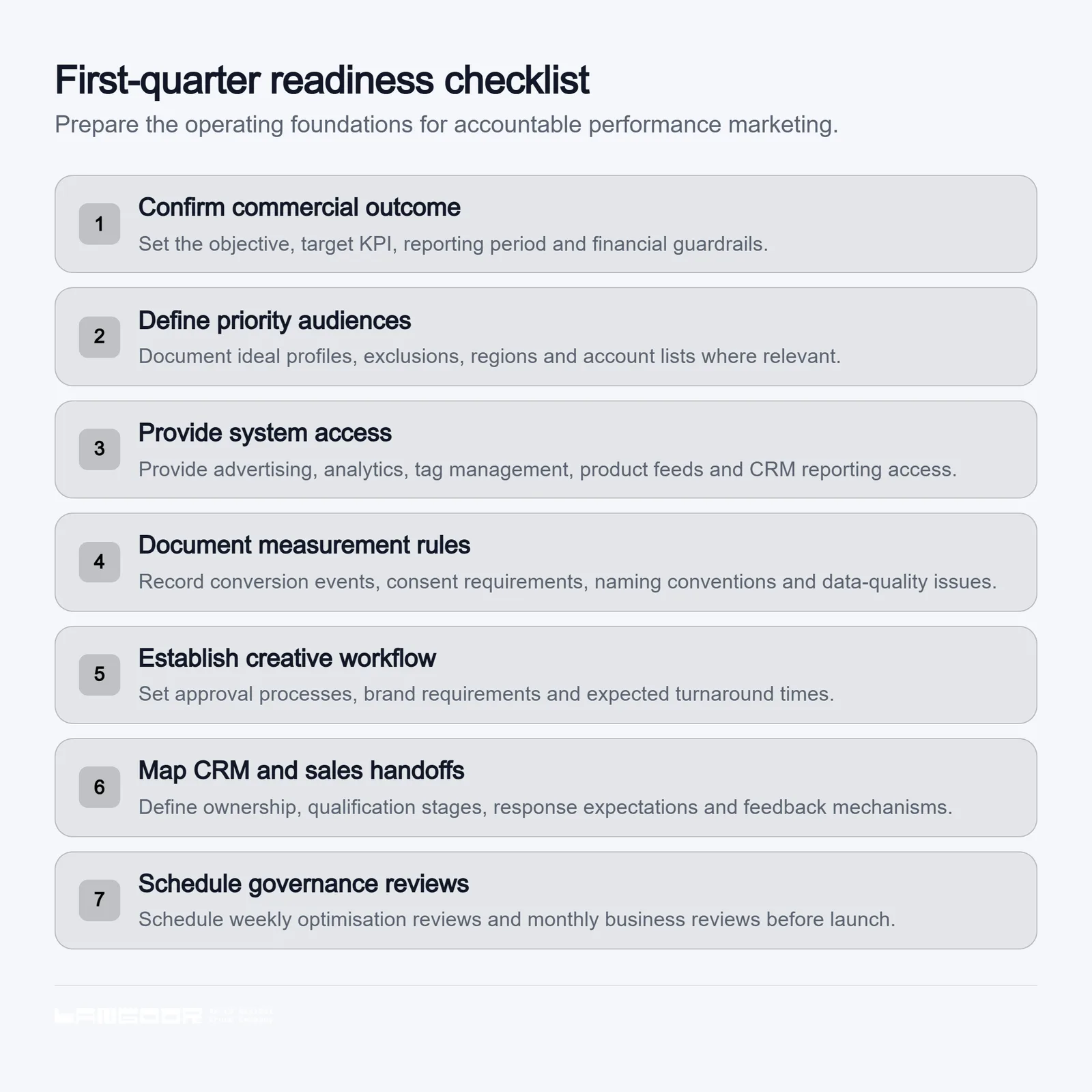
The first quarter should be treated as a learning and governance period, not simply a media-spend ramp. The agency should establish the measurement baseline, resolve tracking gaps, test priority propositions and audiences, and create a documented optimisation rhythm. This approach is more valuable than scaling quickly on weak signals.
Frequently asked questions
Should an enterprise choose the agency with the lowest projected cost per lead?
Not necessarily. A low cost per lead may indicate efficient demand capture, but it may also indicate weak qualification, broad targeting or a form that collects low-intent contacts. Compare agencies on their ability to report cost per qualified lead, sales-accepted lead, opportunity or customer, depending on your commercial model. The appropriate cost benchmark is the one connected to valuable business outcomes.
How long should we allow before evaluating performance?
The answer depends on conversion lag, media spend, data volume and sales-cycle length. Weekly reviews can identify tracking failures, delivery problems and early creative signals, while monthly reviews can assess meaningful shifts in lead quality and channel allocation. For long-cycle B2B demand generation, pipeline cohorts may need several months to mature before final ROI is known.
Can AI-driven advertising remove the need for measurement governance?
No. AI can improve bidding, creative production and audience signals, but it still relies on the quality of the conversion data and objectives supplied to the platform. Google has highlighted AI-powered advertising capabilities for Indian businesses, yet enterprise teams remain responsible for defining valuable conversions, validating outputs and protecting brand and data standards.
Choose a partner that can explain the system behind the result
The best performance marketing agency for an Indian enterprise is not the one that makes the boldest ROI promise. It is the one that can explain how paid growth will be connected to commercial outcomes, how the data will be validated, what will happen when quality shifts and who will own each decision.
Before increasing media investment, assess your current measurement, reporting and optimisation model alongside the agency’s proposed operating framework. Talk to Langoor about building a paid-growth model grounded in data intelligence and accountable decision-making rather than platform metrics alone.
Evaluate operating discipline, not channel claims.
You may also like this