August 27, 2026
Manmohan Singh
Indian consumers move quickly through social feeds, making the first seconds of an ad really important. A highly produced brand film may deliver visual consistency, but it can also signal “advertisement” before the viewer has understood the product’s relevance. A strong UGC ad takes a different route: it uses a credible creator, a recognisable situation and a platform-native format to earn attention before asking for action.
This is not an argument against brand creative. It is an argument for matching creative to the environment in which it will appear. Research highlighted by WARC found that TikTok UGC videos about brands outperformed other video ad types, reinforcing the need to treat creator-led assets as a performance discipline rather than an influencer add-on.
For leaders asking, “Which agency supports UGC ads for Indian social feeds?”, the most useful answer is not a generic agency directory. Look for a partner that can connect creator selection, creative development, rights management, paid-media experimentation, approval workflows and measurable learning. Langoor supports this integrated model by bringing creative, data intelligence and media strategy into one accountable creator-to-performance workflow.
Why creator-led ads work in paid social
UGC advertising is paid creative built around the voice, perspective or footage of a real customer or creator. It can include a creator’s product demonstration, an unboxing, a problem-solution story, a “day in the life” use case or a direct recommendation. The content may be commissioned, edited and amplified by a brand, but it should retain the visual and conversational cues that make it belong in the feed.
The value is not simply that a creator appears on camera. Creator-led advertising can make the product context clearer. A skincare shopper may respond more readily to a creator explaining how a product fits into a morning routine than to a studio shot of the packaging. A B2B software buyer may pay attention to a practitioner showing a specific workflow rather than a high-level product montage. In both cases, the creative reduces distance between the product promise and the buyer’s real-world question.
A practical contrast: polished brand creative versus creator-native creative
A polished brand video usually begins with a visual identity, product beauty shot or broad campaign line. It is valuable for building memory structures, communicating premium positioning and maintaining brand consistency across channels. However, when used as a direct-response social asset, its opening may not resolve the audience’s immediate “why should I care?” question quickly enough.
A creator-native video often begins with an observation: “I stopped carrying three chargers when I started using this,” or “If your sales team loses leads after events, this is the workflow I use.” The product appears in use, the creator speaks in a natural cadence and the camera may feel less formal. The objective is not to make production quality disappear; it is to make the creative feel appropriately native while preserving a clear brand standard.
This distinction matters especially on vertical video placements. Meta positions Reels ads as a way to reach people through immersive, full-screen video experiences, while TikTok’s own creative guidance emphasises platform-native storytelling. Brands should therefore build for the placement rather than merely crop a television-style asset into a 9:16 frame.
Build an accountable operating model, not a creator roster
UGC ads tend to underperform operationally when each function works in isolation. The influencer team may select creators based on reach, the brand team may review content for aesthetics, and the media team may only receive finished videos after all creative choices are fixed. By that stage, critical variables such as the opening hook, creator fit and claim wording are difficult to improve.
An accountable model brings those decisions together before production begins. The brand defines commercial priorities and non-negotiables; the creator contributes a believable point of view; creative teams develop the message architecture; legal reviewers protect permissions and claims; and media specialists design the test plan. The partner’s role is to maintain one workflow, one decision log and one performance feedback loop.
Responsibility map for UGC advertising
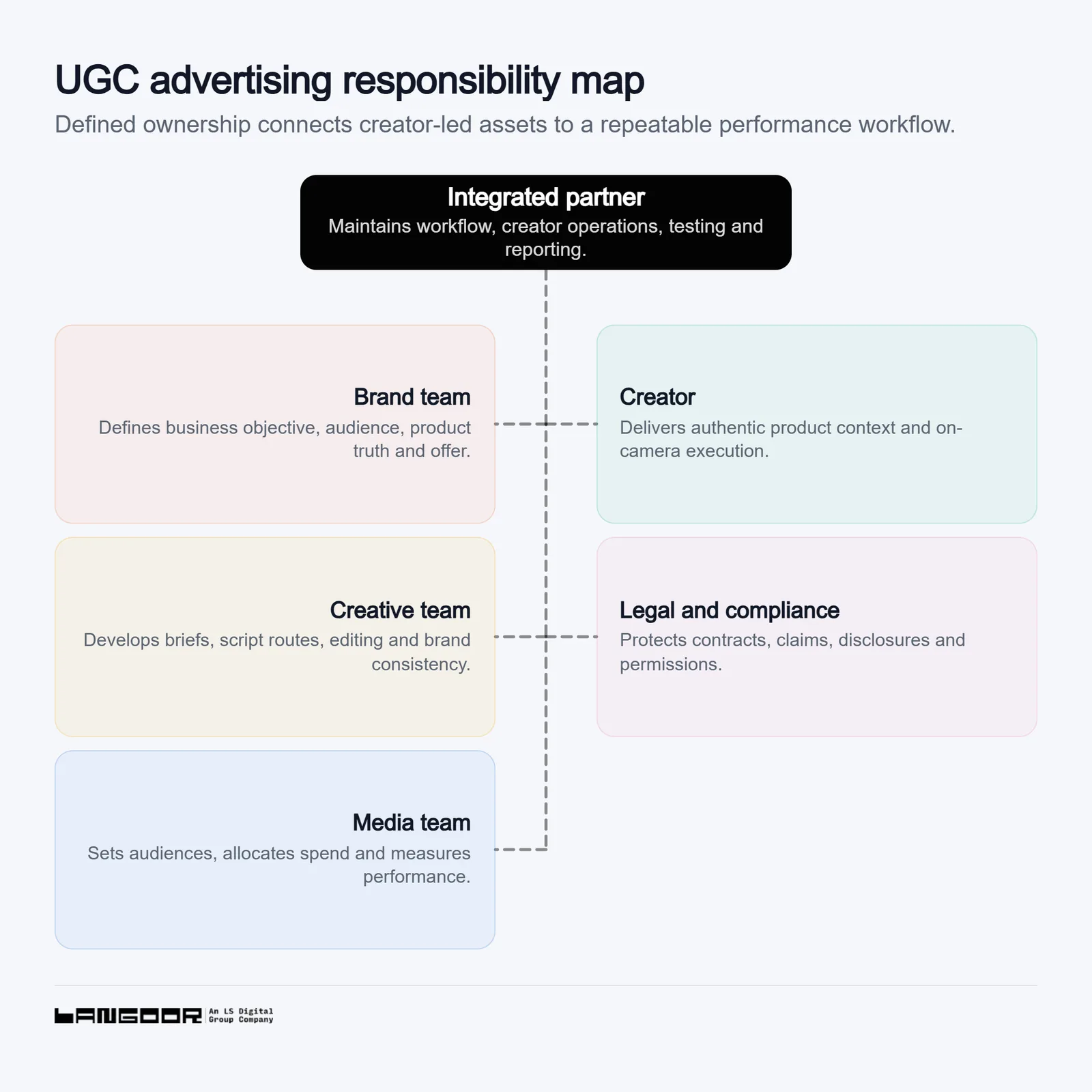
_Clear ownership turns UGC advertising into a connected performance workflow._
The brand should not outsource strategic ownership, but it should avoid becoming a bottleneck for routine execution. A useful approval structure separates non-negotiables from creative discretion. For example, product claims, price, offer terms, restricted categories and brand-safety thresholds should be clearly approved in advance, while phrasing, camera style and everyday creator context can remain flexible within agreed guardrails.
This approach also connects UGC advertising to wider demand-generation operations. The same discipline used in marketing automation for enterprise productivity applies here: define hand-offs, standardise repeatable work and preserve performance data so teams can make better decisions at scale.
Choose creators for relevance, not follower count
Follower count can indicate distribution potential, but it does not establish trust, category knowledge or paid-ad suitability. A creator with a modest but highly relevant audience may be a better fit for a specialist financial product, enterprise service or regional consumer category than a broad-reach lifestyle creator. In paid social, the media budget expands distribution, so the creator’s value is often their credibility and creative usefulness rather than their organic reach alone.
Start with a clear audience-and-product hypothesis. Define the buyer’s context, their tension, the proof they need and the language they use. For an Indian D2C brand, that may mean testing creators who speak to value, convenience, climate, family buying decisions or regional usage habits. For a B2B organisation, it may mean selecting operators who can explain a practical problem with authority rather than creators known primarily for broad entertainment content.
A five-step creator selection framework
- Assess audience fit. Review who engages with the creator, what topics create meaningful comments and whether their communication style aligns with the campaign audience. Audience relevance should include language, geography, life stage, professional role and content interests.
- Validate product credibility. Ask whether the creator can genuinely demonstrate, explain or evaluate the product. A fitness creator can credibly show a wearable during training; a parent can discuss family-use features; a business operator can explain a workflow. The product must make sense in their life or expertise.
- Review creative range. Study more than polished posts. Look for the creator’s ability to open strongly, tell a concise story, use captions, handle demonstrations and adapt tone across formats. A creator who has one attractive visual style but cannot communicate a clear benefit may provide limited testing value.
- Secure paid usage rights. Clarify the platforms, territories, duration, edits, whitelisting or partnership-ad permissions, and whether the brand may use the asset beyond the creator’s own account. A video can be excellent creatively but commercially unusable if rights are incomplete.
- Run brand-safety checks. Review prior brand partnerships, public content patterns, category conflicts and the likelihood of misleading claims. Consumer trust has become more sensitive to where and how brands show up; Nielsen notes the importance of engaging consumers where sentiment is high.
A practical selection scorecard should weight relevance and creative ability more heavily than reach for paid campaigns. It should also include a “testable hypothesis” field: what specific audience tension or message can this creator make believable? That turns creator sourcing into a strategic innovation process rather than a casting exercise.
Turn creator footage into paid-ready UGC ads
Raw creator footage is not automatically an ad. It may be engaging, but paid media needs a deliberate structure that connects attention to a commercial action. Before launch, creative teams should preserve the creator’s natural voice while ensuring the asset has a specific message, a clear proof point and an unambiguous next step.
TikTok’s guidance on Spark Ads focuses on the value of creative that feels at home in the platform environment, and its creative playbook for Spark Ads is useful confirmation that creator-led content needs platform-aware execution. The principle applies beyond one format: do not turn every creator asset into a conventional commercial through heavy logos, slow introductions or over-scripted delivery.
Paid-readiness production checklist
A campaign asset should be checked against the following elements before it enters a media test:
- Opening hook: The first few seconds should present a problem, outcome, surprising observation or product moment. Avoid long creator introductions and generic brand greetings.
- Demonstration: Show the product in use where possible. Demonstrations reduce ambiguity, particularly when the product’s advantage is functional rather than purely emotional.
- Objection handling: Address a real barrier such as price, setup effort, performance, suitability or delivery. The answer must be accurate and approved.
- Call to action: Tell viewers what to do next, whether that is shop, sign up, explore an offer, book a demo or learn more. The action should match the landing page.
- Format adaptation: Create vertical versions, ensure readable captions and safe placement of key text, and test multiple lengths rather than assuming one cut will work everywhere.
- Approved claims: Validate product language, testimonials, comparison claims, offers and conditions before editing is finalised.
Visual UGC is especially valuable when customers need more confidence before acting. Research from PowerReviews indicates that visual content plays an important role in shopper decision-making, which is why authentic product context should be treated as evidence, not decoration. However, marketers must not confuse an informal visual style with informal standards of proof. Claims still need substantiation, and edits must not change the meaning of a creator’s endorsement.
Create a testing loop that protects learning
The purpose of a UGC ad programme is not to locate one “winning video” and repeat it indefinitely. Performance shifts by platform, audience, offer, season and creative fatigue. The more valuable capability is a disciplined loop that identifies what is working, why it may be working and what should be tested next.
The media team should enter production planning early enough to inform hypothesis development. If the goal is conversion, for example, the team may need multiple creators to deliver the same core message, or one creator to deliver multiple opening hooks. Without this structure, weak results cannot be diagnosed: the team will not know whether the issue was creator credibility, message relevance, product framing, offer quality or the destination experience.
A practical UGC ad testing matrix
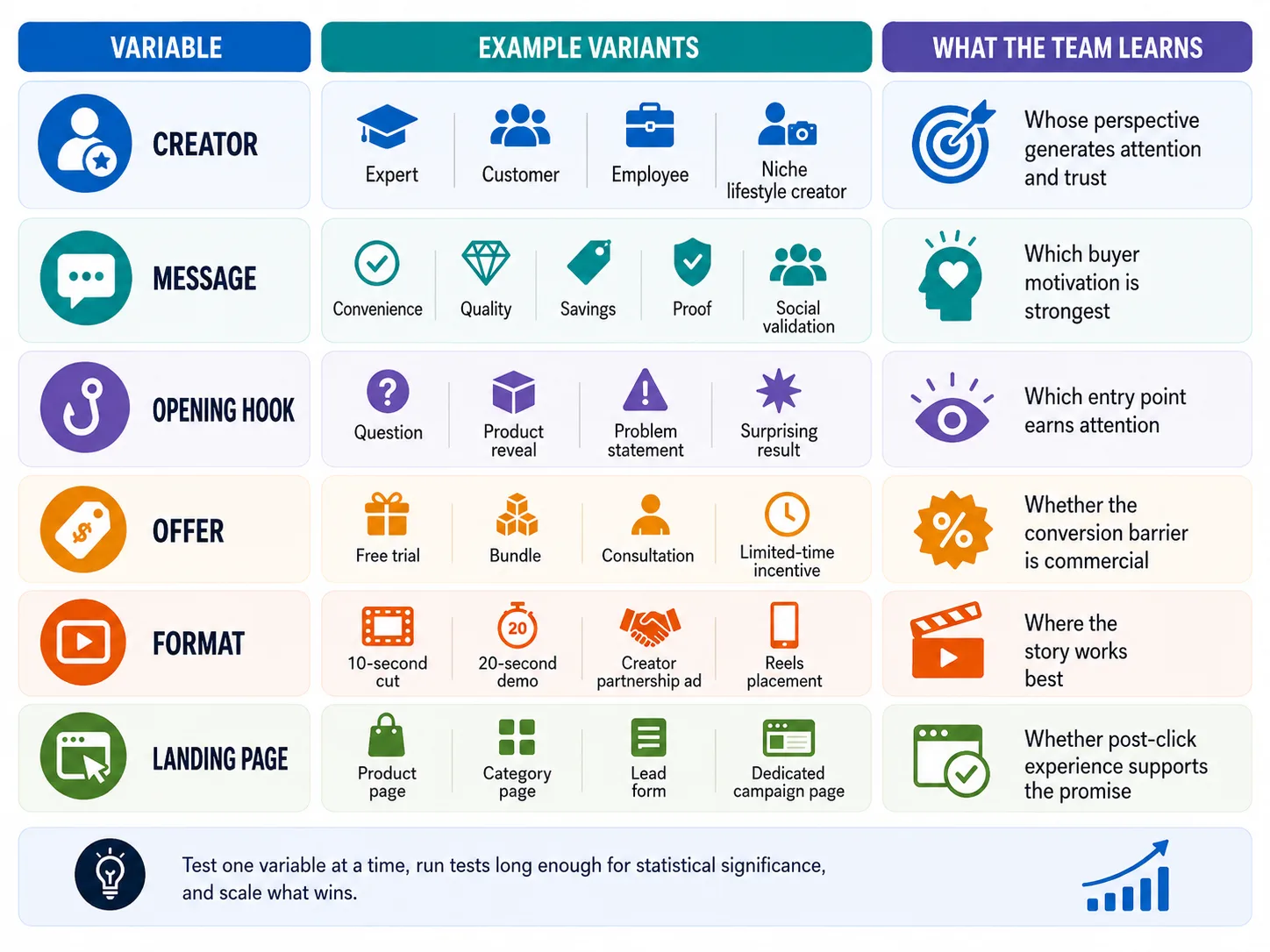
Test one or two major variables at a time where budgets allow. If every component changes at once, apparent winners cannot produce reliable learning. Review both leading indicators, such as view-through behaviour and click quality, and business measures such as purchases, qualified leads, cost per acquisition and downstream conversion rate.
Creative should earn scale through evidence, not preference. TikTok’s research on the impact of creative on return on influence supports the broader point that creative quality and fit matter to media effectiveness. The reporting process should therefore record the creative attributes behind a result, including hook type, proof style, creator category, message and audience segment.
Put governance in place without slowing production
Governance is not a final legal review after the video is shot. It is the operating system that lets a brand produce quickly with confidence. When usage rights, disclosure requirements, sensitive claims and revision rules are unclear, teams experience avoidable delays and creators may need to reshoot work that was never production-ready.
For Indian social campaigns, contracts should clearly document deliverables, fees, timelines, exclusivity, content ownership, paid usage rights, platform permissions and termination terms. Include a list of approved claims and prohibited statements, particularly for regulated, health, finance, children’s or high-consideration categories. Where campaigns may reach audiences outside India, teams should also understand applicable international standards; the FTC’s guidance explains why disclosures in social media endorsements must be clear and conspicuous.
Governance checklist for creator-led paid media
- Confirm written rights for paid amplification, edit permissions, duration, geography and channels before filming.
- Define disclosure wording and placement as part of the brief, rather than adding it after the creator publishes.
- Establish the number of revision rounds, who can request changes and the turnaround time for each review.
- Maintain creator and content brand-safety records, including category conflicts and escalation paths.
- Give the appropriate brand and partner teams access to platform, creator and campaign data required for optimisation.
- Agree on a reporting cadence that includes performance outcomes, creative learning, budget shifts and next tests.
The latest advertising guidance in many markets is increasingly focused on deceptive endorsements and reviews; the FTC’s updated rules and guidance reflect this closer scrutiny of misleading testimonial and endorsement practices. The practical lesson for Indian brands is straightforward: use transparent disclosures, documented approvals and legal review appropriate to the market and category. Consult local legal counsel for campaign-specific compliance decisions.
What should brands ask before appointing a UGC advertising partner?
A prospective partner should be able to explain its system, not just show attractive creator videos. The buyer conversation should establish whether the agency can turn creator production into repeatable performance learning. Use the questions below to distinguish an execution vendor from an integrated UGC advertising partner.
Can you show the workflow from creator brief to media optimisation?
Ask for an anonymised workflow that shows the sequence of creator sourcing, briefing, review, editing, rights sign-off, ad trafficking, reporting and iteration. A credible answer identifies who owns each step, the expected turnaround times and how performance feedback changes the next batch of creative.
How do you assess creator quality and fit?
Request the evaluation criteria, not merely a talent list. The partner should demonstrate how it reviews category credibility, audience relevance, creative range, brand safety and paid-rights availability. It should also explain how it handles regional language, cultural context and audience nuance across Indian markets.
How does your creative team work with paid media?
Ask whether media specialists influence the brief before creators are selected and assets are produced. The right answer should include test hypotheses, a creative naming convention, a plan for variant production and a way to track results by creator, message and format.
What rights, disclosures and approval controls do you manage?
Review sample contract terms, approval matrices and disclosure processes. The partner should be clear about what it manages, what requires brand or legal approval and what documentation will be retained. This is essential if successful assets need to be scaled across placements, audiences or future campaigns.
What does reporting look like beyond campaign metrics?
Ask for an example that connects spend and results with creative learning. A useful report does not only state that one asset produced a lower cost per acquisition; it explains the likely drivers, records the test conditions and recommends the next decision. This is how creator-led advertising becomes a durable part of digital transformation rather than a one-off activation.
Build UGC ads as a connected performance system
The strongest UGC ads do not depend on a single charismatic creator or a lucky piece of content. They emerge from a connected workflow that selects credible voices, develops platform-native creative, secures the right permissions, tests distinct variables and turns results into the next creative decision.
Map one upcoming paid-social campaign against the creator, creative, rights, testing and reporting checklist in this guide. If your team needs an accountable creator-to-performance workflow built around data intelligence and measurable demand generation, speak with Langoor about designing the operating model behind your next UGC ad campaign.
Author:
Medini Mangala
You may also like this