August 3, 2026
Manmohan Singh
AI Overview
Enterprise SEO refers to SEO strategy and execution for large organisations — typically those with 500+ employees, complex website architectures, multiple stakeholders, and high-volume content operations. Enterprise SEO in India in 2026 must account for Core Web Vitals at scale, multi-language content for regional markets, AEO for AI search, and GEO for LLM citation, all coordinated across cross-functional teams. B2B SaaS enterprise SEO delivers an average 702% ROI with a 7-month break-even, and SEO leads close at 14.6%, 8.6x higher than outbound marketing.
Introduction
Enterprise SEO is not standard SEO to run at a larger scale. It is a fundamentally different discipline, one where the primary constraints are not keyword opportunity or content quality, but coordination, governance, and the sheer operational complexity of managing search visibility across thousands or millions of pages, multiple languages, dozens of departments, and a technology infrastructure that makes even straightforward changes a multi-team effort.
For India's large enterprises, Tata group companies, Infosys, Wipro, HDFC, Mahindra, and the hundreds of mid-to-large organisations below that tier, this complexity is the reason organic search chronically underperforms relative to domain authority and budget. Technical foundations are inconsistent. The content architecture lacks structure. Regional language content is an afterthought. And AI search visibility, the new frontier of organic discovery, is largely unaddressed.
This guide is the enterprise SEO playbook for Indian organisations in 2026. It covers technical foundations at scale, keyword and content architecture, authority building, AEO for AI Overviews, regional and international SEO, and the measurement framework that translates organic search performance into language the C-suite can act on.
Key Takeaways
- Enterprise SEO delivers 702% average ROI for B2B SaaS, with an 8–20x return at 36–48 months, the highest long-term ROI of any marketing channel (First Page Sage 2026 / OwlClaw Benchmarks)
- SEO leads close at 14.6% vs 1.7% for outbound marketing, an 8.6x advantage that makes organic traffic the highest-quality lead source for Indian enterprises (HubSpot / SEOProfy 2026)
- Organic search drives 76% of all trackable B2B website traffic and contributes 44.6% of total B2B revenue (Oliver Munro B2B SEO Statistics 2026)
- 60% of digital leaders cite execution at scale as their biggest enterprise SEO obstacle, not strategy, not budget (GTM 8020 Enterprise SEO Statistics 2026)
- 76% of Google AI Overview citations come from pages already ranking in the top 10 — traditional SEO is the foundation for AI search visibility (GTM 8020 2026)
- AI search traffic has grown 527% year over year, and AI visitors are 4.4x more valuable than standard organic visitors, enterprise SEO must now include AEO/GEO alongside traditional rankings (GTM 8020 2026)
- India-specific technical challenges, shared hosting latency, missing hreflang for regional languages, absent GST schema, affect Core Web Vitals and trust signals in ways that generic global enterprise SEO frameworks do not address
What makes enterprise SEO different from standard SEO?
The difference between standard SEO and enterprise SEO is not simply one scale; it is one of categories. Standard SEO is primarily a strategy and content challenge: identifying the right keywords, creating the right content, and building the right links. Enterprise SEO is all of that, and also a coordination, governance, and infrastructure challenge that most SEO frameworks are not built to address.
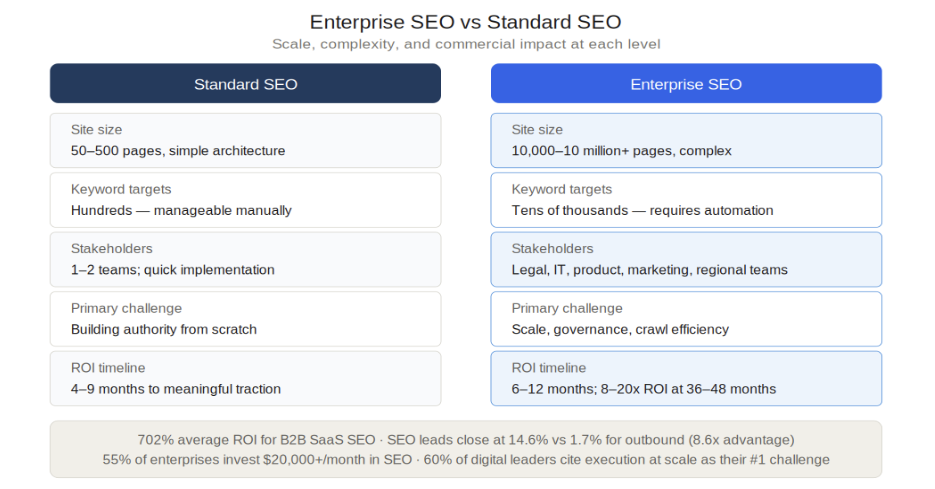
The defining characteristics of enterprise SEO for large Indian organisations:
- Scale: Enterprise sites manage 10,000 to 10 million+ pages. Even a 0.5% improvement in crawl efficiency, page speed, or internal linking on a site of this size translates to millions of incremental organic sessions annually. But the same scale means that errors, misconfigured robots.txt, a canonical tag error on a large URL set, a JavaScript rendering issue, also propagate across millions of pages before anyone notices.
- Multi-stakeholder coordination: Unlike a startup where one person controls the CMS, technical infrastructure, and content calendar, enterprise SEO requires coordination across legal (for compliance content), IT and engineering (for technical changes), product (for feature page content), regional marketing teams (for language and localisation), and external agency partners. Each change requires approvals, testing, and deployment cycles that can take weeks or months.
- Technology constraints: Enterprise sites are typically built on complex, sometimes legacy CMS platforms, SAP Commerce, Adobe Experience Manager, custom-built systems, where SEO recommendations must compete with product roadmaps and engineering sprints for implementation priority. The SEO team's ability to execute is bounded by the technology team's capacity to implement.
- Commercial accountability: Enterprise marketing leadership is accountable to the board for return on marketing investment. Enterprise SEO must be measured not just in traffic and rankings but in pipeline contribution, revenue influence, and CAC, the language of commercial performance.
The 2026 context adds a further dimension: AI search. Google AI Overviews, ChatGPT Search, and Perplexity are now discovery surfaces that large Indian enterprises must optimise for alongside traditional search rankings. 76% of AI Overview citations come from pages already ranking in Google's top 10, meaning strong traditional enterprise SEO is the prerequisite for AI search visibility, not an alternative to it.
Running a large Indian enterprise website with inconsistent organic performance? Langoor's enterprise SEO audits identify the specific technical, content, and governance gaps holding your organic visibility back, benchmarked against category competitors. Request an enterprise SEO audit at langoor.com/contact →
Technical SEO at scale: Crawl budget, indexation, and Core Web Vitals for large sites
Technical SEO is the non-negotiable foundation of enterprise search visibility. Without it, content excellence and link authority cannot be fully realised, because search engines cannot efficiently discover, render, and index the pages those investments produce. At enterprise scale, technical SEO is not a one-time audit task. It is an ongoing operational discipline.
The three technical pillars that matter most for large Indian enterprise sites:
- Crawl budget management: Googlebot allocates a finite crawl budget to each domain based on site authority and crawl demand. For enterprise sites with hundreds of thousands of pages, mismanaging crawl budget, by allowing search engines to crawl low-value paginated URLs, faceted navigation combinations, session parameters, or staging environments, means high-value pages are crawled less frequently. The fix is systematic: block low-value URL patterns via robots.txt and canonical tags, use XML sitemaps segmented by page type to prioritise priority pages, and audit Google Search Console's crawl stats weekly to identify waste.
- Core Web Vitals at enterprise scale: Core Web Vitals: Largest Contentful Paint (LCP), Interaction to Next Paint (INP), and Cumulative Layout Shift (CLS), are both ranking factors and user experience signals. For Indian enterprise sites, the most common Core Web Vitals failure modes are: hosting servers located in Singapore or the US producing Time to First Byte exceeding 1,800ms from Indian user locations (fix: CDN nodes in Mumbai, Chennai, or Delhi); unoptimised images above the fold causing LCP failures (fix: WebP/AVIF formats, lazy loading); and third-party scripts loading synchronously and blocking INP (fix: defer non-critical JavaScript). Enterprise sites must track Core Web Vitals at page-type level, homepage, product pages, blog, category pages, and prioritise fixes based on traffic volume and commercial importance of each page type.
- JavaScript rendering and indexation: Large enterprise sites increasingly use JavaScript frameworks: React, Angular, Vue, for their front-end. If JavaScript is not correctly rendered by Google's crawler, key page content may not be indexed. Enterprise teams should implement server-side rendering (SSR) or dynamic rendering for SEO-critical content, validate rendering in Google Search Console's URL Inspection Tool, and maintain an ongoing rendering audit that flags JavaScript indexation issues before they affect rankings at scale.
An India-specific technical SEO consideration: hreflang implementation for regional language content. With 156% year-over-year growth in Indian regional language content demand in Tier 2 and 3 cities, large Indian enterprises are increasingly producing content in Hindi, Tamil, Telugu, Kannada, and Bengali. Without correct hreflang tags, specifying which language version to show each user, Google cannot determine the correct version to serve, causing ranking dilution between language variants. This is one of the most consistently under-executed technical SEO tasks in Indian enterprise sites.
Keyword strategy for enterprises: Pillar-cluster architecture
The keyword strategy that works for a 50-page website, target one keyword per page, optimise each page individually, does not scale to enterprise SEO. With thousands of pages and tens of thousands of potential keyword targets, enterprise SEO requires a systematic content architecture that distributes topical authority efficiently and ensures no pages compete against each other for the same queries.
The pillar-cluster architecture is the structural solution that large Indian enterprises should use for their content strategy:
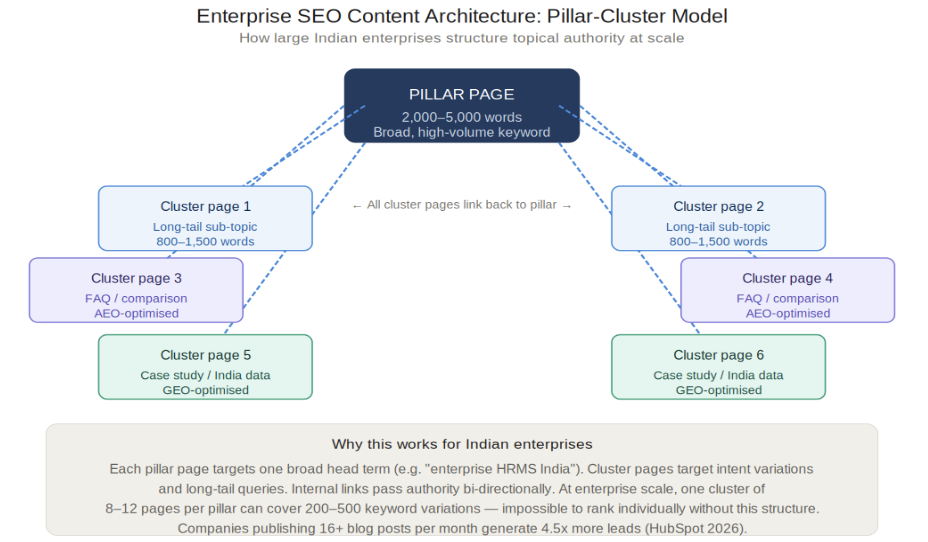
How the pillar-cluster model works for Indian enterprise sites:
- Pillar pages (2,000–5,000 words): Target one broad, high-volume head keyword per pillar, e.g., 'enterprise HRMS India', 'B2B logistics software', 'core banking modernisation'. The pillar page is the comprehensive, authoritative guide to that topic. It answers the primary query and links to all related cluster pages. This is the page that should rank for the head term and earn the most internal link equity from the cluster.
- Cluster pages (800–1,500 words each): Each cluster page targets a specific intent variation or long-tail sub-topic of the pillar. For 'enterprise HRMS India', clusters might include 'HRMS implementation checklist India', 'payroll compliance HRMS software India', 'HRMS integration SAP India', and 'HRMS for manufacturing companies India'. Every cluster page links back to the pillar, passing authority upward while capturing long-tail search volume.
- AEO and GEO pages within the cluster: Within the cluster, specific pages should be purpose-built for AI extraction. FAQ pages with FAQPage schema, comparison pages with table content, and case study pages with named Indian client outcomes serve both search rankings and AI citation. These pages feed Google AI Overviews, People Also Ask boxes, and LLM responses simultaneously.
At enterprise scale, one cluster of 8 to 12 pages per pillar can cover 200 to 500 keyword variations, the range of queries that would be impossible to rank for individual page-by-page targeting. A large Indian enterprise with 20 distinct product or service pillars can systematically build topical authority across its entire offering through 200 to 240 well-structured pages, each serving multiple queries.
The implementation discipline that makes pillar-cluster work at scale: quarterly content audits that identify which cluster pages are underperforming and should be updated, merged, or retired; a content brief template that enforces the correct internal linking structure for every new piece; and a keyword assignment system that prevents multiple pages from targeting the same primary term (cannibilisation).
Content operations at scale: How to produce SEO content consistently
Content is the engine of enterprise SEO. But producing high-quality, keyword-mapped, India-specific content consistently, across multiple topics, personas, and languages, is an operational challenge that strategy alone cannot solve. Enterprise content operations require systems, not just talent.
The content operations infrastructure that high-performing Indian enterprises use:
- Editorial calendar tied to keyword priority, not campaign calendar: Content topics should be selected based on keyword opportunity, search volume, competitive gap, and commercial relevance, not on what the marketing team wants to promote this quarter. A keyword-driven editorial calendar, updated quarterly based on Search Console data and competitor analysis, ensures every piece of content produced earns organic visibility rather than being published into a void.
- AI-assisted content at scale with human editorial oversight: AI content tools (ChatGPT, Claude, Gemini) can reduce content production time by 60 to 70%, enabling enterprise teams to produce 4x more content at the same cost. The non-negotiable requirement is human editorial oversight, an experienced editor who adds India-specific insight, named examples, proprietary data, and brand voice that AI cannot generate. Content that reads as generic AI output earns neither reader trust nor AI citations.
- Original research as a content anchor: The enterprise content assets that earn the most organic links, AI citations, and media coverage are not the pillar guides or cluster pages; they are original research reports. An annual India B2B Digital Marketing Benchmark Report, a BFSI Technology Adoption Survey, or a Manufacturing Sector SEO Study creates citation-worthy content that other publications reference, AI systems cite, and sales teams use as a credibility asset. Enterprise brands with the resources to conduct and publish original research build content moats that smaller competitors cannot replicate.
- Content governance and style guide: At enterprise scale, content is produced by multiple teams, departments, and external agencies. Without a governance framework, brand voice guidelines, India-specific content standards, SEO brief templates, editorial approval processes, the content output becomes inconsistent in quality, tone, and structure. A shared content style guide and brief template is the operational infrastructure that keeps content quality consistent as volume scales.
Link authority for enterprise brands: Building topical authority without spammy tactics
Enterprise sites typically begin SEO programmes with significant existing domain authority, built through years of operation, press coverage, and natural link acquisition. The challenge for enterprise link building is not starting from zero but directing that authority toward the specific pages and topic clusters that need it, while continuing to build new, high-quality links that reinforce category authority.
The link building and authority strategies that work for large Indian enterprises:
- Digital PR and earned media: Press coverage in The Economic Times, Business Standard, Mint, YourStory, and sector-specific publications generate high-authority links and, critically, AI citation inputs. Enterprise marketing leadership should treat digital PR as an SEO investment, not just a brand function. A single feature article in The Economic Times Brand Equity generates more link authority than dozens of guest posts on mid-tier blogs.
- Original research as a link magnet: Industry reports, salary surveys, market sizing studies, and benchmark reports earn natural links from publications that cite the data. For Indian enterprises, research specifically focused on India market data earns disproportionate link value, because India-specific statistics are underrepresented in available research, making your data uniquely citable.
- Partner and ecosystem link building: Enterprise companies have partnership networks, technology vendors, channel partners, industry associations, regulatory bodies, that represent legitimate, high-quality link opportunities. A structured partner link programme that requests and tracks mutual link placements from these established relationships is consistently underutilised by Indian enterprise marketing teams.
- Content-led link acquisition: Tools, calculators, benchmarking assessments, and interactive content that other sites want to link to as a useful resource. For Indian B2B enterprises, an EMI calculator, a compliance checklist, or a market sizing tool for a specific industry vertical can earn natural links from media, consultants, and partner sites that reference it as a utility.
What enterprise link building should avoid: paid link schemes, private blog networks, reciprocal link exchanges, and mass guest posting on low-authority sites. Google's algorithms are sophisticated enough in 2026 to identify these patterns at the domain level, and for enterprise brands with significant existing authority, the reputational and algorithmic risk is disproportionately high relative to any short-term ranking benefit.
Need to build category authority through PR and link acquisition? Langoor's enterprise digital PR team produces original research, earns media coverage in Tier 1 Indian publications, and builds the link authority that makes enterprise SEO compound. Talk to Langoor about enterprise link strategy at langoor.com/contact →
AEO for enterprise: Winning AI Overviews at scale
AI search visibility is no longer a future concern for Indian enterprises; it is a present competitive reality. Google AI Overviews appear on 25 to 40% of Google searches, ChatGPT processes queries from 100 million weekly active users in India, and Perplexity AI users in India grew 640% year-over-year in 2025. Enterprise brands that do not systematically optimise for AI citation are ceding discovery to competitors who do.
The relationship between traditional SEO and AEO at the enterprise level is reinforcing, not competing. 76% of Google AI Overview citations come from pages already ranking in Google's top 10, which means the technical foundations, content authority, and link equity that enterprise SEO builds directly improve AI citation probability.
AEO implementation at enterprise scale requires:
- Answer block templates in content briefs: Every content brief produced at the enterprise level should include a mandatory 40–60-word direct answer block at the top of each page and each major section. Implemented as a brief template requirement rather than a page-by-page editorial decision, this ensures AEO formatting is consistent across hundreds of pages without requiring individual review.
- FAQ Page schema at scale: Enterprise sites should implement FAQ Page schema on every pillar page, cluster FAQ page, and product/service page. At scale, this requires integration with the CMS or a schema management tool that can deploy and update FAQ Page schema programmatically rather than manually. Enterprise sites with 1,000+ pages implementing FAQ Page schema manually will not maintain it, the tooling must automate it.
- E-E-A-T governance: Named author attribution, verified credentials, and sameAs schema linking (to LinkedIn, Wikipedia, or Wikidata) should be implemented across all content that enterprise brands want cited by AI. This requires a contributor database, a managed list of approved authors with their credentials, profile links, and schema markup, maintained as part of the content operations infrastructure.
- AI citation monitoring: Enterprise brands should track their AI citation rate, how often their brand appears in ChatGPT, Perplexity, Gemini, and Google AI Overviews for their category queries, as a standard metric alongside traditional search visibility. Tools like Evertune, Brandlight, and Semrush AI audit enable this tracking at the scale required for enterprise keyword sets.
International and regional SEO for Indian enterprises
Large Indian enterprises face a search visibility challenge that most global SEO frameworks are not calibrated for: the simultaneous need to rank in English for business buyers across India, Southeast Asia, the Middle East, and Western markets, while also serving a rapidly growing domestic audience that increasingly searches in Hindi, Tamil, Telugu, Kannada, Marathi, and Bengali.
The regional language opportunity is significant and underserved. India's regional language internet users are growing at 156% year-over-year, predominantly in Tier 2 and 3 cities where English-language content does not adequately serve buyer intent. Enterprise brands that build regional language content programmes in 2026 are entering a low-competition, high-growth search environment.
- Hreflang implementation: Correct Hreflang tags are the foundational technical requirement for serving multiple language versions without ranking dilution. For Indian enterprises with Hindi and English content, Hreflang must specify en-IN and hi-IN for the respective pages. Errors in Hreflang implementation, the most common being incorrect language-region codes, missing self-referencing hreflang, or inconsistent bidirectional linking, cause Google to treat language variants as duplicate content rather than localized versions.
- ccTLD, subdomain, or subfolder structure: Indian enterprises targeting international markets face a site structure decision: use a .com domain with country/language subfolders (recommended for most enterprises, consolidates domain authority), separate ccTLDs per market (.in, .ae, .sg), or subdomains. The subfolder approach (langoor.com/in/, langoor.com/ae/) is generally preferable for enterprises that want to consolidate link authority while maintaining separate content programmes for each market.
- Hosting and CDN for Indian performance: Indian enterprise sites serving content from servers in Singapore or the US face Time to First Byte latency exceeding 1,800ms for domestic users, a direct Core Web Vitals failure. CDN deployment with nodes in Mumbai, Chennai, Delhi, and Hyderabad is the infrastructure investment that makes the performance difference. For enterprise sites with significant Tier 2 and 3 city traffic, this infrastructure investment has immediate ranking impact on mobile-first Core Web Vitals.
Measuring enterprise SEO performance: The metrics that matter to the C-suite
Enterprise SEO measurement fails when it reports what is easy to measure, impressions, rankings, traffic, rather than what the C-suite needs to make investment decisions: revenue, pipeline, and return capital deployed. Building a measurement framework that connects organic search activity to commercial outcomes is the highest-leverage action an enterprise SEO team can take to secure long-term budget and executive support.
The enterprise SEO measurement framework for Indian organisations:
- Organic revenue attribution: Connect organic traffic to closed-won revenue through CRM and GA4 integration. Tag all organic-sourced leads with UTM parameters, track their progression through the CRM pipeline, and report the total value of revenue closed that originated from organic search. For Indian enterprises using Salesforce or HubSpot, this integration is achievable within weeks and transforms the SEO budget conversation from 'we increased traffic' to 'we generated Rs. X crore in pipeline.
- Pipeline influenced by organic: Beyond first-touch attribution, track the total pipeline value of deals that had at least one organic search touchpoint, whether the first, middle, or last interaction. This multi-touch view gives enterprise marketing leadership a more complete picture of organic search contribution to revenue, particularly for B2B deals with long, multi-stakeholder sales cycles.
- Competitive share of voice: What percentage of total organic visibility across your category keyword set does your brand own versus competitors? Tools like Semrush, Ahrefs, and BrightEdge calculate this metric automatically for defined keyword sets. Share of voice is a leading indicator of future traffic and pipeline that is more strategically informative than absolute ranking positions.
- AI citation frequency and share of AI voice: As AI Overviews and ChatGPT-cited answers become an increasingly significant discovery surface, tracking how often your brand appears in AI-generated answers for your category queries is a new, essential enterprise SEO metric. Set a baseline, track monthly, and report the trend quarterly alongside traditional search visibility.
- Technical health score: A composite measure of Core Web Vitals passes rate (% of URLs in 'Good' threshold), crawl efficiency (% of pages crawled within 30 days), index coverage (% of intended pages indexed), and schema coverage (% of eligible pages with correct schema). This single composite score allows enterprise leadership to track technical SEO health immediately rather than interpreting dozens of individual technical metrics.
Struggling to show the C-suite what enterprise SEO is actually contributing? Langoor builds end-to-end attribution frameworks that connect organic search to pipeline and revenue, giving Indian enterprise marketing leaders the commercial narrative to justify and grow their SEO investment. Book a measurement framework consultation at langoor.com/contact →
Conclusion
Enterprise SEO is a long-game investment that compounds aggressively once the technical foundation is in place. The ROI evidence is unambiguous: 702% average return for B2B SaaS, 8 to 20x return over 36 to 48 months, a 14.6% lead close rate that outperforms every other acquisition channel. Indian enterprises that commit to content architecture, technical hygiene, AEO signals, and regional language optimisation in 2026 will build search moats that smaller competitors cannot replicate regardless of budget.
The 2026 addition to the enterprise SEO mandate is AI search visibility. AI Overviews, ChatGPT, and Perplexity are now discovery surfaces that Indian enterprise buyers use actively. 76% of AI citations come from pages already in Google's top 10, which means the enterprise SEO investment made today is also the AI search investment that pays compound dividends in 2027 and 2028.
The brands building this capability now will own the organic and AI-generated search of real estate in their categories before their competitors have even audited their crawl budget. The window to build compounding advantage is open, but as citation authority builds over time, first movers will be the hardest to displace.
Ready to build an enterprise SEO programme that connects to revenue? Langoor has built enterprise SEO programmes for large Indian and global organisations across BFSI, enterprise technology, manufacturing, and professional services, growing marketing-sourced pipeline from organic search by 4x in 9 months for one B2B SaaS client. We begin every engagement with a comprehensive enterprise SEO audit that benchmarks your current performance against category leaders and identifies the highest-impact opportunities. Get in touch with the Langoor enterprise SEO team today at langoor.com/contact →
Frequently Asked Questions
1) What is enterprise SEO?
Enterprise SEO is the practice of building and managing organic search visibility for large organisations, typically those with 500+ employees, websites with 10,000 or more pages, multiple stakeholder teams, and complex technology infrastructure. Unlike standard SEO, which focuses primarily on content and link building, enterprise SEO must also address crawl budget governance, technical SEO at scale, multi-language and regional content, cross-departmental coordination, and revenue-connected measurement. Enterprise SEO in India in 2026 also requires AEO and GEO capabilities, ensuring large organisation content earns citations in Google AI Overviews, ChatGPT, and Perplexity alongside traditional search rankings.
2) How is enterprise SEO different from regular SEO?
The core difference is complexity at scale. Standard SEO manages dozens to hundreds of pages, one or two content producers, and relatively simple technology. Enterprise SEO manages thousands to millions of pages across complex CMS platforms, coordinates multiple departments and external agencies, implements technical changes through engineering sprints rather than direct CMS access, and must attribute organic performance to revenue in language the C-suite understands. Enterprise SEO also requires dedicated crawl budget management, a technical discipline that is irrelevant for small sites but critical for enterprise-scale domains where Google's crawl allocation determines which pages get indexed.
3) How do large organisations manage content for SEO on scale?
Large organisations manage SEO content through a combination of pillar-cluster content architecture (one comprehensive pillar page per core topic, supported by 8 to 12 cluster pages covering related intent variations), AI-assisted content production with human editorial oversight (reducing production time by 60 to 70% while maintaining quality), a keyword-driven editorial calendar updated quarterly, and a governance framework that includes brief templates, style guides, and editorial approval processes. At enterprise scale, content quality consistency requires systems, not individual talent, because multiple teams, departments, and agencies are producing content simultaneously.
4) What are the most important technical SEO factors for enterprise websites?
The most critical technical SEO factors for Indian enterprise websites in 2026 are: crawl budget management (ensuring Google prioritises your most valuable pages rather than wasting crawl allocation on low-value URLs); Core Web Vitals performance (particularly LCP and INP scores on mobile, the majority of Indian search traffic is mobile); JavaScript rendering health (especially for enterprise sites built on React, Angular, or Vue frameworks); Hreflang implementation for regional language content (Hindi, Tamil, Telugu, Kannada, and Bengali); and India-specific schema markup including GST registration numbers and INR price specification. These factors interact; a technically healthy site with good Core Web Vitals scores is also more likely to be cited by Google AI Overviews.
5) How long does enterprise SEO take to show results?
Enterprise SEO typically shows early measurable improvements in rankings and organic traffic within 3 to 6 months of technical and content foundation work. Revenue impact becomes clear between 6 and 12 months, depending on sales cycle length and the competitive landscape. With full ROI realisation, the compounding returns from sustained content authority and technical excellence, typically emerges over a 24-to-48-month horizon. Enterprise SEO ROI benchmarks from OwlClaw show 8 to 20x return at 36 to 48 months, with B2B SaaS averaging 702% ROI and a 7-month break-even period from First Page Sage's 2026 research. The brands that build patiently through the compounding window are the ones that make organic search an unassailable competitive advantage.
You may also like this