September 19, 2026
Manmohan Singh
For enterprise marketing leaders, the challenge is rarely finding digital marketing companies in Bangalore. The harder task is identifying a partner that can connect brand strategy, demand generation, media, creative, website experience, marketing automation and measurement into one growth system.
This matters in a market where digital investment is accelerating. India’s advertising market was projected to grow by 7.8% in 2025, increasing the pressure on marketing teams to demonstrate not just channel activity, but commercial impact. Bangalore’s technology ecosystem also gives enterprises access to specialist talent, platforms and vendors - yet that abundance can easily create a fragmented operating model.
The strongest agency selection process therefore begins with a business problem and a customer journey, not an agency’s service menu. This guide provides a practical framework for choosing an integrated digital marketing partner built around your organisation’s growth priorities.
Identify the business problem behind the agency brief
Before reviewing credentials or requesting proposals, define the growth problem the partner must solve. “We need SEO, paid media and social campaigns” is a description of possible tactics, not a strategic brief. It leaves every vendor free to recommend the services they already sell best, rather than the capabilities your organisation genuinely needs.
Start by categorising the challenge across five areas:
| Business challenge | Typical symptom | What a marketing partner should help diagnose |
|---|---|---|
| Awareness | Low recognition in priority accounts or markets | Audience reach, brand distinctiveness, category entry points and media strategy |
| Demand generation | Traffic or engagement does not translate into qualified pipeline | Audience targeting, content value exchange, account prioritisation and nurture design |
| Conversion | High acquisition cost or weak enquiry-to-opportunity rates | Landing-page experience, proposition clarity, lead routing and conversion optimisation |
| Retention and expansion | Existing customers are under-engaged or difficult to grow | Lifecycle communications, customer education, advocacy and personalised journeys |
| Digital experience | The website does not support customer or business goals | Information architecture, content design, accessibility, personalisation and analytics |
A B2B technology enterprise, for example, may believe it has a paid-media problem because cost per lead is rising. The deeper issue could be that its campaign promise is too broad, its landing pages do not explain the product’s business value, or sales teams do not receive enough context to follow up effectively. In that case, simply appointing another media specialist is unlikely to improve pipeline quality.
A credible partner should challenge a narrow channel-led brief when the evidence points elsewhere. This is particularly important for complex buying journeys, where a buyer may move between search, analyst content, webinars, product pages, sales conversations and peer recommendations before a commercial decision. Teams can use Langoor’s guide on the difference between B2B and B2C digital marketing to clarify why enterprise marketing requires more than applying consumer-campaign tactics to a longer sales cycle.
Build a problem statement that creates accountability
A useful brief contains a measurable outcome, a priority audience, a known constraint and a decision horizon. For instance: “Increase qualified opportunities among mid-market manufacturing firms in South India within two quarters, while improving the conversion rate of high-intent product-page visitors.”
That statement is more valuable than “improve digital presence” because it establishes what the partner must investigate, influence and report. It also gives procurement, sales, product and marketing teams a common definition of success. The aim is not to eliminate uncertainty before appointing a partner; it is to ensure the partner is solving the right uncertainty first.
Map the customer journey and channel roles
Integrated marketing does not mean using every available channel. It means assigning each channel a distinct role in helping the customer progress from an unmet need to a confident decision. The customer journey should determine the channel mix, creative format, content depth and measurement logic.
Consider an illustrative journey for an enterprise cybersecurity provider seeking to build demand among CIOs and IT leaders:
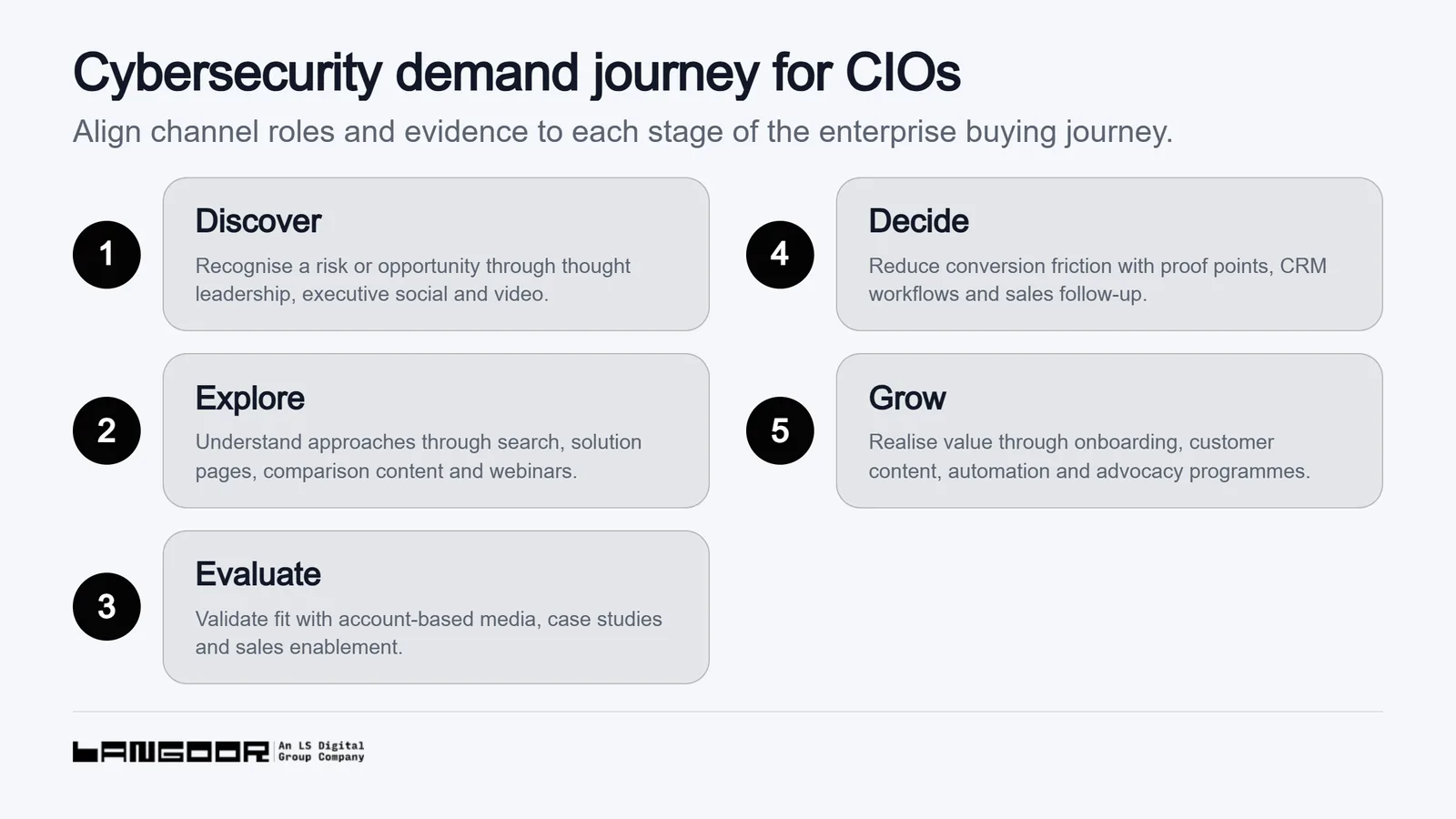
Search can capture active demand, but it cannot independently create preference among buyers who have not yet recognised the urgency of a problem. Social channels can distribute expertise and help build familiarity, while paid media can sequence relevant messages to defined audiences. The website must then convert attention into understanding and action, rather than functioning as a disconnected corporate brochure.
Marketing automation connects these touchpoints by recognising behaviour and orchestrating appropriate next steps. For example, someone downloading a technical guide may need a follow-up invitation to a specialist webinar, whereas a visitor repeatedly viewing pricing or implementation pages may need a prompt sales response. This is why marketing automation is central to personalised digital marketing: it allows teams to treat engagement as journey intelligence rather than a collection of isolated leads.
Bangalore enterprises should also account for the pace of digital change in India. The State of Digital Marketing in India 2025-26 highlights an environment in which marketers must continuously adapt their digital investment and capability choices. A partner should be able to turn that complexity into a coordinated operating plan, not merely add more platforms to the stack.
Evaluate strategic capability before execution capacity
Execution strength matters, but it should be assessed after determining whether an agency can shape the right strategy. A channel vendor can competently manage campaigns, produce assets or optimise a website component while still lacking the ability to connect those outputs to a shared audience model, proposition and commercial target.
| Channel delivery focus | Integrated planning focus |
|---|---|
| “Which campaign assets are needed?” | “Which audience, need state and proposition should the campaign address?” |
| “How can media cost per lead improve?” | “What is the relationship between media quality, website experience, lead qualification and revenue?” |
| “What content should be published this month?” | “What content can move decision-makers through the buying journey?” |
| “Which dashboard should be built?” | “Which indicators should guide investment and business decisions?” |
| “Which platform feature can be activated?” | “Which data, process and experience changes are required for the desired customer outcome?” |
During agency conversations, ask for examples of how the team has formed audience insight. Strong answers should reference research, first-party data, sales interviews, behavioural analysis or customer feedback - not only platform targeting options. The team should also show how it develops and tests a proposition that is relevant to a defined market segment.
Ask how measurement is designed before a campaign launches. An integrated partner should explain the relationship between commercial outcomes, leading indicators and data availability. If a prospective agency begins with an activity calendar before asking about revenue goals, audience economics, CRM stages and customer experience, it may be optimised for production volume rather than strategic innovation.
Questions that reveal strategic depth
Use the proposal process to test the team’s thinking, not just its case-study library. Ask prospective partners to explain what they would need to learn in the first month before finalising the channel plan. Their response should demonstrate intellectual discipline: clear hypotheses, assumptions to validate, stakeholders to involve and data gaps to address.
Also ask what they would stop doing. Every enterprise has legacy campaigns, underused content and technology workflows that consume budget without creating meaningful value. A capable partner should be prepared to recommend trade-offs, protect investment in high-value work and identify activity that no longer supports the growth objective.
Assess delivery across experience and campaigns
Enterprise growth programmes fail when campaign activity promises an experience the website, landing page, sales process or customer journey cannot deliver. The partner you choose needs enough breadth to coordinate experience and campaign delivery, whether those services are delivered in-house or through clearly governed specialist teams.
Use the following checklist during evaluation:
Website and experience: Can the team assess information architecture, user journeys, accessibility, content structure, performance and conversion friction? Do they understand that a website is a commercial experience, not simply a design project?
Landing-page optimisation: Can they align campaign messages with page content, proof, form design and relevant calls to action? Can they test hypotheses without creating disconnected page variants?
Creative and content: Can they develop a consistent idea across executive thought leadership, social content, video, paid assets, email and on-site experiences?
Media and distribution: Can they plan reach, demand capture, retargeting and account-level engagement around the same audience priorities?
Marketing operations: Can they work with CRM, analytics, consent, lead-management and automation teams to ensure campaign engagement produces usable business intelligence?
The most useful proof is often process evidence. Request an anonymised example showing how the agency coordinated a campaign launch across creative, media, web development and marketing operations. Look for practical details: who owned the launch checklist, how tracking was validated, how feedback was routed, what happened when an asset or page underperformed, and how sales teams were prepared to respond.
This approach is more informative than asking whether an agency “offers integrated services.” Many digital marketing companies in Bangalore can list a broad range of capabilities. Fewer can demonstrate the governance needed to make those capabilities operate as one customer experience. For a deeper view of this relationship, see Langoor’s perspective on building a website conversion system rather than a standalone website.
Define measurement and governance upfront
Measurement should be an agreement about decisions, not a monthly reporting exercise. Before work begins, marketing leaders should align the partner and internal stakeholders on what outcomes matter, which signals will indicate progress and who has authority to act on the findings.
A practical measurement brief can include the following:

A measurement brief turns reporting into a shared decision framework.
Attribution should be treated with appropriate caution. Enterprise buying journeys frequently involve multiple people, channels and offline interactions, so no dashboard can prove that one touchpoint alone created all revenue. The goal is to combine outcome metrics with directional evidence that improves decisions over time.
For example, if investment in executive social content increases engaged visits from priority accounts, and those accounts subsequently show stronger opportunity creation, that is useful evidence even if the platform is not credited as the final conversion source. A good partner will communicate the limits of the available data while still creating a disciplined learning agenda.
Governance also protects speed. Establish a single cross-functional client team with representatives from marketing, sales, digital experience, data and legal where necessary. Define approval timelines, escalation paths and the distinction between routine optimisation and decisions that require leadership intervention. Without these agreements, even excellent strategy can be delayed by unclear ownership.
Run a practical selection process
A fair process should allow agencies to demonstrate thinking while avoiding unpaid speculative work that cannot be properly researched or implemented. It should also give your internal team enough structure to compare different proposals consistently.
1. Create a longlist and capability screen
Begin with a longlist based on relevant enterprise experience, sector understanding, strategic capability, technology fluency and evidence of integrated delivery. Bangalore’s position as a technology centre, described by Startup Genome as India’s tech capital and a global innovation powerhouse, means marketers have access to many credible specialists. The objective is not to select the most familiar brand, but to identify partners suited to your operating reality.
Narrow the list through a short capability questionnaire. Ask about team structure, senior strategic involvement, analytics capability, relevant client experience, data-security practices, technology partnerships and the proportion of delivery performed by the proposed team. This prevents a pitch team from being assessed separately from the people who will do the work.
2. Hold a discovery workshop with shortlisted partners
Invite two or three shortlisted agencies to a paid working session. Share a concise business context, selected customer data, existing performance information and stakeholder perspectives. Ask each team to identify questions, risks, priorities and a preliminary approach - not to present fully designed campaign concepts.
Evaluate the workshop against a scorecard covering problem framing, quality of questions, audience understanding, journey thinking, measurement design, collaborative style and delivery realism. This reveals more than a polished pitch deck because it shows how the team works with ambiguity and cross-functional input.
3. Review proposals and check references
Request comparable proposals with an agreed scope, named team, delivery model, assumptions, investment structure, 90-day plan and measurement approach. Look closely at dependencies: a proposal that promises revenue outcomes while excluding website changes, CRM access or sales alignment may be commercially attractive but operationally weak.
During reference checks, speak with current or recent clients rather than relying only on curated testimonials. Ask how the agency dealt with setbacks, how senior leaders remained involved, whether reporting led to decisions, and whether the team could coordinate with internal technology and sales stakeholders. The most valuable reference feedback concerns consistency under pressure, not just the success of a flagship campaign.
Plan the first 90 days
The first quarter should establish a repeatable foundation while generating enough evidence to make informed investment decisions. Avoid expecting an agency to overhaul brand, website, media, content and automation simultaneously. A phased programme produces better learning and reduces the risk of scaling unproven assumptions.

A phased first quarter builds evidence for better investment decisions.
Days 1-30: Discover and align
The partner should audit available performance data, customer journeys, content, media activity, website conversion paths and marketing operations. It should interview relevant marketing, sales, product and customer-facing stakeholders, then consolidate findings into a prioritised set of growth opportunities.
By the end of this phase, the team should have an agreed audience definition, a problem statement, a measurement baseline, an operating cadence, and a list of data or experience constraints. This is also the right time to establish tracking conventions and resolve lead-stage definitions that would otherwise compromise reporting.
Days 31-60: Prioritise and pilot
Select one or two focused initiatives that can test the central growth hypothesis. An example could be a campaign and landing-page pilot for a high-value industry segment, supported by relevant content, paid distribution and a tailored nurture workflow. The pilot should be substantial enough to generate a learning signal, but contained enough to be adjusted quickly.
Set explicit thresholds before launch. Decide what level of engagement, conversion quality, sales acceptance or account activity would justify expanding the approach. This prevents teams from interpreting every result after the fact and keeps the pilot connected to the original business objective.
Days 61-90: Learn, improve and decide what scales
At the end of the quarter, evaluate both results and operating performance. Did the audience respond to the proposition? Did the website and lead process support the campaign? Were decisions made quickly enough? Which dependencies prevented progress, and what should be fixed before more budget is allocated?
The outcome may be to scale the pilot, refine it for another segment, redesign a weak journey stage or pause an assumption that did not hold. This is productive progress. A mature digital partner makes evidence visible and helps leadership direct resources toward the next best decision.
FAQ about digital marketing companies in Bangalore
What should enterprise teams look for in digital marketing companies in Bangalore?
They should look for a partner that can connect business objectives, customer journeys, channel execution, measurement and governance, rather than offering disconnected services.
How should an enterprise compare digital marketing companies in Bangalore?
Use a consistent process: assess strategic depth, run a discovery workshop, review the proposed team and 90-day plan, and check references for evidence of accountable delivery.
Turn the objective into a partner brief
The best choice among digital marketing companies in Bangalore is not automatically the largest agency, the most specialised vendor or the team with the most impressive creative portfolio. It is the partner that can understand your business problem, design around the customer journey, coordinate the required capabilities and operate with measurable accountability.
Before beginning outreach, convert your current objective into a one-page partner brief. Include the priority audience, journey challenge, capabilities required, evidence you expect to see, operating constraints and measurement expectations. That brief will lead to more relevant proposals, better workshops and a partnership built for integrated growth.
For organisations ready to combine data intelligence, customer experience and strategic innovation, Langoor’s digital expertise can help translate complex marketing requirements into connected growth programmes.
You may also like this