Search engine optimisation for Google often gets reduced to a list of technical jobs: add keywords, update titles, fix links, repeat. That view misses the commercial point. Search works when a brand helps people find the right answer, product, or service at the moment they are looking for it.
This case study outlines Langoor’s structured approach to improving organic discoverability for a confidential client engagement. Client-specific metrics, rankings, traffic volumes, timelines, and conversion figures were not supplied for publication, so none are claimed here. The outcomes discussed are limited to documented directional and operational improvements: clearer priorities, a more coherent search plan, and a stronger basis for ongoing measurement.
The work started with a simple business question: which search journeys mattered most, and what stopped the website from serving them well? That question shaped every decision that followed.
Search engine optimisation Google: the business challenge was discoverability, not just rankings
The client needed a stronger digital presence in Google Search, but the challenge was broader than gaining positions for a set of keywords. Users were likely arriving with different levels of knowledge and different needs. Some wanted early-stage information. Others wanted to compare options or find a clear route to an enquiry, purchase, or conversation.
That was the starting point. The engagement focused on making the website easier for both people and Google to understand, while keeping the client’s business priorities in view.
The starting point: a site without a clear search role for every page
The initial review treated the website as a collection of search entry points rather than a digital brochure. Each page had to answer a practical question: who is this page for, what are they trying to do, and why should Google return it for that search?
The review looked for confirmed gaps across four areas:
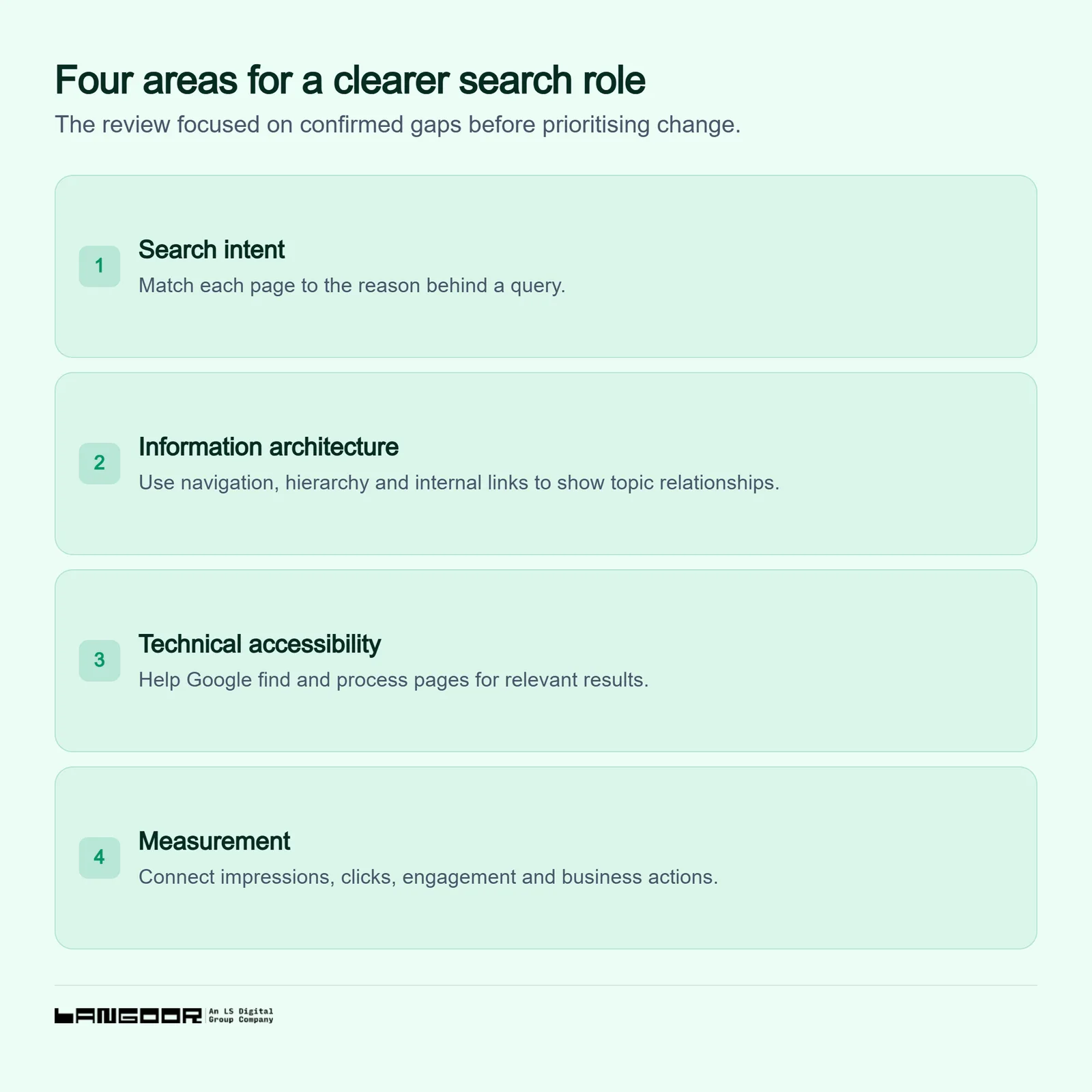
A structured review begins with the gaps that can be confirmed.
Diagnosing the opportunity before making changes
Langoor’s approach began with evidence, not a preset task list. Search behaviour, existing page coverage, technical signals, and business priorities were reviewed together. That matters because a high-volume query has little value if it brings the wrong audience or leads visitors away from the client’s commercial goals.
The team mapped priority topics to stages of the user journey. Early research queries called for useful explanatory content. Evaluation queries needed clearer service, solution, or category pages. Pages close to a decision needed direct next steps and enough detail to remove doubt. The more closely a page matched the searcher’s task, the more useful it could be.
Technical work followed the same discipline. Google recommends that site owners make pages crawlable, use descriptive titles and links, and create people-first content rather than content built only to attract visits. Those principles are set out in Google’s SEO starter guide and guidance on helpful content. No trickery. Just clarity.
The strategy connected content, structure, and measurement
A focused search optimisation programme works best when each workstream supports the next, with clear guidance about SEO. Langoor grouped the activity into connected areas rather than treating content, technical work, and reporting as separate projects.
Topic and page mapping
The first workstream assigned priority search themes to the right page types. Existing pages could be improved where they already had a clear purpose. Gaps called for new or expanded content only where the search need aligned with the client’s business offer.
It also gave content teams a usable brief: audience need, page goal, related questions, internal-link targets, and the action a reader should take next.
Site structure and on-page clarity
The second workstream focused on helping users and Google make sense of the site. Clear headings, descriptive titles, logical page paths, and internal links reduce friction. Internal links are not decorative; they show relationships between pages and help users continue their research.
Measurement tied to business questions
The third workstream joined Google Search Console data with Google Analytics reporting. Search Console can show how a site performs in Google Search, while Analytics helps teams understand what people do after arriving.
The reporting view should answer more than “did traffic rise?” It should show which pages gained impressions, which queries produced clicks, where engagement changed, and whether priority landing pages moved users towards meaningful actions.
What execution looked like in practice
The work moved in a sensible order. High-confidence issues with clear user or search impact came before lower-priority refinements.
For each priority page, the team would review the page’s purpose, likely intent, heading structure, title, supporting copy, calls to action, and internal links. Content teams need room to write naturally, but the page still needs a defined job. One page should not try to explain a broad topic, sell every service, and answer every FAQ at once. It becomes mush.
Collaboration mattered here. Search recommendations had to fit the client’s brand, content approval process, technical release cycle, and analytics setup, while giving teams clear guidance about SEO. Some changes may require developers; others sit with marketing teams. A useful agency partner does not hand over a spreadsheet and disappear. It helps teams decide what to do first and why.
Measuring impact without overstating it
The documented impact was qualitative and operational:
Priority search themes had clearer ownership across page types.
Teams had a shared method for judging which work deserved attention first.
Content and technical activity could be reviewed against search intent and business goals.
Measurement had a clearer role in ongoing decision-making.
Those gains are directional, not commercial proof. Still, they are useful because they replace scattered SEO tasks with an accountable process. Search performance often takes time, especially where technical releases or content approval cycles slow implementation.
What other brands can take from the case
Start with the business question, then work back to search behaviour. A long keyword list is not a strategy. The useful question is which searches connect to a real audience need and a page the business can credibly support.
Treat search optimisation for Google as a connected discipline. Technical accessibility matters, but so do page purpose, content quality, internal links, and reporting. Fixing one area while ignoring the others often creates short-lived progress.
Keep measurement honest. Track visibility indicators such as impressions and clicks, but connect them to engagement and commercial actions where data quality permits. If an outcome is directional, call it directional. Credibility beats inflated dashboards.
Questions marketing teams often ask
What does an SEO strategy involve?
A sound SEO strategy connects business priorities with the searches people make, the pages a site needs, and the technical conditions that help Google find and interpret those pages. It also includes measurement, because teams need evidence before deciding where to invest next.
How long does SEO take to show results?
There is no fixed timeline. Results depend on the starting condition of the site, the scope of implementation, search competition, content quality, and how quickly teams can publish or release technical changes. Early indicators may appear before commercial outcomes, but neither should be promised without verified data.
A stronger presence starts with clearer choices
The engagement did not treat SEO as a pile of isolated fixes. It centred on search intent, site clarity, disciplined implementation, and measurement that people could use. That is the work behind a more sustainable presence in Google.
If your organisation needs a clearer view of its search priorities, Langoor can help assess the opportunity and build a practical path forward.