A large paid-media portfolio rarely fails because a team does not know how to launch search or social campaigns. It fails when each brand, market and business unit defines success differently, works from different data, or reallocates budget without a shared decision framework. In that environment, channel activity can look busy while commercial performance becomes harder to explain.
This is increasingly relevant for enterprises investing in performance marketing across India’s rapidly evolving digital ecosystem. Digital spend is rising across sectors, with FMCG and e-commerce among the categories contributing to the expansion in 2025, according to reporting on digital ad spends climbing across major Indian sectors. More investment creates more opportunity - but also raises the cost of weak controls, fragmented attribution and untested assumptions.
The question, then, is not simply, “Which digital ads agency in India handles large client portfolios effectively?” The more useful question is whether a prospective partner can operate an accountable system across accounts: one that links business objectives to measurement, runs structured experiments and gives leaders transparent control over spend and outcomes.
What makes a paid-media portfolio difficult to manage at enterprise scale?
A single campaign can usually be managed with a straightforward brief: define the audience, develop creative, set a budget and monitor results. A portfolio introduces additional variables. Multiple brands may target overlapping audiences; regional teams may use different offers; and separate business units may optimise toward leads, app installs, revenue or customer lifetime value.
The core difficulty is that local optimisation does not always improve enterprise performance. For example, a business unit may lower its reported cost per lead by targeting high-intent branded searches, while another pays to build demand among new audiences. Both activities may be valuable, but they should not be judged through the same immediate KPI. Without clear portfolio rules, the first team can appear more efficient while the organisation underinvests in future demand.
| Operating area | Single-campaign delivery | Enterprise portfolio management |
|---|---|---|
| Objective | One defined campaign outcome | A hierarchy of commercial, brand and market outcomes |
| Budget decisions | Optimised within one campaign | Allocated across brands, channels, geographies and funnel stages |
| Measurement | Platform metrics may be sufficient | Shared definitions, attribution rules and financial reconciliation are required |
| Audience management | One or two segments | Overlap controls, exclusion logic and first-party data governance |
| Stakeholder model | One marketing owner | Marketing, sales, finance, analytics, procurement and agency teams |
| Risk management | Campaign-level overspend or underperformance | Brand-safety, access, compliance, reporting and portfolio-level budget risk |
A mature operating model therefore distinguishes between account-level optimisation and portfolio-level governance. Account teams need enough autonomy to respond to auctions, creative fatigue and market signals. Enterprise leaders need consistent guardrails that prevent duplicated spend, unapproved tracking changes and reporting that cannot be reconciled with CRM or finance data.
This distinction matters because measurement confidence is not automatic. Nielsen’s 2024 marketer research identified ongoing pressure on teams to prove ROI while managing a fragmented media environment, reinforcing the need for measurement strategies that connect marketing activity with business outcomes. For a complex portfolio, governance is the mechanism that makes that connection repeatable.
Which paid channels should sit inside one integrated growth plan?
An integrated plan does not mean every channel must be managed in the same way or by the same specialist. It means each channel has a defined job, measurement role and hand-off point. Search, social and display often address different stages of the customer journey, while lifecycle, affiliate, retail media and owned channels can influence the quality and conversion of paid traffic.
The table below can help an enterprise set responsibilities before appointing a media marketing partner. It prevents the common problem of treating every channel as an isolated source of clicks or leads.
| Channel or activity | Primary portfolio role | Core performance signal | Governance requirement |
|---|---|---|---|
| Paid search | Capture existing demand and protect priority intent | Qualified conversion rate, marginal CPA, revenue | Query governance, negative-keyword rules and brand/non-brand separation |
| Paid social | Create, qualify and retarget demand | Incremental reach, qualified leads, assisted conversion | Audience exclusions, creative-test calendar and frequency controls |
| Display, video and programmatic | Build consideration and support retargeting | Reach quality, frequency, lift and downstream conversion | Inventory standards, placement controls and verification requirements |
| Retail media or marketplaces | Convert shoppers near purchase | Contribution margin, new-to-brand sales, share of search | Product-feed ownership and retail-data reconciliation |
| Landing pages and CRO | Improve paid-traffic conversion quality | Conversion rate, form quality, abandonment rate | Feedback loop between media, product, sales and web teams |
| Marketing automation and CRM | Nurture, score and validate acquired demand | MQL-to-SQL rate, pipeline and retention | Shared lifecycle definitions and consent-aware data flows |
A media marketing partner should own the day-to-day discipline of buying, pacing, testing and documenting channel decisions. However, it should not become the sole owner of the customer definition, commercial target or source-of-truth data. Those decisions require enterprise participation from marketing, sales operations, analytics and finance.
For B2B organisations, this becomes especially important where paid media supports defined account groups rather than broad lead volume. Teams can align audience design, sales priorities and nurture activity by connecting the portfolio plan with an account-based marketing framework. The aim is not channel uniformity; it is a connected growth system.
How should an India-focused marketing programme define growth before budgets are assigned?
Budget allocation should begin with the commercial model, not a channel forecast. India-focused programmes often need to accommodate geographic diversity, varied language preferences, different levels of category maturity and distinct purchase journeys across metropolitan and emerging markets. Those differences should shape the plan, but they should not create separate definitions of success.
Build the growth logic in five steps
1. Set the commercial outcome. Start with the outcome leadership can validate: incremental revenue, contribution margin, qualified pipeline, retained customers or new-customer acquisition. A lead target may be useful operationally, but it is not the commercial objective unless every lead has comparable value.
2. Prioritise audiences and markets. Identify the segments that matter most, including their expected value, buying role, geography and readiness to act. A higher allowable CAC may be justified for a high-LTV enterprise segment, while a lower threshold may be needed for a price-sensitive self-serve offer.
3. Define conversion actions by funnel stage. Separate early signals, such as engaged visits or content registrations, from commercial signals such as verified leads, demos, orders and renewals. Each action needs a named system of record; otherwise, a platform conversion can be mistaken for a business conversion.
4. Establish economic guardrails. Document the maximum CAC, desired payback period, target ROAS and minimum lead-quality threshold. ROAS should not be used as a universal answer: it can be helpful for transactional businesses, but contribution margin, retention and incrementality may be more meaningful for subscription or B2B models.
5. Allocate test and scale budgets separately. Reserve a defined portion of spend for controlled learning. This protects innovation from being eliminated whenever a mature campaign delivers a stronger short-term platform metric.
The result is a planning document that answers practical questions before media buying begins: which markets receive investment, which objective each channel serves, which outcomes unlock more budget and which metrics trigger intervention. It also creates a more productive conversation with performance marketing agencies because they can be evaluated against an agreed business model rather than a generic cost-per-click benchmark.
Which performance marketing services need a named owner and service level?
Enterprise performance marketing requires explicit ownership across the workflow. A broad statement that an agency “manages paid media” leaves too much open to interpretation, especially when account access, creative approvals, reporting and landing-page performance affect results. Procurement teams should ask for a responsibility matrix with service levels, approval paths and escalation rules.
Use this checklist to structure the scope:
Audience strategy: Define priority segments, first-party-data use, exclusions, suppression logic and market-level targeting. The enterprise should approve customer-data policy, while the specialist team should maintain audience hygiene and document targeting changes.
Creative testing: Establish a testing backlog, production process, asset naming convention and approval turnaround time. Creative should be assessed against the intended audience and funnel role, not only engagement metrics, because a low-cost click may still produce poor-quality demand.
Media buying and pacing: Assign responsibility for campaign build, budget pacing, bid management, search-query review, placement controls and monthly reconciliation. Service levels should specify how quickly the team must flag a material pacing variance or tracking failure.
Landing-page feedback: Paid-media teams cannot own every web release, but they should provide evidence-based recommendations on message match, page speed, form friction and conversion drop-offs. The web or product owner must then confirm whether and when a change will be implemented.
Analytics and optimisation: Define who validates conversion events, maintains taxonomy, investigates anomalies and certifies monthly results. Where marketing automation is part of the conversion path, the operating model should also connect with enterprise marketing automation practices so lead handling does not become a reporting blind spot.
Stakeholder communication: Set a weekly operating review, monthly performance review and quarterly business review. Each forum should have a different purpose: operational resolution, budget decisions and strategic planning respectively.
Named ownership is not bureaucracy for its own sake. It gives leadership a clear route to resolve issues before they affect a quarter’s results, and it gives agencies the authority to act within approved boundaries.
How can teams use customer and campaign data without creating conflicting reports?
Conflicting reports usually arise when platforms, analytics tools, CRM systems and finance teams use different dates, conversion definitions or attribution windows. A platform can accurately report a conversion under its own methodology while the CRM correctly records fewer qualified opportunities. The problem is not necessarily that one system is wrong; it is that the organisation has not decided which system answers which question.
Use a reporting architecture, not one oversized dashboard
A workable architecture begins with source data. Ad platforms provide spend, impressions, clicks and platform-attributed conversions. Web analytics records sessions and onsite actions. CRM and marketing automation establish lead qualification, pipeline and revenue. Finance validates invoiced revenue, margins and actual media cost. Each system should retain its purpose rather than being forced into a single, misleading number.
Next, publish the agreed measurement definitions. Specify attribution windows by channel, the treatment of view-through conversions, the currency and tax basis for spend, and the definitions of CAC, LTV and ROAS. CAC should state whether it includes media only or also creative, technology and agency costs. LTV should identify the cohort period and margin assumptions. ROAS should clarify whether revenue is gross, net or contribution-based.
A shared dashboard should not erase the underlying data. It should show the reconciled view, identify the source of every metric and record material changes in tracking or attribution. The Interactive Advertising Bureau’s guidance on incremental measurement in commerce media is useful here: attribution explains how a system assigns credit, while incrementality asks whether the outcome would have happened without the intervention.
What does a disciplined experimentation process look like across paid search and paid social?
Experimentation is not the same as running several ad variations and selecting the one with the lowest reported CPA. At portfolio scale, it is a documented process for resolving uncertainty while protecting commercial performance. It should apply equally to paid search and paid social, even though the mechanics and time horizons differ.
Consider a hypothetical enterprise software business. The team believes that paid social campaigns aimed at finance leaders, using a cost-of-delay message, will generate more sales-qualified opportunities than feature-led creative. The hypothesis is specific: the new message should improve the rate of CRM-verified opportunities, not merely increase click-through rate.
First, set the guardrails. The test may run for four weeks with 15% of the relevant social budget, while maintaining a maximum cost per verified opportunity and excluding existing customers. Second, establish a control: retain the current feature-led creative for a comparable audience and use the same qualification criteria. Third, record the audience, creative versions, budget, attribution window, CRM fields and anticipated decision rule before launch.
During the test, teams should monitor delivery health but avoid ending the experiment solely because a daily platform metric fluctuates. At the close, analyse both platform signals and downstream CRM outcomes. If the new creative increases qualified opportunities within the guardrail, the team can scale it gradually. If it improves engagement but not opportunity quality, the result is still valuable evidence: the message may suit a different funnel stage rather than deserve more acquisition budget.
The same discipline applies to search. A team might test whether a dedicated landing page for non-brand, high-intent queries improves qualified conversion compared with sending traffic to a broad product page. The guardrail could be stable lead quality and no unacceptable increase in CAC. Every result - scale, iterate, pause, or reject - should be logged in a portfolio learning register so different brands do not repeat the same test without reason.
How should leaders evaluate a performance marketing agency in India before appointment?
There is no universal “best” agency for a large portfolio. The appropriate choice depends on the organisation’s markets, data maturity, commercial model and governance requirements. Instead of relying on a ranking list, leaders should test whether prospective performance marketing companies can demonstrate a credible operating model.
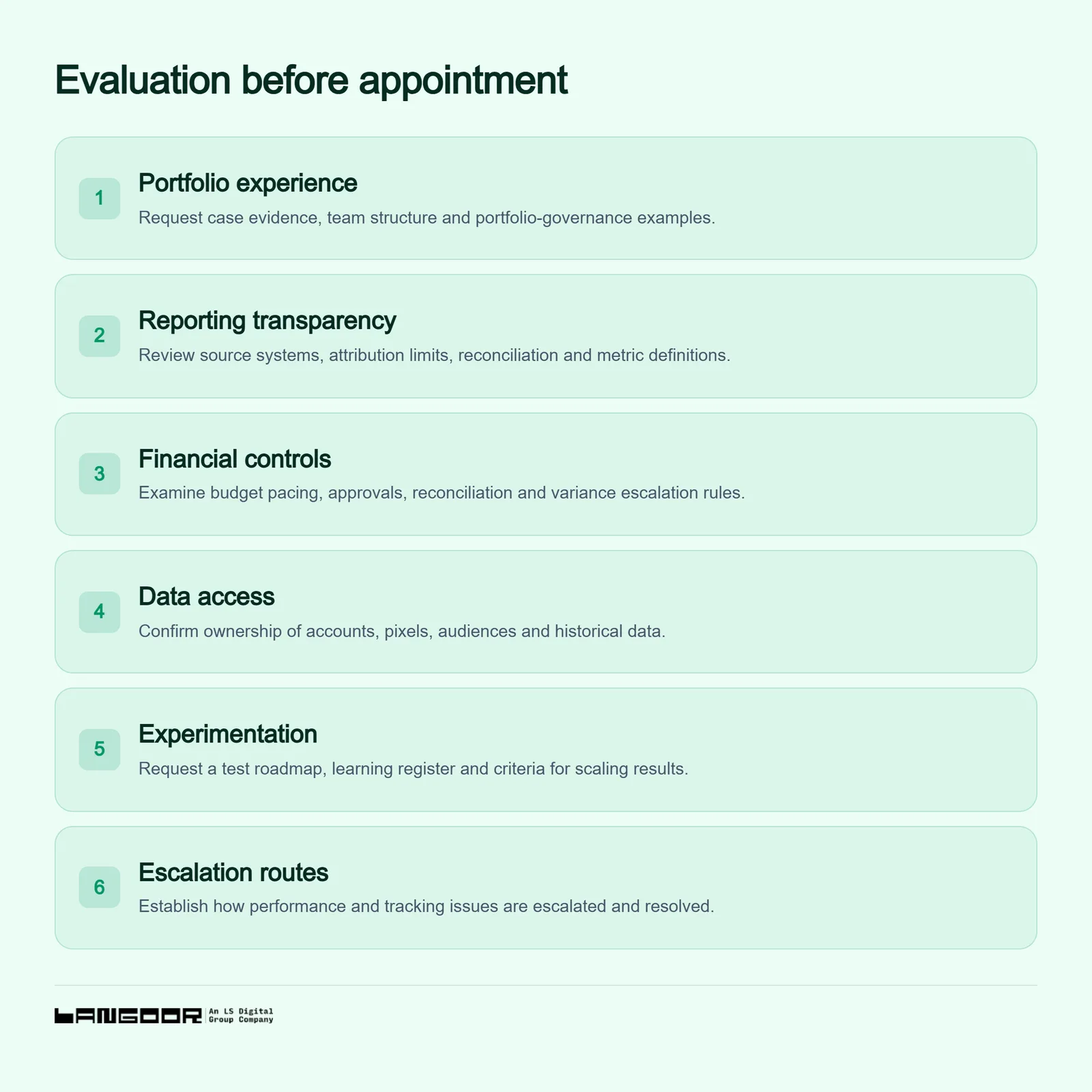
Evaluate the operating model, not a generic agency ranking.
A strong partner will be candid about what cannot be inferred from platform reporting alone. It will also welcome auditability: enterprise-owned accounts, shared documentation, defined approvals and the ability to export data are signs of a durable relationship, not a lack of trust. For a more detailed appointment process, review Langoor’s guide on how to evaluate a performance marketing agency for measurable ROI.
Frequently asked questions
How do media marketing, digital media marketing and broader digital marketing services work together?
Media marketing focuses on planning, buying and optimising paid reach across relevant channels. Digital media marketing extends that remit into digital environments such as search, social, video, display, retail media and publisher platforms. Broader digital marketing services also include customer experience, content, SEO, marketing automation, analytics and conversion optimisation.
For an enterprise, these capabilities should operate as connected functions. Paid media can generate attention and demand, but the website, CRM workflow and sales process determine whether that attention becomes a valuable customer relationship.
What should a performance marketing agency own versus the enterprise team?
An agency should normally own executional excellence: media operations, pacing, optimisation, test design, reporting preparation and clear recommendations. The enterprise should retain ownership of business priorities, customer-data permissions, commercial definitions, final approvals and strategic budget decisions.
The boundary should be formalised in a RACI or service matrix. This protects the organisation’s data and account continuity while enabling the agency to move quickly within agreed guardrails.
Are CAC and ROAS enough to govern a complex portfolio?
CAC and ROAS are important, but neither metric is sufficient on its own. CAC can look favourable when lead quality declines or retention weakens, while ROAS can over-credit the channels closest to conversion. Leaders should also consider incrementality, pipeline quality, contribution margin, payback period and customer lifetime value.
The right metric set depends on the business model and decision being made. A portfolio dashboard should make those trade-offs visible rather than treating one platform metric as the definitive result.
Build governance before you scale spend
Effective performance marketing India programmes are governed systems, not collections of channel campaigns. They align commercial goals, audience priorities, account structures, measurement definitions and experimentation decisions across every business unit that influences growth. When those controls are clear, a partner can optimise faster - and leadership can see what is genuinely working.
Langoor’s enterprise paid-media portfolio brief template helps teams document objectives, account architecture, measurement rules, governance roles and the evidence required from prospective partners. Use it as the starting point for a performance-marketing planning workshop with Langoor, bringing marketing, analytics, finance, sales and procurement into the same operating conversation.