May 28, 2026
Medini Mangala
Account Based Marketing (ABM) is a B2B strategy that treats individual high-value accounts as markets of one, coordinating marketing and sales efforts around a defined list of target companies. In India, the ABM market is projected to reach $150 million by 2027 at 18% CAGR. ABM campaigns deliver 208% more revenue from key accounts than broad-based approaches, making it the fastest-growing go-to-market strategy for Indian enterprises selling into complex, multi-stakeholder buying environments.
What is Account Based Marketing (ABM)?
Account Based Marketing is a B2B go-to-market strategy in which marketing and sales teams identify a defined set of high-value target accounts and build programs specifically designed to engage, influence, and convert those accounts, rather than generating a broad pool of inbound leads and filtering them down.
In a traditional demand generation model, the funnel is wide at the top. You attract a large volume of leads, qualify for them, and pass the best ones to sales. ABM inverts this logic entirely. You start with a list of companies you want to win, and you build content, outreach, advertising, and sales motions specifically around those accounts.
The shift matters enormously in the Indian B2B context, where the accounts that drive the most revenue are typically a small and identifiable set: large domestic conglomerates, MNC India offices, public sector enterprises, or anchor clients within a specific industry vertical. Spraying generic marketing across the internet to find these accounts is inefficient. ABM is the precision alternative.
There are three common ABM models:
- One-to-one ABM (Strategic ABM): Fully bespoke programs for a small number of named accounts, typically your top 10 to 20 targets. Highest effort, highest reward.
- One-to-few ABM (ABM Lite): Industry- or segment-level personalisation for clusters of 20 to 100 accounts with shared characteristics.
- One-to-many ABM (Programmatic ABM): Technology-driven personalisation at scale for hundreds of accounts, using intent data and dynamic content.
Most Indian enterprises begin with one-to-few ABM and graduate to one-to-one for their most strategic targets as they build the capability and infrastructure.
Why ABM is the fastest-growing B2B strategy in India in 2026
Several structural forces are converging to make ABM the dominant B2B growth strategy for Indian enterprises in 2026.
First, Indian enterprise buying has become more complex. Deals that once involved two or three stakeholders now involve procurement of committees, legal, finance, information security, and multiple business unit heads. Broad digital marketing cannot reach all of them with the right message. ABM can.
Second, intent data is now commercially accessible in India. Platforms like Bombora, 6sense, and Demand Base now offer intent signals for Indian IP ranges and job functions, making it possible to identify accounts that are actively researching your category before they ever fill out a form.
Third, the cost of getting B2B digital marketing wrong has increased. With CACs rising across performance channels and longer sales cycles compressing pipeline velocity, Indian marketing leaders are under pressure to demonstrate that every rupee of spend connects to revenue. ABM's account-level attribution model makes that case easier than broad demand generation.
The numbers reflect this momentum. The Indian ABM market is on track to reach $150 million by 2027, growing at 18% CAGR. ITSMA data shows that 87% of B2B marketers globally say ABM delivers higher ROI than other marketing activities. In India, ABM adoption is accelerating fastest in BFSI, enterprise technology, manufacturing, and professional services.
ABM vs traditional demand generation: Key differences
Understanding the difference between ABM and traditional demand generation is not just conceptual; it changes how you budget, hire, measure, and align with your teams.

The most important operational difference is what happens to sales and marketing alignment. In a demand generation model, marketing generates leads and throws them over the wall to sales. In ABM, both teams are working from the same account list, the same intelligence, and the same goal.
For Indian enterprises where sales-marketing misalignment is one of the most cited growth obstacles, this structural alignment is often the biggest non-obvious benefit of moving to ABM.
How to select your target account list for ABM
The target account list (TAL) is the foundation of every ABM program. A strong TAL ensures your effort and budget is concentrated on accounts with the highest probability of becoming significant revenue. A weak TAL wastes both.
Building a strong TAL for Indian B2B market involves four layers of analysis:
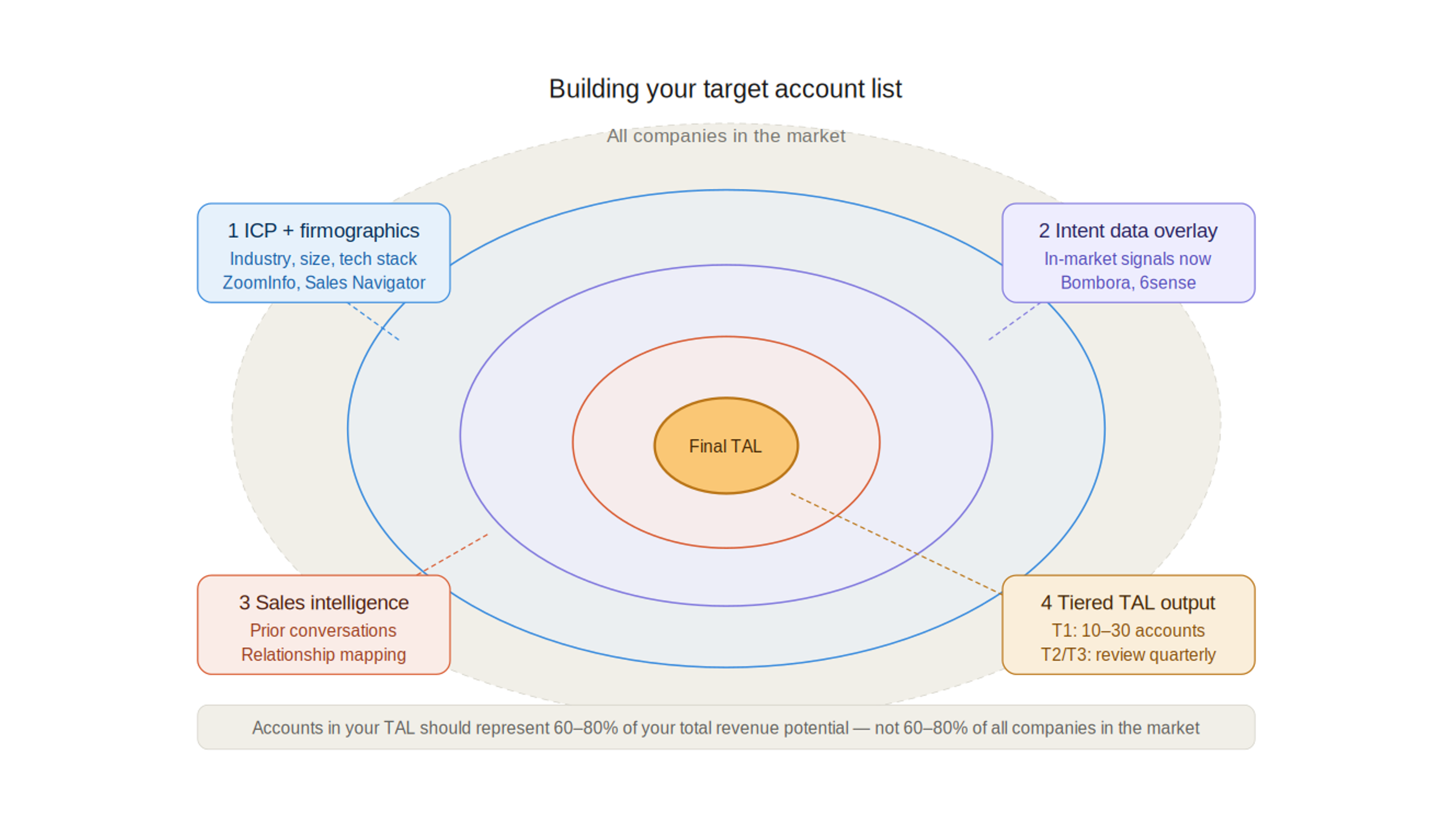
- Ideal Customer Profile (ICP) definition
Start with your best existing customers. What industry are they in? What is their annual revenue? How many employees do they have? What technology do they use? What triggered their purchase? Your ICP is the template for who you want to replicate. In an Indian context, this also means considering ownership structure (listed conglomerate vs family-owned vs MNC subsidiary) and procurement maturity.
- Firmographic and technographic filtering
Use databases like Dun & Bradstreet, ZoomInfo, or LinkedIn Sales Navigator to build a long list of Indian accounts that match your ICP on firmographic criteria: industry, revenue range, employee count, geography. Layer technographic data on top to identify accounts using complementary or competing technology.
- Intent data overlay
Prioritize accounts that show active in-market signals, reading content related to your category, visiting competitor websites, and downloading relevant research. Intent data platforms like Bombora and 6sense now provide reasonable coverage for Indian enterprise accounts.
- Sales intelligence and relationship mapping
Your sales team holds intelligence that no database does. Which accounts have they been in conversation with? Where do existing relationships exist? Which accounts have come close to signing in the past? Sales input is non-negotiable in building a TAL that reflects reality on the ground.
The output should be a tiered account list: Tier 1 (your top 10 to 30 fully personalised targets), Tier 2 (50 to 150 accounts receiving industry-level personalisation), and Tier 3 (a broader programmatic pool). Revisit and refresh the TAL quarterly as accounts move in and out of buying cycles.
Building personalised content for ABM campaigns
Personalisation is what separates ABM from a well-targeted demand generation campaign. But personalisation does not mean rewriting every piece of content from scratch for every account. It means building a content architecture that allows you to adapt core assets to the language, priorities, and context of each account or segment. This is where demand generation and content marketing intersect, with content serving as the mechanism that nurtures interest, builds trust, and supports account-specific engagement throughout the buyer journey.

At Tier 1 (one-to-one ABM), personalisation is deep. This means:
- Account-specific landing pages that reference the prospect's industry, company name, and known business challenges
- Custom ROI calculators or benchmark reports built around the account's metrics
- Executive briefing documents or strategy papers written for the specific stakeholders you are engaging
- Personalised direct mail or physical touchpoints for senior decision-makers
- Custom video messages from senior Langoor leadership to key contacts at the account
At Tier 2 (one-to-few ABM), personalisation is industry-level. A campaign targeting five BFSI enterprises uses content that speaks to regulatory pressures like RBI compliance, core banking modernization, and digital lending — rather than generic B2B content.
At Tier 3 (programmatic ABM), personalisation is driven by dynamic content tools and intent signals — serving different creative, copy, or content offers based on the account's size, industry, or behaviour.
The content types that perform best in Indian ABM program include:
- India-specific industry research reports that demonstrate category authority
- Case studies from comparable Indian companies with named outcomes (not anonymous testimonials)
- Regulatory or compliance-focused thought leadership for regulated industries
- Peer benchmark tools or assessments that prompt self-identification
- Executive roundtable or CXO breakfast invitations for senior stakeholder engagement
ABM technology stack: What tools do you need in India?
A functional ABM program does not require the most expensive enterprise tech stack. It requires the right tools for your tier of ABM and the maturity of your sales and marketing operations. Here is how to think about building an ABM stack suited to the Indian market:
Core CRM (non-negotiable):
- Salesforce, HubSpot, or Zoho CRM form the backbone. Your CRM must be able to track accounts (not just individual contacts), support account-level opportunity reporting, and integrate with your marketing automation platform.
Marketing automation:
- HubSpot, Marketo, or Zoho Marketing Hub for nurture sequences, email personalisation, and behaviour tracking. These platforms are widely used in India and have solid local support ecosystems.
Intent data:
- Bombora (global third-party intent), 6sense (predictive intent and AI account scoring), or Demand Base (intent plus advertising). Coverage for Indian IP ranges has improved significantly, though Tier 1 and Tier 2 Indian cities have stronger data density than smaller markets.
LinkedIn advertising:
- LinkedIn Campaign Manager for account-list-based targeting (upload your TAL directly), Sponsored Content to serve personalised ads to specific job functions at named accounts, and LinkedIn Lead Gen Forms for friction-free content downloads.
Sales engagement:
- Outreach.io or Apollo.io for sequenced, personalised outreach from the sales team to contacts at target accounts. Ensures sales activity coordinates with marketing's digital touchpoints.
Measurement:
- Dreamdata, HockeyStack, or CRM-native attribution to track account engagement across every touchpoint and connect marketing activity to pipeline and revenue.
For most Indian enterprises beginning their ABM journey, a practical starting stack is Salesforce or HubSpot CRM + HubSpot or Marketo for automation + LinkedIn for account-matched advertising + Bombora for intent data.
Measuring ABM success: Pipeline velocity, win rate, and deal size
ABM measurement looks fundamentally different from demand generation measurement. Volume metrics - lead count, MQL volume, cost per lead - are largely irrelevant. What matters is account-level engagement leading to commercial outcomes. Unlike traditional demand generation programs that optimise for lead volume, modern from clicks to conversions approaches focus on measuring the quality of engagement and its contribution to pipeline and revenue.
The primary ABM metrics Indian enterprises should track:
- Account coverage: What percentage of your target accounts have at least one engaged contact?
- Account engagement score: A composite measure of how actively target accounts are engaging with your marketing - content downloads, ad clicks, website visits, email opens, event attendance.
- Pipeline velocity: How quickly are target accounts moving from first engagement to qualified opportunity to closed deal?
- Win rate from target accounts: What percentage of opportunities within your TAL are converting to closed-won?
- Average deal size from ABM accounts: ABM's access to senior stakeholders typically produces larger deal values than inbound-driven opportunities.
- Marketing-influenced revenue: What percentage of closed revenue in your TAL was touched by marketing activity?
A note on time horizons: ABM takes longer to produce pipeline than a paid media campaign. For enterprise accounts with 6-to-18-month sales cycles, it is not unusual for an ABM program to run for two to three quarters before it produces closed revenue.
ABM case study: How Langoor ran ABM for an enterprise B2B brand
A B2B technology platform serving Indian financial services enterprises approached Langoor with a pipeline problem. They had strong inbound lead volume but poor conversion — most leads were from companies that were too small, out of segment, or too early in their buying journey. Their target was to expand into five large BFSI conglomerates and three MNC banking groups operating in India.
Langoor designed and executed a 12-month ABM program structured in three phases:
- Months 1 to 3: Foundation and account intelligence
We built a Tier 1 TAL of eight named accounts and a Tier 2 list of 60 BFSI enterprises. For each Tier 1 account, we mapped the buying committee using LinkedIn Sales Navigator and existing sales relationships. We overlaid Bombora intent data to identify the two accounts showing active in-market signals.
- Months 4 to 8: Content, outreach, and account activation
We created a BFSI-specific content program: an India Digital Banking Benchmark Report (with media coverage in The Economic Times and Mint), three account-specific executive briefing documents, a regulatory compliance whitepaper aligned to RBI's 2025 digital lending guidelines, and personalised LinkedIn outreach sequences for the sales team.
- Months 9 to 12: Deepening and conversion
As engagement scores climbed across six of the eight Tier 1 accounts, we activated a CXO roundtable in Mumbai with a curated guest list drawn from the TAL. Four of the eight Tier 1 accounts attended. Three accounts entered formal sales conversations within 60 days of the roundtable.
Outcomes at the 12-month mark: two closed-won deals from Tier 1 accounts (combined contract value 11x the program investment), one active opportunity in late-stage negotiation, and 68% of Tier 2 accounts engaged with at least one content asset. Pipeline influenced by the ABM program represented 34% of the company's total new-logo pipeline.
Frequently asked questions
1) What is Account Based Marketing?
Account Based Marketing (ABM) is a B2B go-to-market strategy in which marketing and sales teams align around a defined list of high-value target accounts and build coordinated, personalised programs to engage and convert them. Rather than generating a broad pool of leads and filtering them down, ABM starts with the accounts you most want to win and builds marketing and sales activity specifically for those organisations. It is most effective for enterprises with high average deal values, long sales cycles, and a clearly identifiable ideal customer profile.
Modern enterprises are increasingly combining ABM with artificial intelligence to create AI-driven ABM programs that improve targeting, personalisation, and engagement across key accounts.
2) How is ABM different from demand generation?
The core difference is directionality. Demand generation casts a wide net to attract a high volume of leads, which are then filtered by quality. ABM starts with a narrow, pre-qualified account list and builds personalised programs for those specific companies. Demand generation is measured by lead volume and cost per lead. ABM is measured by account engagement, pipeline velocity, win rate, and deal size.
3) What tools do you need for ABM in India?
A practical ABM stack for Indian enterprises typically includes a CRM (Salesforce, HubSpot, or Zoho), a marketing automation platform (HubSpot, Marketo, or Zoho Marketing Hub), LinkedIn Campaign Manager for account-matched advertising, an intent data provider (Bombora or 6sense), and a sales engagement tool (Outreach or Apollo). You do not need the full enterprise stack to start — a CRM, LinkedIn, and one intent data source is a credible beginning.
4) How do you measure the success of an ABM campaign?
ABM success is measured through account-level metrics rather than lead volume. The key indicators are account coverage, account engagement score, pipeline velocity, win rate from target accounts, average deal size from ABM accounts, and marketing-influenced revenue. Volume metrics like MQL count are not appropriate for ABM measures.
5) How much does an ABM program cost in India?
ABM program costs in India vary significantly by tier and scope. A Tier 1 program targeting 10 to 20 accounts with full personalisation typically requires a dedicated budget of Rs. 30 to 80 lakh per year. A one-to-few program covering 50 to 150 accounts can operate at Rs. 15 to 40 lakhs annually. Langoor recommends beginning with a 90-day pilot targeting your top five accounts before scaling the program.
Conclusion
ABM is not a campaign; it is a go-to-market operating model. Indian enterprises that shift from spray-and-pray demand generation to precision account targeting will see shorter sales cycles, higher deal values, and stronger marketing-sales alignment. The ABM market in India is growing at 18% CAGR, and the enterprises building that capability now will own the relationships with the highest-value accounts before their competitors even identify them as targets.
The window to build early advantages is open. It will not stay open indefinitely.
If you are ready to build an ABM strategy that connects directly to your most important accounts and your most significant revenue opportunities, get in touch with the Langoor team at langoor.com/contact.
You may also like this