June 18, 2026
Vinay Rao
Marketing automation in B2B refers to the use of software platforms to automate lead nurturing, lead scoring, CRM updates, and personalised content delivery across the buyer journey. In India, the marketing automation market is projected to exceed $1.5 billion by 2027, growing at over 14% CAGR as enterprises shift from manual nurture sequences to intelligent, behaviour-triggered programs. Organisations using marketing automation report 451% more qualified leads than those relying on manual outreach, making it the most scalable lever for Indian B2B enterprises facing long sales cycles and complex multi-stakeholder buying committees. Marketing automation is one of five core channels in a complete B2B digital marketing programme. See our complete guide to B2B digital marketing in India for how automation fits alongside SEO, LinkedIn, content, and ABM.
Key Takeaways:
- B2B marketing automation automates lead nurturing, lead scoring, CRM handoffs, and personalised content delivery across the buyer journey
- Marketing automation and CRM are complementary, automation qualifies and nurtures leads before passing them to the CRM for sales follow-up
- The MQL-to-SQL handoff is where most Indian B2B enterprises lose pipeline, automation enforces a jointly agreed definition that both marketing and sales trust
- A five to six step automation workflow triggered by a high-intent content download is the most effective starting point for Indian enterprises
- Lead scoring models must be built with sales input and validated against historical data before being used to trigger MQL alerts
- HubSpot, Zoho Marketing Hub, and LeadSquared are the most widely used automation platforms in India across SME and enterprise segments
- Compliance with India's DPDP Act (2023) must be built into automation workflows, consent, opt-out, and data handling must be configured before launch
- Full ROI on marketing automation investment is typically reached within 9 to 18 months for Indian B2B enterprises with average deal values above Rs. 10 lakhs
What is B2B Marketing Automation?
B2B marketing automation is the use of software to execute, manage, and optimize marketing tasks and workflows that would otherwise require manual effort across a large volume of prospects and contacts. Rather than sending a single email to an entire list, automation enables you to trigger personalised messages based on behaviour, segment contacts dynamically by attributes and actions, score leads based on engagement, and hand warm accounts to sales at exactly the right moment.
For Indian B2B enterprises, the value is structural. Most B2B sales cycles in India involve multiple stakeholders, long evaluation periods, and a mix of digital and relationship-driven touchpoints. A buyer researching an enterprise software solution may visit your website six times, download two whitepapers, attend a webinar, and have three conversations with your sales team across four months before signing. Marketing automation makes it possible to maintain a coherent, personalised presence across every one of those touchpoints, without requiring a team member to manually manage each interaction.
Marketing automation is not a replacement for human relationship-building. In Indian enterprise sales, where trust and senior relationships remain decisive, automation handles the volume and velocity of digital engagement while freeing your team to invest time where it matters most: in the rooms that close deals.
This same principle underpins account-based marketing (ABM) programmes, where automation handles personalised content delivery at scale while sales teams focus on the relationships that close enterprise deals.
What marketing automation does: It scores and segments leads, triggers personalised email sequences based on behaviour, alerts sales when an account crosses a readiness threshold, updates CRM records automatically, and reports on pipeline influence across every touchpoint.
Marketing Automation vs CRM: Understanding the Difference
Marketing automation and CRM are complementary systems: a CRM manages sales relationships and closed pipeline, while marketing automation nurtures and qualifies leads before they enter that pipeline.
The most common source of confusion in Indian marketing and sales teams is the distinction between a CRM (Customer Relationship Management platform) and a marketing automation platform. They are complementary, not interchangeable.
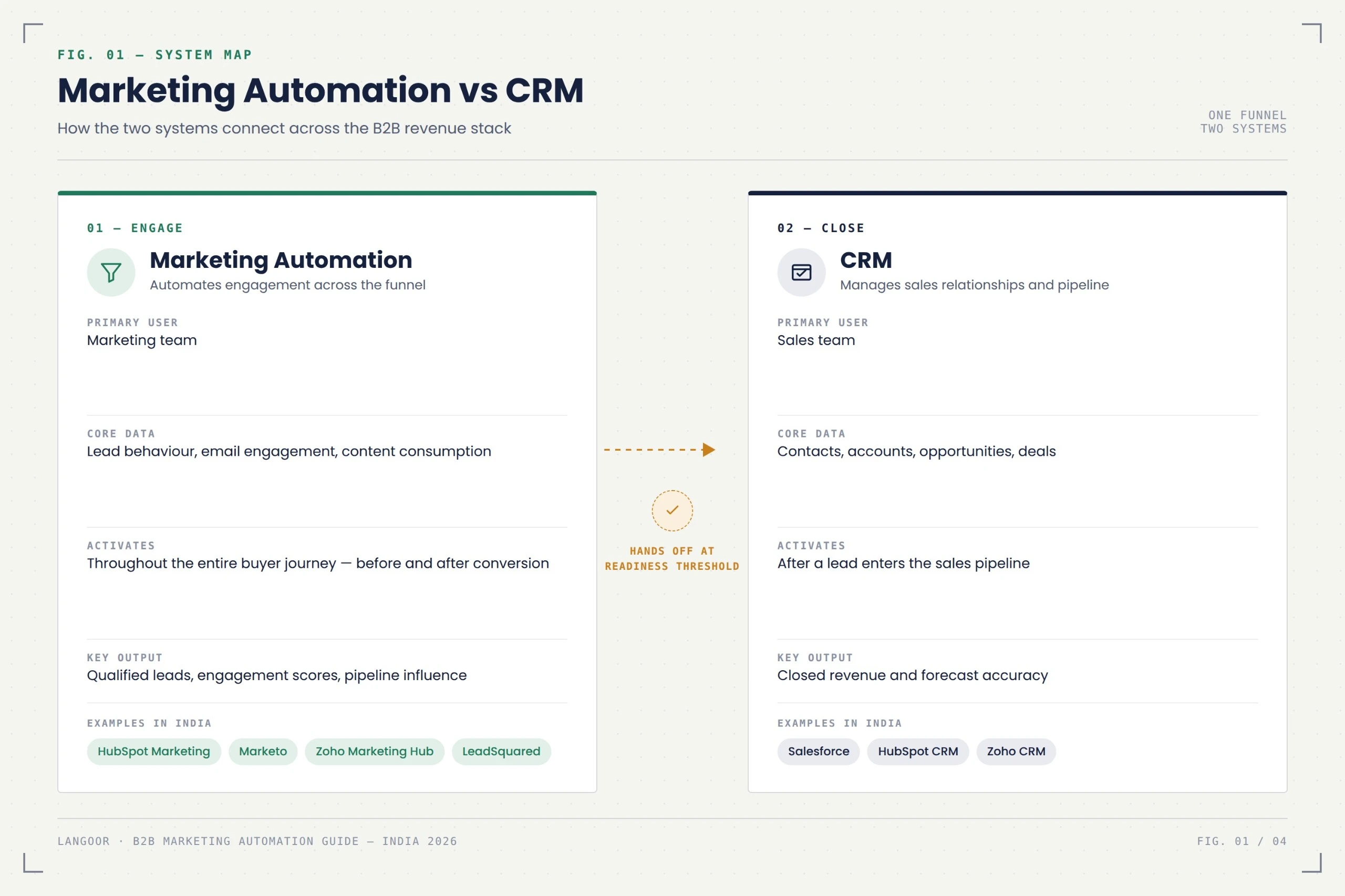
The relationship between them is sequential: marketing automation qualifies and nurtures leads and passes them to the CRM when they reach a defined readiness threshold. Without integration between the two, marketing and sales operate from different pictures of the same prospect, one of the most damaging sources of pipeline leakage in Indian B2B organisations.
The B2B Lead Nurture Journey: MQL to SQL in the Indian Market
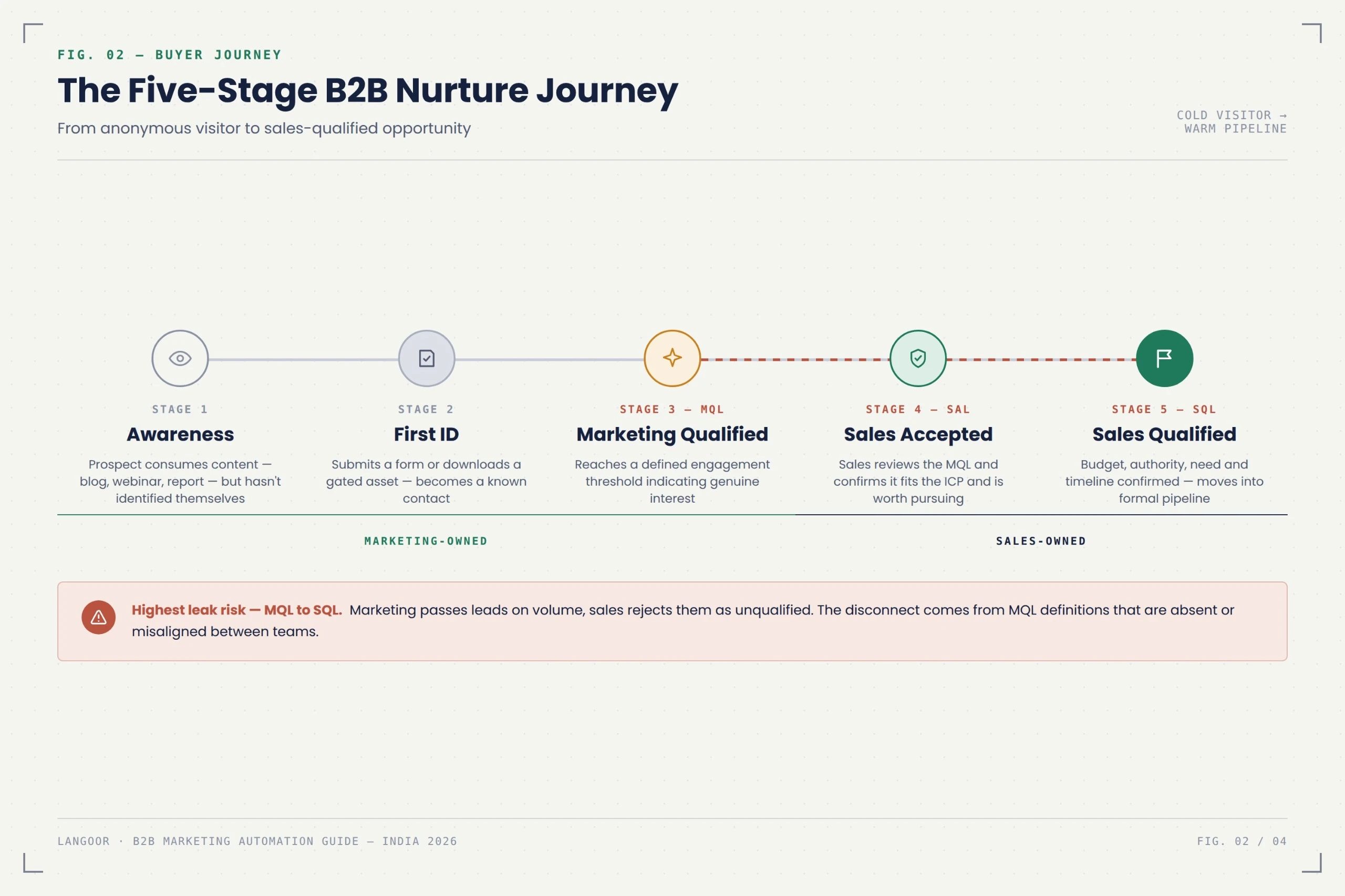
The purpose of marketing automation is to move prospects from initial awareness to sales-readiness without requiring manual intervention at every step. In Indian B2B, this journey typically moves through five stages:
- Awareness: Prospect consumes content (blog, webinar, report) but has not yet identified themselves
- First identification: Prospect submits a form, downloads a gated asset, or registers for an event, becoming a known contact
- Marketing Qualified Lead (MQL): Contact reaches a defined engagement threshold indicating genuine interest, based on lead score, behaviour pattern, or explicit intent signal
- Sales Accepted Lead (SAL): Sales team reviews the MQL and confirms it fits the ICP and is worth pursuing
- Sales Qualified Lead (SQL): Sales team has engaged directly with the prospect, confirmed budget, authority, need, and timeline, and moved the opportunity into formal pipeline
The MQL-to-SQL handoff is where most Indian B2B organisations lose pipeline. Marketing passes leads based on volume; sales reject them as unqualified. The disconnect happens because MQL definitions are either absent or misaligned between teams. Marketing automation enforces a shared definition; a lead only becomes an MQL when it has met the jointly agreed criteria, not when marketing is under pressure to show volume.
How to Build Your First Marketing Automation Workflow
The most common mistake Indian enterprises make when implementing marketing automation is trying to build everything at once. Begin with the highest-leverage workflow: the MQL nurture sequence for your most important content offer.
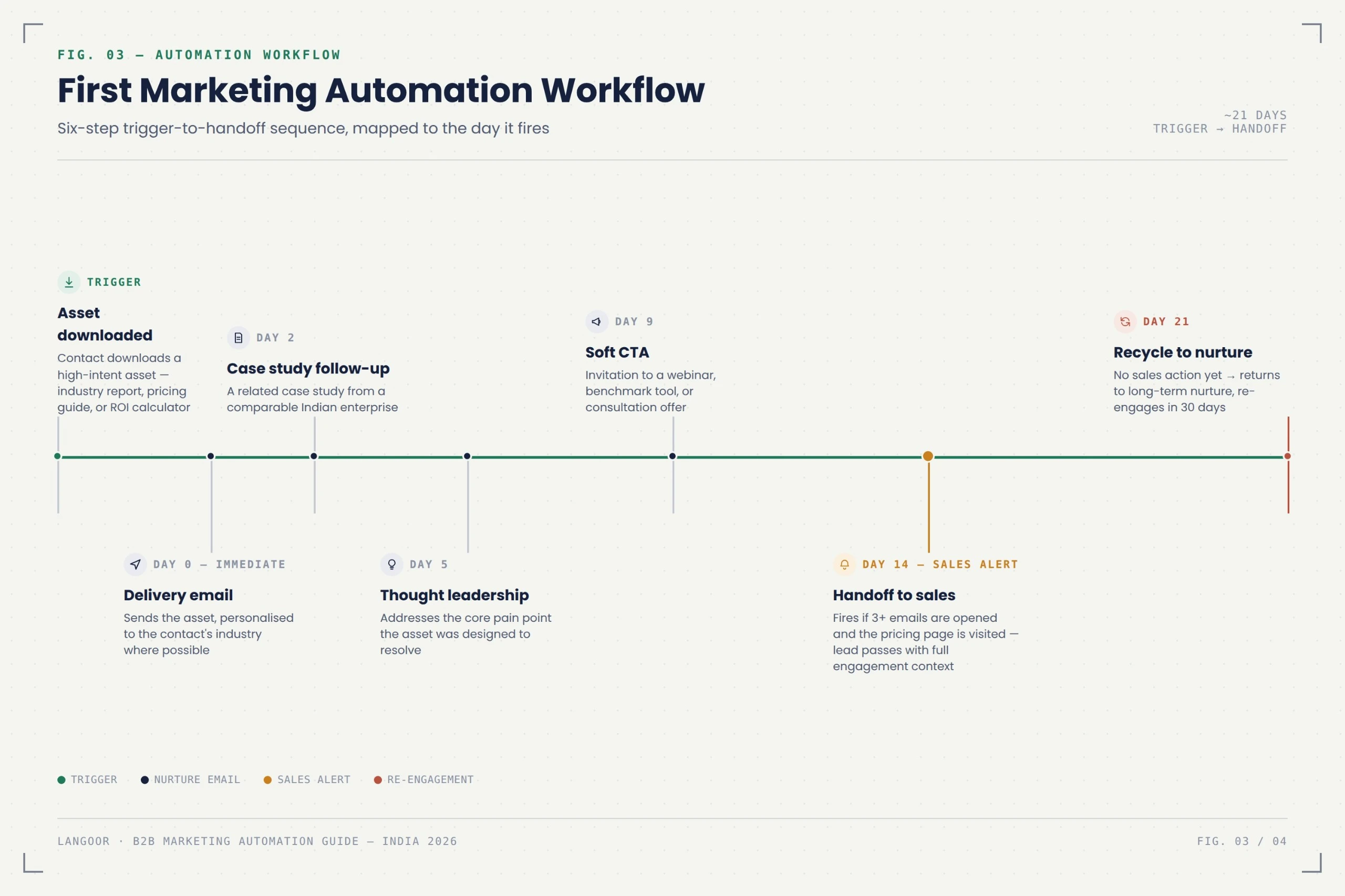
A practical first automation workflow follows this structure:
- Trigger: Contact downloads a high-intent content asset (e.g., an India-specific industry report, a pricing guide, or a ROI calculator)
- Day 0 (Immediate): Delivery email with the asset, personalised to the contact's industry if possible
- Day 2: Follow-up email with a related case study from a comparable Indian enterprise
- Day 5: Thought leadership email addressing the core pain point the asset was designed to resolve
- Day 9: Soft CTA email, invitation to a webinar, a benchmark tool, or a consultation offer
- Day 14: Sales alert triggered if the contact has opened 3 or more emails and visited the pricing page, passing the lead to sales with full engagement context
- Day 21: If no sales action has been taken, return contact to a longer-term nurture track for re-engagement in 30 days
This structure takes four to six weeks to build and configure. Once live, it runs for every contact who downloads that asset, without requiring marketing to manually manage each interaction. That is the compounding value of automation: you build it once, and it works continuously.
Lead Scoring in India: Building a Model That Reflects Your Buyer
Lead scoring assigns numerical values to prospect attributes and behaviours, producing a composite score that indicates how close a contact is to being sales ready. A contact with a score above a defined threshold becomes an MQL and triggers a sales alert.
Most Indian B2B enterprises use a combination of demographic scoring (who the contact is) and behavioural scoring (what they have done):
Demographic scoring examples:
- Job title is CMO, VP Marketing, or Head of Digital: +20 points
- Company revenue above Rs. 500 crores: +15 points
- Industry matches your top three verticals (e.g., BFSI, manufacturing, enterprise tech): +15 points
- Location in Tier 1 Indian city (Mumbai, Bengaluru, Delhi, Hyderabad, Chennai): +10 points
- Company size below 50 employees: -20 points (outside ICP)
Behavioural scoring examples:
- Visited pricing page: +25 points
- Downloaded a gated content asset: +15 points
- Attended a webinar: +20 points
- Opened 5 or more emails in a sequence: +10 points
- Visited the website 3 or more times in a 7-day window: +15 points
- Email unopened for 60 days: -10 points (score decay)
The specific thresholds are less important than having a model that sales and marketing have agreed on. MQL threshold of 60 points means nothing if sales do not trust the definition behind it. Build the scoring model with sales input, pilot it against historical data to validate, and revisit the model quarterly.
Marketing Automation Tools Available in India in 2026
The Indian market has several mature marketing automation platforms with local support, integrations suited to Indian CRM infrastructure, and pricing accessible to enterprises at varying levels of investment:
For most Indian enterprises beginning their automation journey, HubSpot or Zoho are the practical starting points — both offer strong native CRM integration, reasonable onboarding timelines, and local support ecosystems. Enterprises with existing Salesforce infrastructure should evaluate Pardot (now Salesforce Marketing Cloud Account Engagement) for native integration.
Common Mistakes to Avoid When Implementing Marketing Automation in India
The majority of Indian B2B marketing automation implementations underdeliver not because the technology fails, but because the programme design, data quality, or organisational alignment is inadequate. The most common failure modes:
- Automating a broken process: Automation amplifies what exists. If your lead handoff process is broken, automation will pass more unqualified leads to sales faster. Fix the process first, then automate it.
- Starting without clean data: Indian CRMs frequently contain duplicate contacts, incomplete firmographic data, and outdated job titles. Automation built on dirty data produces irrelevant nurture sequences and inaccurate lead scores. Invest in data hygiene before launching.
- Building overly complex workflows before validating simpler ones: Enterprises frequently design 12-step conditional workflows before they have tested whether a 3-step sequence produces pipeline. Start simple. Validate. Then add complexity.
- Treating automation as a volume machine: The goal is not to send more emails. The goal is to move the right prospects to the right stage faster. Optimise for pipeline velocity, not email volume.
- Neglecting the MQL definition: Without a jointly agreed MQL definition, lead scoring is arbitrary. Marketing and sales leaders must define together what a qualified lead looks like before a scoring model is built.
- Ignoring unsubscribe and compliance requirements: India's DPDP Act (Digital Personal Data Protection Act, 2023) introduces consent requirements that must be built into automation workflows. Ensure opt-in mechanisms and unsubscribe handling are compliant before going live.
How to Measure Marketing Automation ROI
Marketing automation ROI is most clearly measured through pipeline influence rather than email engagement metrics. Open rates and click rates are process metrics. Pipeline is the outcome metric.
The primary measures Indian enterprises should track:
- MQL volume and MQL-to-SQL conversion rate: How many automation-generated MQLs are being accepted by sales, and what percentage become qualified opportunities?
- Pipeline influenced by automation: Of the total pipeline in your CRM, what percentage includes at least one marketing automation touchpoint in the path to opportunity creation?
- Time from first touch to MQL: Is automation accelerating the journey from first content interaction to sales readiness? Benchmark against your pre-automation baseline.
- Cost per MQL: As automation scales, cost per qualified lead should decrease relative to manual outreach or paid acquisition channels.
- Revenue from marketing-automated pipeline: How much closed revenue in the past 12 months came from accounts that went through an automation nurture sequence?
A typical B2B marketing automation program in India reaches breakeven on technology and implementation investment within 9 to 18 months, depending on deal size and cycle length. Enterprises with average deal values above Rs. 25 lakhs typically see positive ROI faster due to the high leverage of even a modest increase in win rate from qualified accounts.
Frequently Asked Questions
1) What is B2B marketing automation?
B2B marketing automation is the use of software to automate lead nurturing, lead scoring, CRM updates, and personalised content delivery across the buyer journey. Rather than manually managing individual prospect interactions, automation platforms trigger relevant communications based on behaviour, segment contacts dynamically, and pass sales-ready leads to the sales team at precisely the right moment.
2) What is the difference between marketing automation and CRM?
A CRM (e.g. Salesforce, HubSpot CRM, Zoho CRM) manages sales relationships and pipelines; it is primarily used by sales teams to track opportunities and close deals. A marketing automation platform (e.g. HubSpot Marketing, Marketo, LeadSquared) manages marketing engagement across the buyer journey, it is primarily used by marketing teams to nurture leads before they enter the sales pipeline. The two systems are complementary and must be integrated for effective B2B revenue operations.
3) Which marketing automation tool is best for Indian B2B enterprises?
The right choice depends on your team size, budget, and existing CRM. HubSpot Marketing Hub is the most common choice for Indian SME and mid-market B2B enterprises due to its strong CRM integration, ease of implementation, and accessible pricing. LeadSquared is a strong India-first option, particularly suited to inside-sales-led organisations. For large enterprises with existing Salesforce infrastructure, Salesforce Marketing Cloud (or Pardot) is the natural choice. Zoho Marketing Hub offers the best value-for-money for organisations already in the Zoho ecosystem.
4) How long does it take to see results from marketing automation in India?
Most Indian enterprises see measurable impact on MQL volume within 60 to 90 days of launching their first automation workflow. Pipeline impact, meaning automation-influenced opportunities in the CRM, typically becomes visible within 4 to 6 months, depending on sales cycle length. Full ROI on technology and implementation of investment is typically reached within 9 to 18 months for B2B enterprises with average deal values above Rs. 10 lakhs.
5) Does marketing automation comply with India's DPDP Act?
Marketing automation can be configured to comply with India's Digital Personal Data Protection Act (2023), but compliance is not automatic. Enterprises must ensure that consent is obtained before adding contacts to nurture sequences, that unsubscribe mechanisms function correctly, and that data storage and processing practices align with DPDP requirements. It is advisable to have your legal and compliance team review your automation workflows before launching, particularly forms, data collection touchpoints, and communication consent mechanisms.
Conclusion
Marketing automation is not a technology decision; it is a go-to-market decision. Indian B2B enterprises that build a functioning nurture engine will shorten sales cycles, improve MQL-to-SQL conversion, and give their sales teams a consistent pipeline of warm, contextually informed leads rather than a cold list of form-fillers.
The window for competitive advantage is real. Marketing automation adoption among Indian B2B enterprises is still uneven. The enterprises that build their nurture infrastructure now will have a structural advantage in account engagement, pipeline velocity, and marketing-sales alignment over those that continue to rely on manual outreach and batch-and-blast email.
The starting point is simpler than most teams expect: a clean contact database, a defined MQL threshold agreed with sales, one high-intent content offer, and a five-step automation sequence. From that foundation, the program compounds.
Ready to turn leads to predictable revenue? Get a Langoor Automation Audit, we’ll analyze your CRM, lead flows, and content, then deliver a clear, prioritized plan to accelerate pipeline.
You may also like this