June 9, 2026
Venugopal Ganganna
Answer Engine Optimisation (AEO) is the practice of structuring content to directly answer specific questions in a concise, authoritative format that AI search engines and Google's featured snippets prefer to surface. AEO focuses on question-based headings, 40–60-word direct answer blocks, FAQPage schema, and content that mirrors how users phrase natural language queries. Brands cited in AI Overviews earn 35% more organic clicks, and AI search visitors convert at 4.4x the rate of standard organic traffic.
Introduction
More than 60% of Google searches now end without a single click. The answer appears directly on the results page, in a featured snippet, a People Also Ask box, an AI Overview, or a voice response. For brands accustomed to measuring success through website traffic, this is disorienting. For brands that understand Answer Engine Optimization, it is an opportunity.
AEO is the discipline of making your content the most reliable, easy-to-quote source for the questions your buyers are asking. AI Overviews, featured snippets, People Also Ask boxes, voice assistants, and AI chat platforms. The goal is not just to rank near the answer. The goal is to be the answer.
For Indian brands already investing in search, AEO builds on the same SEO foundation covered in our guide to mastering search visibility, and extends it to the AI surfaces that traditional optimisation alone cannot reach.
This guide covers what AEO is, how AI Overviews and featured snippets decide what to show, the exact content structures that win citations, how to implement the FAQ Page schema correctly, and how to measure whether your AEO program is working. It is written specifically for Indian B2B and enterprise brands navigating an increasingly AI-mediated search landscape.
Key Takeaways
- 60%+ Google searches now end without a click. Brands must optimize for visibility without clicks, not just traffic (SparkToro 2026)
- Featured snippets deliver a 35% CTR lift over the #1 organic result, owning position zero is worth more than position one (SERP Features research, Cloro.dev 2026)
- PAA boxes appear on 65% of all Google SERPs in 2026, up from 32% in 2018, one of the fastest-growing search features (Semrush / Searchlab 2026)
- 81% of AI Overview answers co-occur with PAA blocks, FAQ-optimised content feeds both surfaces simultaneously (TurboAudit 2026)
- 40–60-word answer blocks are the single most effective AEO content format, matching the optimal paragraph snippet length (Semrush / Backlinko)
- FAQPage schema delivers ~35% Featured Snippet selection lift, one of the few AEO tactics with measurable statistical lift on specific surfaces (TurboAudit 2026)
- AI search visitors convert at 4.4x the rate of standard organic visitors, even small AI referral volumes carry disproportionate commercial value (Semrush 2025)
What is Answer Engine Optimisation (AEO)?
Answer Engine Optimisation (AEO) is the discipline of making your content the most reliable, easy-to-extract source for the questions your target audience asks across every surface where AI systems synthesize and serve answers.
Those surfaces now include Google AI Overviews; Google featured snippets, People Also Ask boxes, voice search results (Google Assistant, Siri, Alexa), ChatGPT Search, Perplexity, Gemini, and Microsoft Copilot. What these surfaces share is a common requirement: the ability to extract a specific, accurate, concise answer from your content and surface it directly to the user without necessarily routing them to your website.
AEO sits at the intersection of three disciplines:
- Traditional SEO: which builds the domain authority, technical health, and ranking signals that make pages eligible for AI extraction in the first place
- GEO (Generative Engine Optimisation): which builds the schema, E-E-A-T signals, and earned media presence that earns citations in LLM-based engines like ChatGPT and Perplexity. We cover GEO in depth in our companion guide: What is Generative Engine Optimisation (GEO)?, including the 7 signals that determine AI citation and how to measure your brand's AI visibility score
- Content strategy: which produces the answer-first structure, question-based headings, and FAQ architecture that AI systems can extract and cite
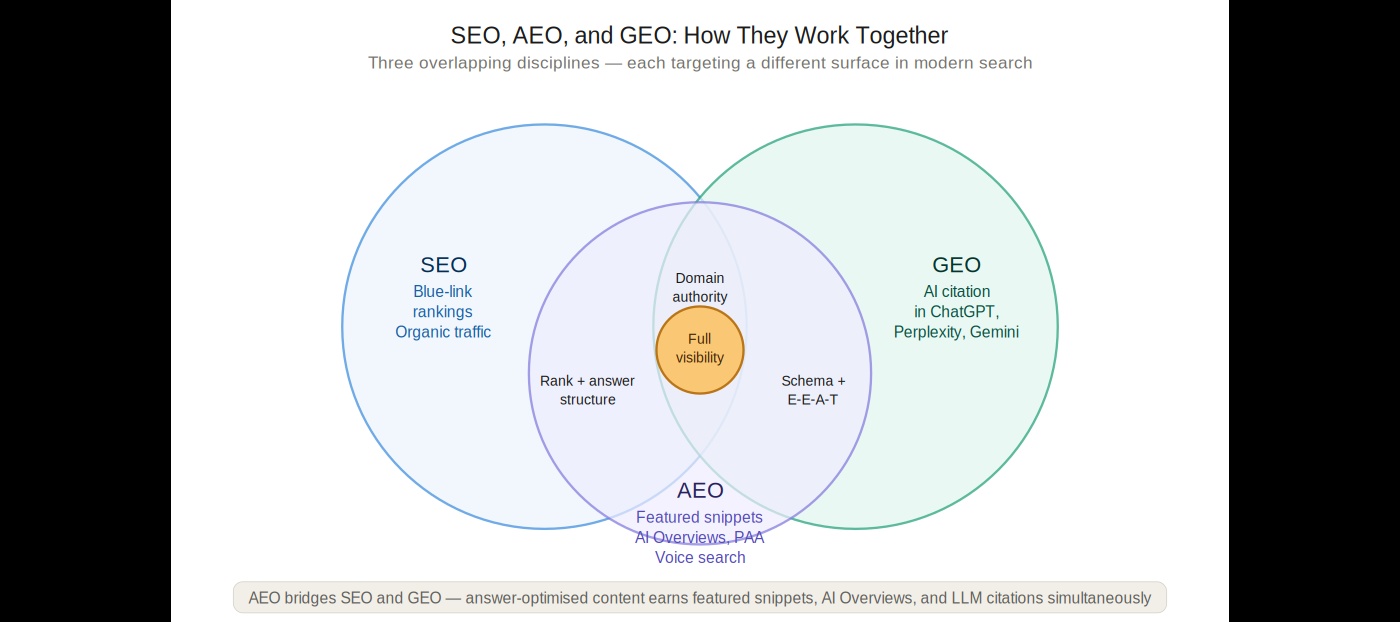
Similarweb's 2026 AEO guide notes: 'AEO involves three sequential outcomes, being retrieved when an AI system searches for source material, being trusted enough to be selected as a primary source and being cited with your brand name in the final answer. Miss any of these steps and you are present in the information ecosystem but invisible in the answer.
For Indian B2B brands, AEO is the highest-leverage search investment available in 2026 because almost no India-specific AEO content exists. The competitive window is wide open.
How AI Overviews and featured snippets decide what to show
Understanding the selection mechanism behind AI Overviews and featured snippets is foundational to AEO. They operate differently, but the content requirements overlap significantly.
Featured snippets are selected by Google's algorithm through a straightforward process: scan pages ranking in positions 2 through 8, identify the most concise self-contained paragraph that directly answers the query under a relevant heading, and extract it. Approximately 70% of featured snippets are sourced from pages ranking in positions 2 through 10 meaning you do not need to rank first to win position zero. The selection criteria prioritize answer clarity, structural formatting, and E-E-A-T signals over raw ranking position.
Google AI Overviews operate through a Retrieval-Augmented Generation (RAG) process: Google retrieves relevant web pages, synthesizes information across multiple sources, and generates a summary answer that cites its sources. The citation selection is broader than featured snippets, AI Overviews cite an average of 13.34 sources per response (up from 6.82 in 2024), meaning there are more citation slots to compete for. However, the content requirements are more exacting: AI systems evaluate extractability, entity clarity, and source credibility in ways that differ from traditional search ranking factors.
People Also Ask boxes are dynamically generated from user behavior and query relationships. They appear on 65% of all Google SERPs in 2026 as the most common SERP feature and are infinitely expandable (each clicked question generates additional related questions). The content selected for PAA answers follows the same 40–60-word format as featured snippets. Critically, 81% of AI Overview answers co-occur with PAA blocks optimizing one surface reinforces the other.
The key implication for Indian content teams: the same content structure that wins featured snippets also wins PAA slots and increases AI Overview citation probability. AEO is not three separate optimization tracks; it is one content architecture applied consistently.
The anatomy of an AEO-optimized content page
AEO-optimized content is not a different kind of content, it is the same high-quality, genuinely useful content structured for machine extraction. Every element of the page serves a specific AI surface. Here is how to build it:
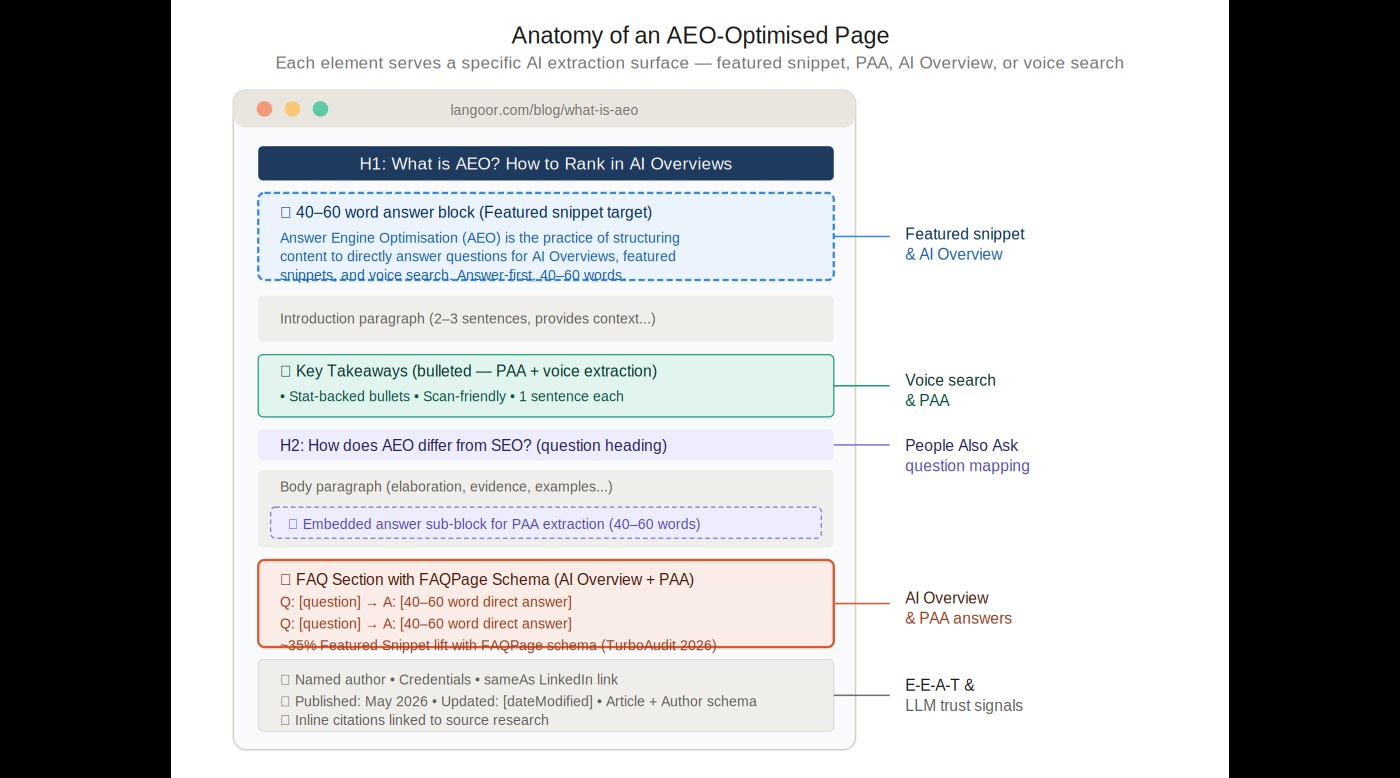
- H1 as the primary query: Your H1 should mirror the exact question your target audience asks, or the closest natural language equivalent. 'What is AEO?' Outperforms 'AEO Overview' because AI systems are trained on natural language queries, not SEO topic labels.
- 40–60 word opening answer block: The single most important AEO element. Position a direct, complete, factual answer to the primary question within the first 200 words of the page ideally in the first paragraph. This is the content Google extracts for featured snippets and AI Overviews. Write it as if answering a verbal question in a single breath. Optimal paragraph snippet length is 40 to 50 words, with 50-word snippets appearing in 20% of SERPs.
- Key Takeaways section: A bullet summary after the opening answer block serves voice search and PAA extraction. Each bullet should be a single, complete, factual sentence with a specific statistic or claim. Voice assistants draw disproportionately from featured snippet content, and voice queries average 29 words conversational phrasing in your bullets increases voice search eligibility.
- H2 headings as questions: Every H2 heading should be phrased as the question it answers. This maps directly to PAA query structure and signals to AI systems that the section is designed to answer a specific query, not just elaborate on a topic.
- Embedded answer sub-blocks: Within each H2 section, open with a 40–60-word direct answer before elaborating. This creates multiple extraction targets throughout the page, increasing the probability that different sections of your content appear in different SERP features for related queries.
- FAQ section with FAQ Page schema: A structured FAQ section at the end of each page is one of the most consistent AEO triggers. FAQ Page schema delivers ~35% Featured Snippet selection lift and feeds both PAA and AI Overview surfaces simultaneously. Each answer should be a self-contained 40–60-word response.
- Named author with schema: Article schema with a named author and verified links increase citation probability significantly. E-E-A-T signals, particularly first-hand experience and verifiable expertise, are prioritized by Google's quality evaluators and increasingly by AI extraction systems.
How to write 40–60-word answer blocks that win featured snippets
The 40–60-word answer block is the foundational unit of AEO content. It is the format that Google's featured snippet algorithm is trained to extract, the format that voice assistants read aloud, and the format that AI Overviews pull most reliably. Writing it well is a learnable craft.
The structure of a high-performing answer block:
- Open with a direct definitional or declarative sentence that answers the question completely, even if read in isolation
- Follow with one to two supporting sentences that add precision, context, or a key statistic
- Close within 60 words, excess content is not extracted and may obscure the answer
- Use present tense, active voice, and specific factual language rather than hedging or promotional phrasing
- Avoid marketing language, first-person brand voice, or calls to action, extraction engines deprioritise content that reads as promotional
Examples of weak vs strong answer blocks for the same query:
The pattern is consistent across both examples: the weak block explains the answer. The strong block delivers the answer in the first sentence, then adds precision. AI extraction systems are designed to find the most information-dense, self-contained passage, which is always the version that leads to the answer.
For Indian B2B content specifically: answer blocks perform best when they include India-specific context or data. An answer block about ABM that references the Indian ABM market size ($150 million by 2027) is more citation-worthy than a globally generic answer, because it provides information AI cannot synthesize from general training data alone.
FAQ Page schema: Implementation guide for 2026
FAQ Page schema is the most direct AEO lever available to content teams. It explicitly marks question-and-answer pairs on a page, enabling Google to display those pairs in featured snippets, PAA boxes, and AI Overviews and signaling to LLM-based engines that the content is structured for answer extraction.
The 2026 FAQ Page schema implementation checklist:
- Use JSON-LD format in the document head it is the implementation format recommended by Google and most reliably parsed by AI retrieval systems
- Mark up only genuine Q&A pairs of FAQs that exist on the page and provide real value to users. A schema that marks content not visible to users is a spam signal.
- Each accepted answer should be 40–60 words, matching the optimal answer block length that maximizes extraction probability
- Questions should mirror natural language queries, not SEO keyword phrases How do I implement FAQ Page schema?
- Include a minimum of 3 and maximum of 10 FAQ pairs per page, Google displays a maximum of 3 rich result FAQs in the SERP, but additional pairs contribute to AI extraction targets
- Update date modified in your article schema every time FAQ content changes — AI systems treat recently updated content as more reliable
Example JSON-LD FAQ Page schema block (simplified):
{"@context": "https://schema.org", "@type": "FAQPage", "mainEntity": [{"@type": "Question", "name": "What is AEO?", "acceptedAnswer": {"@type": "Answer", "text": "Answer Engine Optimisation (AEO) is the practice of structuring content to answer questions in a 40–60 word format that AI Overviews, featured snippets, and voice assistants prefer to extract and cite."}}]}
One important 2026 clarification from Google's Search Central documentation (May 2026): schema markup does not directly boost AI Overview or ChatGPT citations — it specifically improves Featured Snippet and PAA selection probability. For LLM citation (GEO), the more impactful signals are content extractability, E-E-A-T, and earned media presence. Use FAQ Page schema as an AEO tactic; use E-E-A-T and earned media as GEO tactics.
People Also Ask strategy: How to identify and target the right questions
People Also Ask boxes are the fastest-growing SERP feature in Google's history present on 65% of all SERPs in 2026, up from just 32% in 2018. Each PAA box contains 4 visible questions that dynamically expand into additional questions with every click, creating an infinite cascade of query opportunities.
PAA strategy for Indian B2B brands begins with systematic question research:
- Mine PAA cascades for your target queries: Search your primary target keyword, then expand each PAA question by clicking it. Document the full question cascade, typically generating 20 to 30 related questions from a single starting query. These are the exact questions your target audience is asking, surfaced by Google's own user behaviour data.
- Prioritize questions with weak current answers: Where PAA answers are vague, overly generic, or outdated particularly for India-specific queries there is an opportunity to produce a more authoritative answer. AI systems update their selections when better answers become available.
- Map questions to content gaps: Identify which PAA questions your existing content does not answer. These are direct content opportunities: write a section or a page that addresses each gap with a properly structured 40–60-word answer block and relevant H2 question heading.
- Prioritise long tail and temporal queries: Searches containing eight or more words are 7x more likely to trigger a Google AI Overview. Queries with temporal modifiers like 'in 2026' or 'latest' create citation opportunities because AI systems struggle with time-sensitive information and actively seek recently updated, dated content.
A practical PAA workflow for Indian B2B content teams: run a monthly PAA audit for your top 20 target queries. Track which questions are appearing, which you currently answer, and which represent gaps. Build a rolling content calendar around the gaps targeting one to two new PAA questions per week in your existing content or as dedicated FAQ pages. This systematic approach compounds: PAA content that earns one citation tends to earn additional citations as AI systems learn to trust the source.
AEO for B2B: Optimizing for complex, long-tail buyer questions
AEO for B2B marketing presents a specific opportunity that is different from B2C. B2B buyers ask complex, research-intensive questions, not the short-tail informational queries that most AEO guides focus on. A procurement manager researching enterprise HRMS software is not asking 'what is HRMS?' They are asking 'what are the key differences between SAP SuccessFactors and Oracle HCM for a mid-sized Indian manufacturer with multi-state payroll compliance requirements?' That is an AI search query. And if your content answers it, you earn a citation.
The B2B AEO opportunity is concentrated in three query types:
- Comparison of queries: 'X vs Y' and 'best X for [specific context]' queries where B2B buyers are in active evaluation mode. These queries are high commercial intent and have relatively few authoritative answers, particularly in Indian market contexts. A well-structured comparison page with clear H2 headings, a comparison table, and embedded answer blocks for each comparison dimension is a strong AEO target.
- How-to and process queries: 'How to implement X', 'how to build X strategy', 'step-by-step guide to X' process queries that B2B practitioners use during implementation. How To schema with structured steps has a 6.4x higher citation rate than prose equivalents (upGrowth 2026). For Indian B2B teams building marketing operations documentation, this is a direct AEO lever.
- Definition and concept queries: CXOs and procurement teams researching unfamiliar technology or strategy concepts. These queries ('what is ABM', 'what is GEO', 'what is a CDP') are among the most reliably answerable with the 40–60-word answer block format. The Indian B2B context is particularly underserved India-specific definitional content is chronically absent from AI training data, meaning locally relevant answers have outsized citation value.
B2B AEO measurement should track query intent, not just snippet appearance. A B2B brand appearing in AI Overviews for procurement-stage queries 'best B2B marketing agency India', 'how to choose ABM software India' delivers fundamentally different pipeline value than appearing for awareness-stage queries. Segment your AEO performance tracking by funnel stage and weight commercial-intent citations more heavily in your reporting.
How to measure AEO success
AEO measurement requires a different dashboard from traditional SEO. The primary metric in traditional SEO is organic traffic. The primary insight in AEO is visibility how often your brand appears in answer surfaces, even when no click occurs. Because 60%+ of searches now end without a click, traffic alone dramatically understates AEO impact.
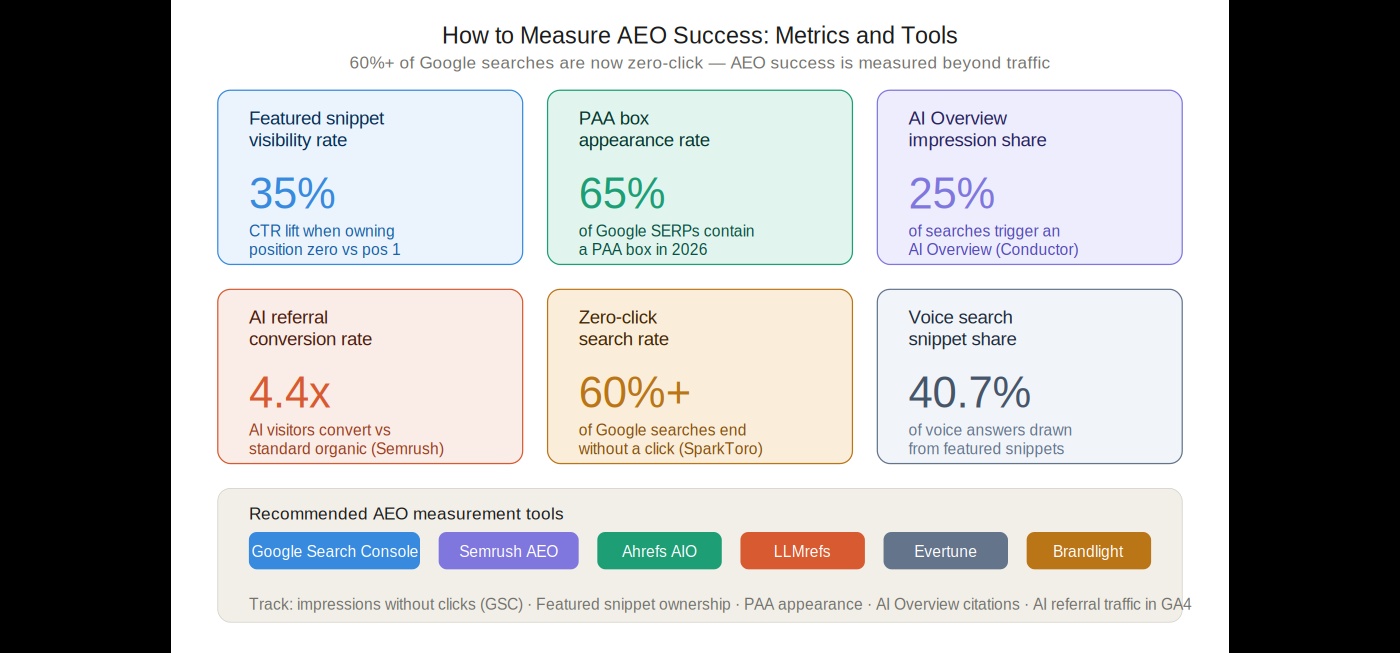
Building an AEO measurement program:
- Google Search Console impressions without clicks: The most direct AEO signal available without third-party tools. In GSC, filter queries with high impressions and low click-through rates these are the queries where your content is appearing in AI Overviews or featured snippets, but users are getting the answer without clicking. Track this segment over time: growing impressions with flat or declining clicks is a sign that you are earning zero-click visibility, not losing traffic.
- Featured snippet and PAA tracking: Tools like Semrush, Ahrefs, and Advanced Web Ranking track featured snippet ownership and PAA appearances for your target queries. Run a monthly audit of your top 50 target queries: what percentage do you own a featured snippet for? What percentage appears in PAA? These rates should increase as your AEO content investment compounds.
- AI Overview impression share: GA4 now captures some AI Overview referral traffic, but the more reliable measurement is manual query auditing — searching your target queries in Google and recording whether your brand appears in the AI Overview. Tools like Semrush's AI Overview tracker and Conductor's AEO dashboard automate this at scale. Benchmark your AI Overview appearance rate for your top 100 queries quarterly.
- AI referral traffic and conversion rate in GA4: Create a custom channel grouping in GA4 that segments traffic from chatgpt.com, perplexity.ai, claude.ai, and Google AI Overviews. Track both volume and conversion rate. AI referral visitors convert at 4.4x the rate of standard organic visitors even a small AI referral volume carries significant commercial value. Trending this metric monthly shows whether your AEO investment is translating to qualified traffic.
The compounding logic of AEO: The answer surfaces are sticky. Pages that earn featured snippet citations maintain them as long as the content stays current, and the answer quality stays high. PAA citations reinforce brand familiarity even without clicks. AI engines that have cited your content once are more likely to cite it again. The brands that invest in AEO now are building a visibility infrastructure that compounds — while competitors are still optimising exclusively for blue links.
Conclusion
AEO is not a replacement for content quality, it is a framework for making quality content findable by machines. The brands that learn to structure their expertise into answer-first content will dominate the zero-click search landscape that is increasingly defining how buyers discover vendors. Over 60% of Google searches end without a click in 2026. Featured snippets deliver 35% more CTR than organic rankings. PAA boxes now appear on 65% of SERPs. AI search visitors convert at 4.4x the rate of standard organic traffic.
The evidence is consistent: the surface has changed. The question is no longer whether to optimise for answer engines. It is whether to start now, before your competitors claim the citation territory in your category, or later, when claiming it back will cost far more.
As AI-powered discovery continues to reshape search behaviour, brands must also understand how to interpret and act on emerging AI marketing insights. Organisations that combine Answer Engine Optimisation with data-driven AI intelligence will be best positioned to earn visibility, authority, and conversions in the evolving search landscape.
The organisations seeing the greatest returns from AI are not necessarily the earliest adopters, they are the ones with a clear roadmap for implementation and measurement. To understand where your business sits on that journey, assess your AI maturity with our diagnostic tool and receive a structured view of your current capabilities and opportunities.
If you are ready to build an AEO strategy that makes your brand the cited source across your most important search queries, get in touch with the Langoor team at langoor.com/contact.
Frequently Asked Questions
Looking for more answers? Explore our complete AI FAQ covering AI adoption, implementation, governance, generative AI use cases, and other common questions about AI in marketing.
1) What is Answer Engine Optimisation?
Answer Engine Optimisation (AEO) is the practice of structuring content to directly answer specific questions in a concise, authoritative format that AI search engines and Google's featured snippets prefer to surface. AEO targets Google AI Overviews, featured snippets, People Also Ask boxes, voice search results, and AI platforms like ChatGPT, Perplexity, and Gemini — surfaces where users get answers without necessarily clicking through to a website. The core technique is the 40–60-word direct answer block, placed at the top of each content section.
2) How do I optimise content for Google AI Overviews?
To appear in Google AI Overviews, structure your content with a direct 40–60 word answer block within the first 200 words of each page; use question-based H2 headings that mirror natural language queries; implement FAQPage, Article, and Organisation schema markup; include original data and statistics that AI cannot generate from general knowledge; earn third-party media coverage in publications Google indexes; and ensure your named authors have verified credentials and schema links. Sites implementing structured data and FAQ blocks have seen a 44% increase in AI search citations (BrightEdge 2026).
3) What is FAQPage schema and how do I implement it?
FAQPage schema is a structured data type that marks question-and-answer content on a web page, enabling Google to display those Q&A pairs in featured snippets, People Also Ask boxes, and AI Overviews. Implement it as JSON-LD in your document head, using the @type FAQ Page with main entity arrays containing Question and accepted answer pairs. Each answer should be 40–60 words, written as a self-contained response. FAQ Page schema delivers approximately 35% Featured Snippet selection lift (TurboAudit 2026) and is one of the highest-impact AEO tactics available.
4) How long should an answer be to win a featured snippet?
The optimal answer length for a featured snippet is 40 to 60 words. Semrush's analysis of snippet text lengths found that 50-word snippets appear in 20% of SERPs, and 40-word snippets appear in 19.27% of SERPs both significantly outperforming shorter or longer formats. The ideal structure is a direct declarative or definitional opening sentence that answers the question completely, followed by one to two supporting sentences that add precision or a key statistic, within the 60-word ceiling. Excess content is not extracted and can reduce selection probability.
5) Does AEO work differently for B2B vs B2C?
Yes, B2B AEO targets more complex, research-intensive query types than B2C. B2B buyers ask comparison queries ('SAP vs Oracle for Indian payroll'), how-to and process queries ('how to build an ABM strategy India'), and definitional queries about unfamiliar technology or strategy concepts. These queries are less competitive than B2C informational queries, making B2B AEO relatively easier to win. B2B AEO performance should be segmented by buyer journey stage, citations on commercial-intent queries carry more pipeline value than awareness-stage citations, and reporting should reflect that weighting.