June 3, 2026
Venugopal Ganganna
Generative Engine Optimisation (GEO) is the practice of structuring content, schema, and brand authority signals so that AI-powered search engines, including Google AI Overviews, ChatGPT Search, Perplexity, and Gemini, cite your brand as a trusted source in their generated answers. Unlike traditional SEO which targets ranked links, GEO targets AI-generated summaries that now appear at the top of 30–40% of search results. AI search visitors convert at 4.4–23x the rate of standard organic visitors.
Introduction
Something changed in how your buyers find you, and most Indian brands have not noticed yet.
When a CMO at an HDFC subsidiary asks ChatGPT for a recommended B2B digital marketing agency in Bangalore, or when a CTO at a Tata company uses Perplexity to shortlist enterprise SEO partners, the answer they receive is not a list of ten blue links. It is a synthesized paragraph that names two or three brands. If your brand is not in that paragraph, you did not lose the search - you were never in the conversation.
That is the reality GEO addresses. Traditional SEO gets you onto page one of Google. Generative Engine Optimisation gets you cited in the AI-generated answers that increasingly appear before page one, and in the AI tools that an estimated 58% of B2B buyers now use at the start of their vendor research journey (Mersel AI 2026). For Indian brands already investing in B2B digital marketing, GEO is the next layer of visibility that search alone cannot provide. Our complete guide to B2B digital marketing in India covers the foundational strategy GEO builds on.
This guide explains what GEO is, why it is the most significant search opportunity for Indian brands in 2026, and exactly how to build the content, authority, and technical signals that earn AI citations.
Key Takeaways
- GEO targets AI-generated answer citations, not ranked links, across ChatGPT, Perplexity, Gemini, and Google AI Overviews
- The overlap between Google's top 10 results and AI citations has dropped from ~75% (mid-2025) to just 17–38% (BrightEdge / Demand Local 2026), ranking on page one no longer guarantees AI visibility
- AI search visitors convert at 4.4–23x the rate of standard organic traffic (Ahrefs / Seer Interactive 2026)
- 86% of AI citations come from brand-managed sources: first-party websites (44%) and business listings (42%) - brands control most of their GEO destiny (Yext / Brandlight 2026)
- 82% of AI citations come from earned media, not owned content - PR and third-party coverage are direct GEO inputs (Muck Rack 2025)
- B2B pages with original statistics earn 42% higher AI citation rates than generic guides (Infineural 2026)
- Only 14% of marketers currently measure AI search performance - the competitive window is wide open (Conductor 2026)
What is GEO and how is it different from SEO?
Generative Engine Optimisation (GEO) is the practice of structuring your content and brand signals so that AI engines: ChatGPT, Perplexity, Google AI Overviews, Gemini, and Claude — cite your brand as a trusted source when generating answers to user queries.
The term was coined in a peer-reviewed paper presented at the 30th ACM SIGKDD Conference in Barcelona by researchers from Princeton University, Georgia Tech, the Allen Institute for AI, and IIT Delhi. Their study introduced GEO-bench - a benchmark of 10,000 queries across nine domains and demonstrated that targeted GEO methods can increase brand visibility in AI answers by up to 40%.
The distinction from traditional SEO is not just technical - it is structural. Traditional SEO competes for position in a ranked list. GEO competes for inclusion in a synthesized answer. Those are different games, measured differently, won differently.
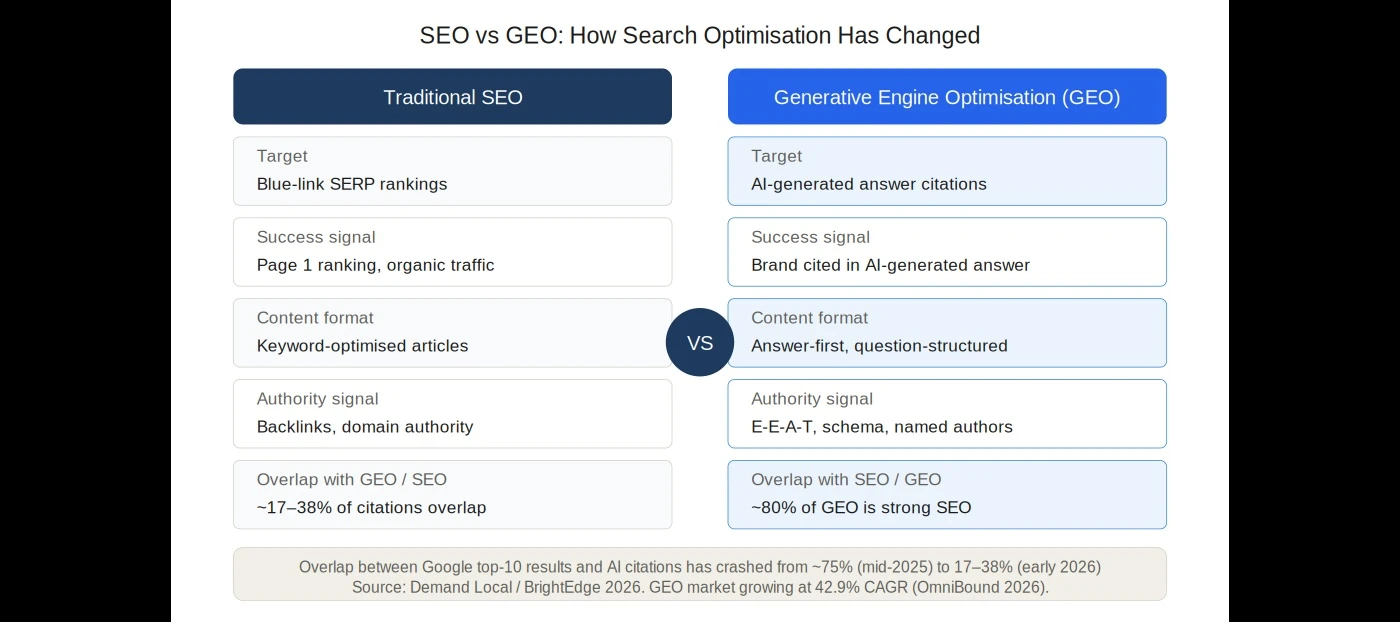
Infographic: SEO vs GEO — how optimisation targets, success signals, and authority signals differ, and why only 17–38% of AI citations overlap with top Google results (BrightEdge 2026)
Critically, GEO does not replace SEO; it extends it. As Mersel AI's 2026 framework notes: '80% of GEO is good, fundamental SEO. Technical health, content depth, and domain authority all feed into GEO performance. If you are building your SEO foundation alongside GEO, our guide on mastering visibility through SEO covers the technical and content signals that serve both strategies. But GEO adds specific requirements: answer-first structure, schema markup, named author authority, and original data, that SEO optimisation alone does not address.
For Indian brands, the competitive window is unusually wide. Almost no India-specific GEO guidance exists, and most Indian marketing teams are optimising exclusively for traditional search. The brands that build GEO capability in 2026 will find relatively uncontested AI citation territory in their categories.
Why GEO matters: How AI Overviews are changing search behaviour
The scale of AI-mediated search is no longer theoretical. Consider what is happening right now:
- Google AI Overviews reaches 2 billion monthly users globally, appearing on an estimated 30–40% of all search queries
- ChatGPT processes queries from 700 million weekly users, with referral traffic now flowing to tens of thousands of distinct domains
- 51% of software-category buyers start their vendor research with an AI chatbot more often than Google (G2 2026 report)
- Traditional search volume is projected to decline 25% by 2026 as queries shift to conversational AI interfaces (Gartner)
- Zero-click searches on Google grew from 56% to 69% in a single year following AI Overviews' rollout (Similarweb, July 2025)
These trends expose the ugly side of SEO, where strong rankings alone no longer guarantee visibility, traffic, or commercial impact as AI-generated answers increasingly intercept user journeys. The commercial implication for Indian B2B brands is direct. If 58% of your potential buyers are asking AI tools for vendor recommendations, and your brand does not appear in those AI-generated shortlists, you are invisible at the exact moment a buyer is forming their consideration set. That is not a traffic problem; it is a pipeline problem.
The good news is that AI citation traffic, when it does arrive, is extraordinarily high quality. Ahrefs found that AI traffic generated 12.1% of signups for tracked SaaS brands while accounting for only 0.5% of total visitors - a 24:1 conversion ratio. ChatGPT converts at 14.2–15.9% and Claude at up to 16.8%, compared to Google organic's 1.76% (Seer Interactive / First Page Sage 2026). The volume may be smaller than organic search; the value per visitor is not.
How AI engines decide which sources to cite
Understanding how AI engines select sources is the foundation of effective GEO. The process varies slightly between platforms, but the core mechanism is consistent: AI engines retrieve content, synthesise across sources, and cite those sources in their generated responses.
The retrieval phase is where GEO wins or loses. AI engines use retrieval-augmented generation (RAG) - pulling live web content to ground their answers in current information. What makes a page retrievable and citable comes down to three things: whether the AI can parse and extract the content cleanly, whether the content is structured to answer the specific query directly, and whether the source carries sufficient authority signals for the AI to trust it.
The key insight from the Princeton/KDD GEO research is that AI systems evaluate pages differently from search engines. Where Google's algorithm assesses hundreds of ranking factors, AI engines primarily evaluate:
- Extractability: Can the AI pull a clean, specific answer from the page? Content buried in marketing prose, hidden behind navigation, or structured as vague generalisations is less extractable than content with clear question-and-answer structure, numbered lists, and direct factual statements.
- Entity of clarity: Is it unambiguous who the content is from, who wrote it, and what it is about? AI engines resolve entities - they need to confidently attribute content to a recognised organisation and author to cite it without risk of misattribution.
- Source credibility: Does third-party evidence (earned media mentions, external citations, E-E-A-T signals) support treating this source as authoritative? AI engines are trained to cite credible sources, the same signals that build human trust build AI trust.
A critical finding from Brandlight's GEO research: the overlap between Google's top 10 organic results and AI citations has dropped from ~70% to below 20%. Ranking on page one does not guarantee AI citation. And appearing in AI citations does not require ranking on page one. They are increasingly separate competitions.
The 7 GEO signals that determine AI visibility
Based on the Princeton/KDD academic research, upGrowth's AI Citation Tracker data, BrightEdge 2026 analysis, and Mersel AI's practitioner framework, seven signals consistently determine whether a brand's content earns AI citations.
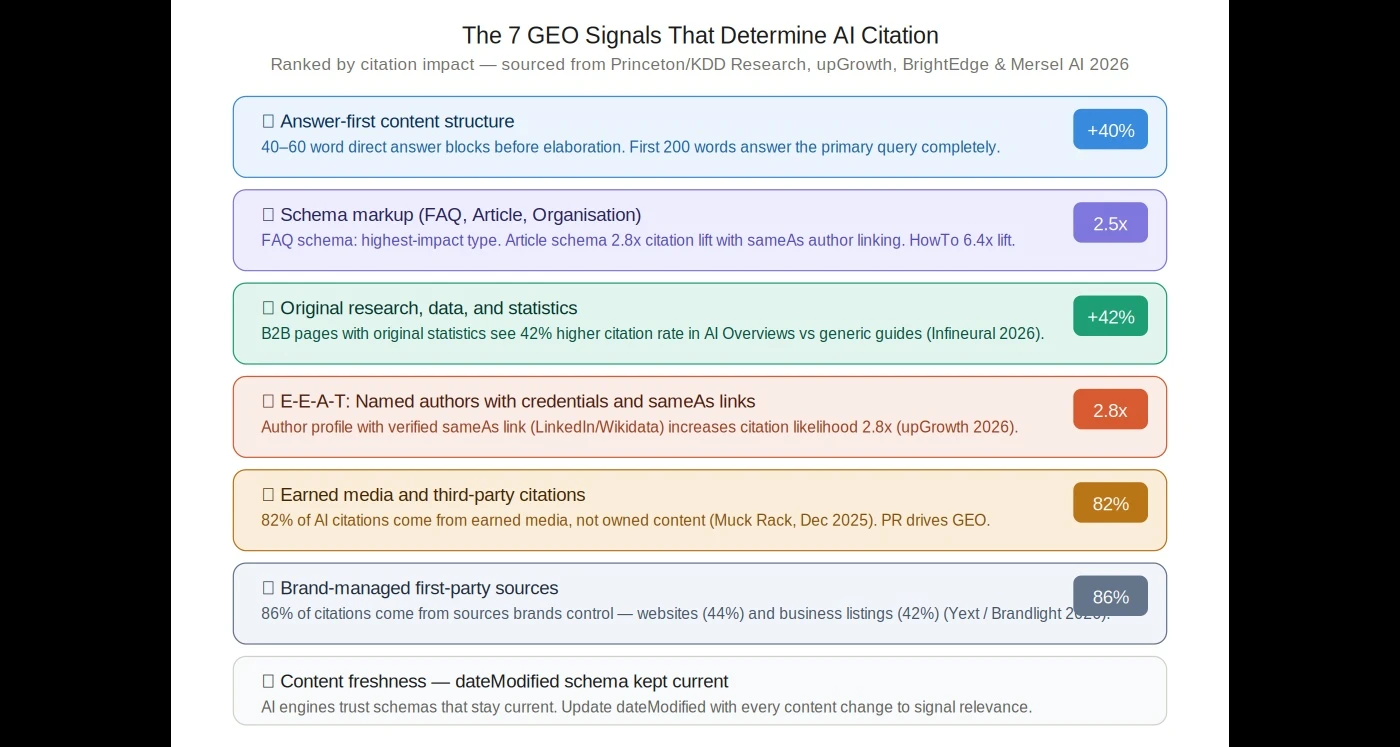
Two of these signals deserve deeper treatment for Indian B2B brands specifically.
On original data: AI engines are trained to cite content that provides specific, verifiable information that they cannot generate from general knowledge alone. A generic article about 'B2B marketing best practices' is not citation-worthy; it says nothing an AI doesn't already know. An article that contains original survey data, India-specific benchmarks, or proprietary case study outcomes is citation-worthy because it provides information the AI cannot synthesise from elsewhere. For Indian brands, this is an opportunity: India-specific research is chronically underrepresented in AI training data, which means original Indian market data has outsized citation value.
On earned media: 82% of AI citations come from earned media, not owned content. This means PR; media coverage in publications the AI has been trained on or actively retrieved from, is a direct GEO input. For Indian brands, coverage in The Economic Times, Business Standard, Mint, YourStory, Inc42, and sector-specific publications directly increases the probability of AI citation. A PR strategy is a GEO strategy.
How to write content that gets cited by ChatGPT and Gemini
The content structure that earns AI citations is distinct from traditional long-form SEO content, though it builds the same foundation of depth and accuracy. The key difference is the primacy of direct, extractable answers.
The most important structural principle: answer first, elaborate second. AI engines prioritise the first 200 words of any page when evaluating relevance. A page that opens with a direct, complete answer to the primary query is extractable. A page that builds up to the answer through context, background, and preamble is not; the AI may not 'read' that far before moving to the next candidate source.
The anatomy of a GEO-optimised page:
- Opening answer block (40–60 words): A direct, complete, factual answer to the primary question the page addresses. This is the content most likely to be extracted for AI Overview or ChatGPT responses. Write it as if answering a verbal question in a single breath.
- H2 headings as questions: Structure headings as the questions your target audience asks, not as topic labels. 'What is GEO?' outperforms 'GEO Overview' because it mirrors the natural language queries AI engines process.
- Numbered and bulleted structure: AI engines extract structured lists far more readily than dense prose. Where you have multiple points, use numbered lists with specific, factual items rather than paragraph elaboration.
- Inline citations and source links: Link to the research, data, and sources you cite. AI engines treat cited content as more credible than unsourced claims, and inline citation links signal that your content is part of the broader knowledge graph, not isolated.
- FAQ sections at page end: A structured FAQ section with question headings and 40–60-word answers is one of the most consistent citation triggers. It maps exactly to how AI engines respond to user queries, providing ready-to-extract content in the ideal format.
You can see this principle applied in our guide on B2B digital marketing for Indian enterprises and our account-based marketing strategy guide, both of which are structured with answer-first H2s and FAQ schema.
What to avoid: AI engines are sophisticated enough to recognise content optimised for extraction at the expense of genuine usefulness. Endless bullet points with vague generalisations, robotic phrasing, and repetitive key-term insertion will not earn citations, and may reduce them, as AI engines increasingly penalize low-quality content regardless of its structural formatting.
Building E-E-A-T for GEO: Author authority and brand entity
E-E-A-T: Experience, Expertise, Authoritativeness, and Trustworthiness was originally a Google Search Quality Evaluator concept. In 2026, it has become the primary credibility framework that AI engines use to evaluate whether a source is citation-worthy.
The critical difference between E-E-A-T for traditional SEO and E-E-A-T for GEO is that AI engines require explicit, machine-readable signals, not just the presence of expertise on the page. An author whose credentials are described in a paragraph of prose is less citation-worthy than an author whose credentials are structured in Article schema with a verified link to their LinkedIn profile.
Building E-E-A-T for GEO requires investment in four areas:
- Named author profiles: Every piece of content should be attributed to a named individual with visible credentials, a biography, and links to their professional profiles. Anonymous or team-authored content is less citable. Author sameAs linking in Article schema increases citation likelihood 2.8x (upGrowth 2026).
- Organisation entity clarity: Your Organisation schema should include a verified sameAs link to your Wikipedia page, Wikidata entry, LinkedIn company page, and Google Knowledge Panel. This entity graph tells AI engines: 'This is a real, verifiable organisation with a defined area of expertise.' AI engines resolve entities. If your organisation is not in their entity graph, it is harder to cite with confidence.
- Third-party validation: External coverage, case study mentions, industry award recognition, and client testimonials from verifiable companies all strengthen AI trust in your brand as a citation-worthy source. This is why the PR-GEO connection is so direct: earned media is third-party validation at scale.
- Transparent sourcing: Cite your sources with links, display publication dates and date modified timestamps prominently, and attribute statistics to named research firms. AI engines treat pages with transparent sourcing as higher trust than unsourced claims.
For Indian B2B brands, building E-E-A-T requires deliberate content investment. The default for most Indian agency and enterprise marketing blogs is brand-authored content with no named authors, no inline citations, and no schema attribution. That default is the reason most Indian brands are invisible in AI citations despite producing reasonable content.
Schema markup for GEO: What works
Schema markup is the most directly actionable GEO lever available — it provides the machine-readable signals that AI engines use to verify, attribute, and cite content with confidence. Content with proper schema markup has a 2.5x higher chance of appearing in AI-generated answers (Stackmatix 2026).
The schema types that drive GEO performance in 2026 are:
An important update for 2026: Google deprecated seven schema types in January 2026, including HowTo rich results (the visual display, not the schema itself), Q&A schema for user-generated content, and several specialised local business sub-types. The core GEO schema types — FAQPage, Article, Organisation, Product, and Review — remain fully supported and increasingly important. Build your implementation around these types.
Implementation principle: deliver schema as JSON-LD in the document head. Multiple JSON-LD blocks on a single page are acceptable — use the @graph array to nest related entities where possible. Validate every implementation using Google's Rich Results Test before publishing. Ensure dateModified is updated every time content changes — AI engines trust schemas that reflect current content.
Measuring your GEO performance: Tools and metrics
One of the most striking gaps in current marketing practice is the measurement lag. Conductor's 2026 data shows that only 14% of marketers currently measure AI search performance, even though 43% claim to be 'optimising for it. You cannot manage what you do not measure. GEO measurement is now possible with available tools, and it should be part of every Indian brand's analytics infrastructure.
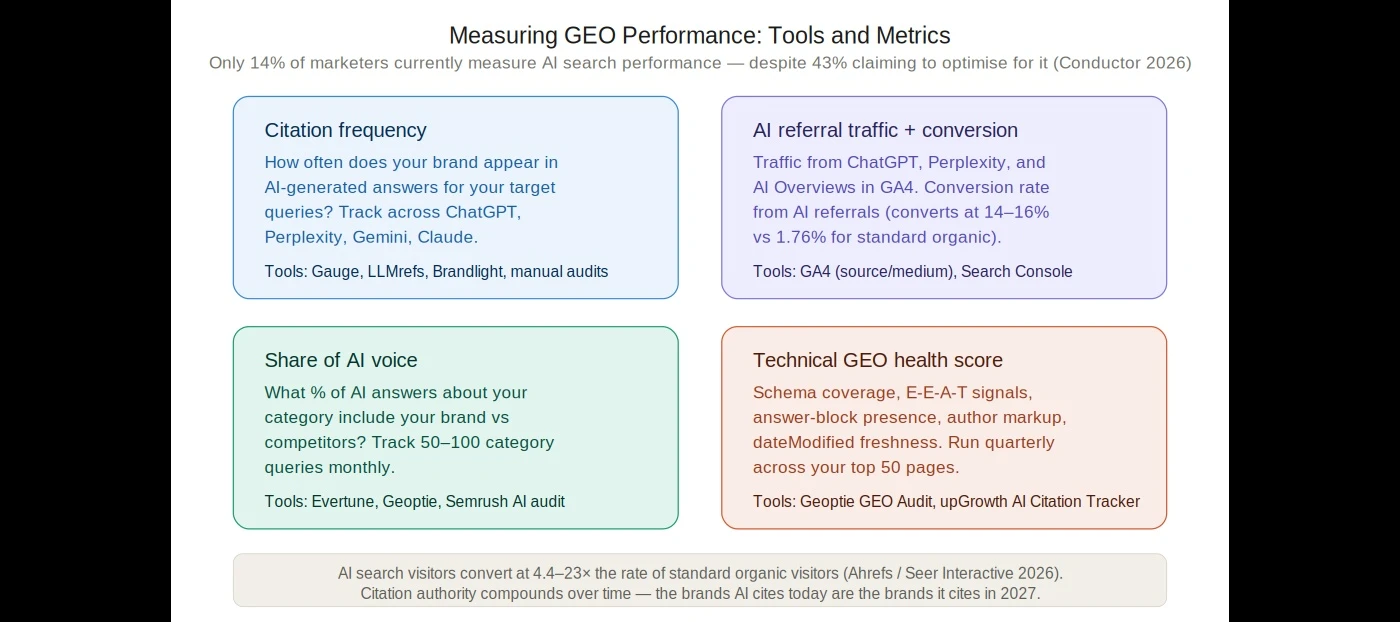
Building a GEO measurement programme for Indian brands:
- Step 1 — Define your citation query set: Build a list of 50 to 100 queries your target buyers use when researching your category. Include head terms ('B2B digital marketing agency India'), mid-tail ('how to choose a digital marketing agency in Bangalore'), and long-tail ('what is the best ABM strategy for Indian BFSI companies'). This becomes your GEO benchmark.
- Step 2 — Run monthly citation audits: For each query in your set, manually check whether your brand is cited in ChatGPT, Perplexity, Gemini, and Google AI Overviews. Record citation frequency, position, and sentiment. Tools like Gauge, Evertune, and Brandlight automate this at scale, but even a manual monthly audit of your top 20 queries provides actionable insight.
- Step 3 — Track AI referral traffic in GA4: In Google Analytics 4, create custom channel grouping for AI referrals. Traffic from chatgpt.com, perplexity.ai, and claude.ai will appear as direct or referral traffic segment explicitly. Track both volume and conversion rate. The conversion rate differential (AI converts at 14–16% vs organic's 1.76%) makes AI referral traffic one of the highest-value channels in your acquisition mix.
- Step 4 — Monitor competitor citation share: GEO is a relative competition. Track not just whether you appear, but whether your competitors appear instead of you. If three competitors appear consistently in AI answers about your category and you do not, that is the gap GEO investment closes.
The compounding dynamic that makes early GEO investment so valuable: citation authority builds over time. AI engines that have cited your content once are more likely to cite it again because the training data and retrieval systems reinforce established citation patterns. The brands AI cites today are the brands AI cites in 2027 and 2028. Starting now builds a compounding advantage; waiting cedes that advantage to competitors.
Conclusion
GEO is the most significant shift in search optimisation since the introduction of mobile-first indexing. The rules have not changed entirely - strong SEO fundamentals, deep content, and genuine domain authority remain in the foundation. But the target has shifted: from the blue-link SERP to the AI-generated answer that now appears above it.
For Indian brands, the opportunity is acute. Almost no India-specific GEO content exists. Coverage of Indian market dynamics, regulatory context, and sector-specific benchmarks is chronically underrepresented in AI training data, which means original Indian content has outsized citation value. The brands that invest in answer-first content, E-E-A-T signals, schema markup, and earned media today will own AI-generated search real estate in 2027 in a way their competitors cannot quickly replicate.
For Indian brands already investing in B2B digital marketing, GEO is the next layer of visibility that search alone cannot provide. It also represents one of the most important emerging marketing technology tactics reshaping how brands build visibility and authority online.
The window is open. But as citation authority compounds over time, the brands that build it first will be the hardest to displace.
If you are ready to build a GEO strategy that gets your brand cited by AI engines across your highest-value search queries. Ready to get your brand cited by ChatGPT, Gemini, and Google AI Overviews? Start with a Langoor GEO audit.
Frequently Asked Questions
1) What is Generative Engine Optimisation (GEO)?
Generative Engine Optimisation (GEO) is the practice of structuring content, schema markup, and brand authority signals so that AI-powered search engines, including Google AI Overviews, ChatGPT, Perplexity, and Gemini, cite your brand as a trusted source in their generated answers. The term was coined in peer-reviewed research from Princeton University, Georgia Tech, and IIT Delhi presented at the ACM SIGKDD Conference in 2024. Unlike traditional SEO, which optimises for ranked link positions, GEO optimises for inclusion in AI-synthesised answers that now appear on 30–40% of all searches.
2) How is GEO different from traditional SEO?
The core difference is the target output. SEO targets a ranked position in the ten blue links on a search results page. GEO targets citation in the AI-generated answer that appears above those links. The authority signals that drive each also diverge: SEO is heavily influenced by backlink quantity and domain authority; GEO is driven by content extractability, schema markup, named author E-E-A-T signals, and earned media mentions. Crucially, the overlap between Google's top-10 results and AI citations has dropped from ~75% in mid-2025 to just 17–38% in early 2026, ranking on page one no longer guarantees AI visibility, and appearing in AI answers does not require ranking on page one.
3) How do I get my brand cited in Google AI Overviews?
Getting cited in Google AI Overviews requires five primary actions: structure your content with a direct 40–60 word answer block at the top of each page; implement FAQ Page, Article, and Organisation schema markup with named author; publish original data, research, or India-specific benchmarks that AI cannot generate from general knowledge; earn third-party media coverage in publications Google indexes heavily; and ensure your Organisation entity is clearly defined with links to Wikipedia, Wikidata, and LinkedIn. Sites with complete Tier 1 schema see up to 40% more AI Overview appearances (Stackmatix 2026).
4) What types of content get cited most by AI engines?
Based on GEO research across multiple platforms, the content types with the highest AI citation rates are: structured FAQ content (maps directly to how AI engines respond to user queries), original research and data-driven articles (42% higher citation rate than generic guides), step-by-step how-to guides, and definitional content that clearly explains concepts, terms, and frameworks. All high-citation content shares a common characteristic: it provides specific, verifiable information in an extractable format that AI engines can surface without significant interpretation.
5) Does GEO replace SEO?
No, GEO extends SEO rather than replacing it. As Mersel AI's 2026 framework notes, 80% of GEO is good, fundamental SEO. Technical site health, content depth, page speed, mobile optimisation, and domain authority all feed into GEO performance, because AI engines that use real-time retrieval (Perplexity, Google AI Overviews) evaluate the same technical quality signals that Google uses for ranking. GEO adds a specific layer on top: answer-first content structure, schema markup, E-E-A-T author signals, and earned media citations. Think of GEO as the AI search layer built on the SEO foundation; both are necessary, but SEO alone is no longer sufficient.
Citations:
- https://www.mersel.ai/generative-engine-optimization
You may also like this