June 2, 2026
Venugopal Ganganna
AI in digital marketing refers to the use of artificial intelligence technologies, including generative AI, predictive analytics, and machine learning, to automate, personalise, and optimise marketing activities. In 2026, 87% of marketers globally use generative AI in at least one workflow, with AI-driven campaigns delivering 30–40% higher ROI than manual optimisation. In India, 78% of businesses now use AI for marketing, with Bangalore leading adoption at 91%.
Introduction
For most Indian marketing teams, AI entered the workflow through the back door. Someone started using ChatGPT to draft a copy. Another team member tried Gemini for keyword research. A performance manager switched to AI-powered bidding on Google. Before long, AI was everywhere, but without a strategy to make it coherent.
That is where most Indian brands still are in 2026: AI adoption without AI strategy. The tools are being used, but the compounding benefits - consistent output quality, faster campaign cycles, personalised customer journeys, AI search visibility, remain out of reach because there is no systematic approach to integration. Much like a well-defined B2B digital marketing strategy, successful AI adoption requires clear objectives, aligned processes, and measurable outcomes rather than isolated tactical efforts.
This guide is for marketing leaders who want to move from ad-hoc AI to a structured, measurable AI marketing capability. It covers what AI in marketing means, where the real ROI is, which tools are accessible in India, and how to build a strategy without dismantling the team that got you here.
Key Takeaways
- 87% of marketers globally use generative AI in at least one workflow in 2026 - up from 51% in 2024 (Salesforce State of Marketing 2026)
- 78% of Indian businesses now use AI for marketing, with the gap between metro and Tier 2 cities shrinking rapidly (MMA-EY / Cloud 9 Digital 2026)
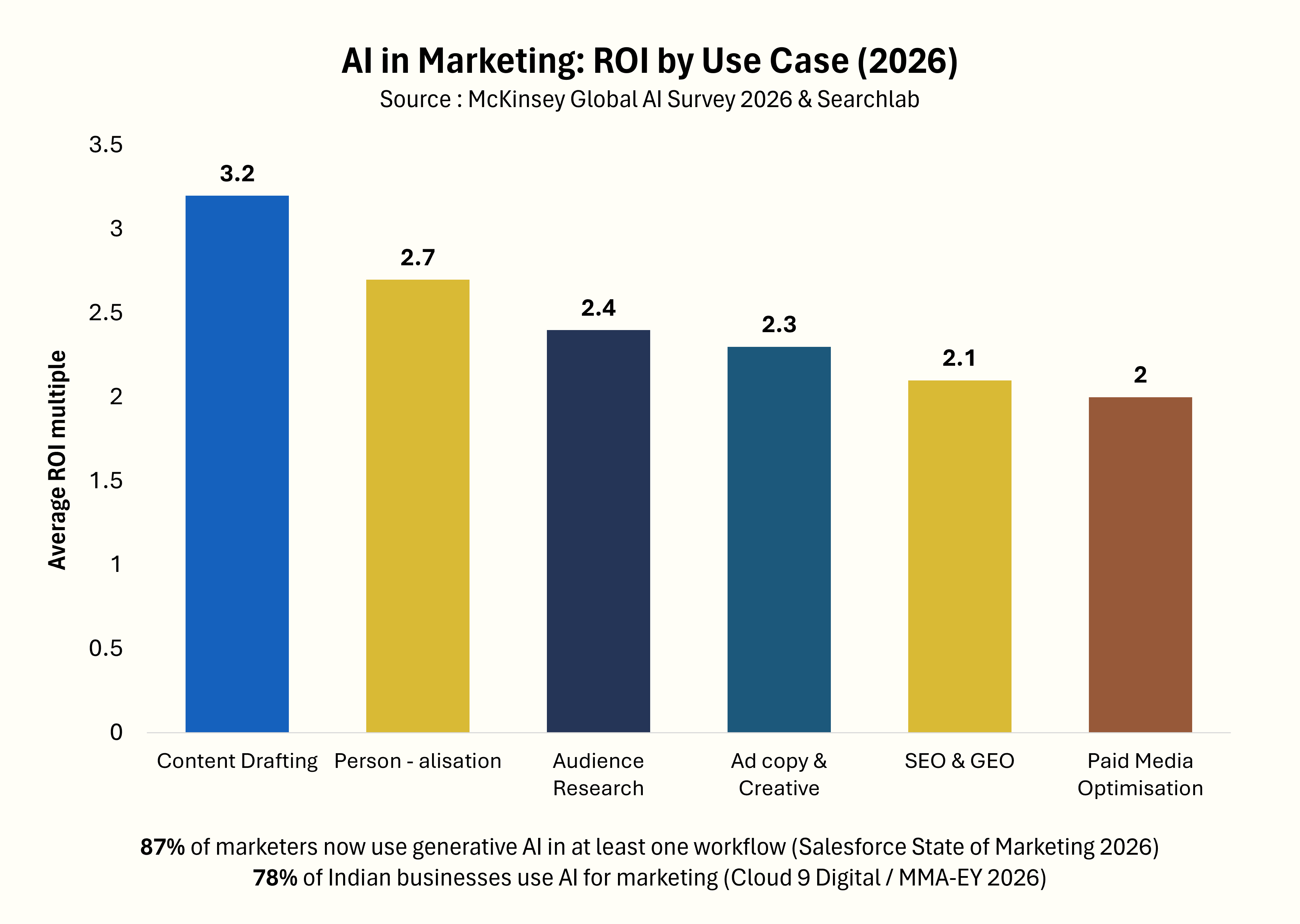
- AI content drafting delivers a 3.2x average ROI; personalisation engines deliver 2.7x (McKinsey Global AI Survey 2026)
- The average marketer saves 6.1 hours per week from AI adoption - rising to 8-10 hours for senior practitioners (HubSpot AI Trends 2026)
- For 34% of B2B marketers, AI search platforms are where qualified prospects first encounter their brand (eMarketer 2026)
- Teams that invest in AI training achieve 43% higher project success rates, yet only 17% of AI users currently receive proper training
- AI is a collaborator, not a replacement, human creative direction, brand voice, and strategic judgement remain essential differentiators
What does AI in digital marketing actually mean?
Artificial intelligence in digital marketing is not a single technology; it is a family of capabilities that can be applied across almost every marketing function. Understanding the distinctions between these capabilities helps marketing leaders deploy them where they deliver the most value.
The three main AI capabilities in marketing are:
- Generative AI: Large language models (LLMs) like ChatGPT, Claude, and Gemini that generate text, images, audio, and video from prompts. Used for content drafting, ad copy, email personalisation, and SEO content at scale.
- Predictive analytics: Machine learning models that analyse historical data to forecast future outcomes, which prospects are most likely to convert, which customers are at risk of churning, which ad creative will outperform. Used for lead scoring, bid management, and audience segmentation.
- Automation and agentic AI: AI systems that execute multi-step tasks autonomously, managing ad bids in real time, routing leads based on behaviour, triggering personalised email sequences, or updating CRM records. Used across paid media, marketing automation, and customer experience.
In 2026, these three capabilities are converging. A single campaign might use generative AI to produce content variants, predictive analytics to decide which variant to serve to which audience, and agentic AI to optimize bid strategies in real time, all without manual intervention between steps.
For Indian brands, the most important shift is conceptual: AI is no longer a tool that assists individual tasks. It is becoming the operational layer through which marketing programs run. The brands that treat it as a productivity add-on will capture some efficiency gains. The brands that redesign their workflows around AI capabilities will compound those gains into structural competitive advantage.
AI for content creation: What works and what doesn't
Content creation is the most widely adopted AI use case globally and in India. It is also the use case most frequently mishandled, producing output that is technically correct but generic, off-brand, or unfit for the audience it is meant to serve.
What AI does well in content creation:
- First-draft generation for blog posts, articles, email sequences, and social captions - saving 60–70% of the time typically spent on blank-page drafting
- Repurposing long-form content into short-form: turning a 2,000-word guide into LinkedIn posts, email snippets, and video scripts
- Scaling content production: teams using AI content tools now produce 4.1x more published content per marketer per month than pre-adoption baselines (HubSpot AI Trends 2026)
- Generating content briefs, outlines, and keyword-mapped structures for SEO programmes
- Translating and localising content for regional Indian languages - Hindi, Tamil, Telugu, Kannada, where vernacular content demand is growing at 156% YoY in Tier 2/3 cities
What AI does not do well in content creation:
- Original research, proprietary data, and genuinely novel insights, the content that earns citations and builds domain authority
- Brand voice consistency without well-engineered prompts and editorial human review
- India-specific cultural nuance, regulatory context, and market-specific framing that resonates with Indian B2B buyers
- Authenticity signals, real case studies, named client outcomes, and executive perspectives that build trust
The correct model for Indian marketing teams is AI as collaborator, not creator. A skilled marketing writer using AI as a drafting and structuring tool produces better output faster than either AI alone or a human working without AI assistance. The editorial judgement, India-specific framing, and brand voice remain human responsibilities. The research structuring, first-draft generation, and variant production are where AI earns its ROI.
AI-powered personalization: Moving beyond first-name emails
Personalization in marketing has existed for decades, segment by job title, insert first name, done. AI-powered personalization is categorically different. It responds to real-time behavioural signals to dynamically adapt to what content, offer, or experience an individual sees, without manual segmentation or rule-building.
The difference between basic personalization and AI personalization is the shift from static rules to dynamic prediction. A rule-based system says: 'If the user is in BFSI, show them the banking case study.' An AI personalization system says: 'This specific user visited the compliance page three times, downloaded the RBI whitepaper, and attended the fintech webinar, serve them the core banking modernization content with a specific CTA.'
AI personalization delivers 2.7x average ROI across use cases (McKinsey, 2026). In Indian B2B contexts, personalization is most impactful in:
- Website experience: Dynamically adapt homepage messaging, CTAs, and featured case studies based on the visiting company's industry, company size, and prior engagement
- Email marketing: AI-driven send-time optimization and content selection that goes beyond subject-line testing to full email body personalization
- WhatsApp and in-app messaging: India-specific channels where MoEngage, WebEngage, and CleverTap enable real-time personalised messaging at scale
- Retargeting and paid media: AI audience modelling that identifies and targets lookalike audiences based on your highest-value converters, not demographic proxies
A critical consideration for Indian brands in 2026 is India's Digital Personal Data Protection (DPDP) Act. AI personalization programs must be built on explicit, purpose-specific consent. First-party data, collected from your own website, CRM, and marketing automation platform, is the only legally and commercially sustainable foundation for AI personalization in India. Third-party data dependencies are a compliance risk and an increasingly poor signal.
AI becomes more effective when businesses can combine data from multiple channels and customer interactions into a unified customer profile and deliver personalised experiences at scale.
Using AI for paid media optimization and bid management
Paid media is where AI has delivered the most measurable, fastest-compounding results for Indian marketers. AI-powered bid management, audience optimization, and creative testing reduce cost per acquisition by an average of 41% compared to manual management (McKinsey, 2026).
The key AI capabilities in paid media are:
- Performance Max (Google): Google's AI-first campaign type that automatically allocates budget across Search, Display, YouTube, Gmail, and Maps based on conversion probability. For Indian brands with broad audience reach goals, PMax consistently outperforms manually managed campaigns at equivalent or lower CPAs.
- Meta Advantage+: Meta's AI campaign automation that tests creative variants, expands audiences, and adjusts placements dynamically. Advantage+ campaigns in India have shown 20–32% improvement in cost per result versus manual campaigns in Meta's own data.
- LinkedIn AI targeting: LinkedIn's predictive audience expansion and AI-powered Lead Gen Form optimization. For Indian B2B marketers targeting CXOs and department heads, LinkedIn's AI targeting improves click-through rates by 25–30% versus manually defined audiences.
The important caveat: AI-powered paid media requires strong inputs to deliver strong outputs. Creative quality, landing page relevance, conversion tracking accuracy, and first-party audience data all determine how well the AI optimises. Feeding a Performance Max campaign with weak creative and a poor-converting landing page will produce an efficiently optimised path to a bad outcome. AI amplifies your inputs; it does not correct them.
For Indian brands, the recommended approach is to run AI-powered campaigns alongside a controlled human-managed baseline for the first 60 to 90 days, measure performance against the same KPIs, and gradually shift budget toward AI-managed campaigns as performance validates.
AI for SEO and Generative Engine Optimisation (GEO)
Search optimisation in 2026 has a new dimension that most Indian brands are not yet addressing systematically: Generative Engine Optimisation (GEO). Traditional SEO gets your content to rank in the ten blue links on Google. GEO gets your brand cited in AI-generated answers from Google AI Overviews, ChatGPT, Perplexity, and Gemini, which now appear for an estimated 30 to 40% of all searches.
For 34% of B2B marketers globally, AI search platforms are now where qualified prospects first hear about their brand (eMarketer 2026). For Indian CXOs who increasingly use AI tools as the first step in vendor research, this means a brand that does not appear in AI-generated shortlists may be invisible before a human conversation ever begins.
AI is also transforming how SEO work is done:
- AI-powered keyword research tools like Semrush AI and Ahrefs AI identify topical clusters, intent gaps, and SERP feature opportunities faster than manual research
- Content brief generation: AI analyses top-ranking pages and builds structured content briefs in minutes rather than hours
- Technical SEO automation: AI tools identify crawl errors, page speed issues, and schema markup gaps at scale, critical for large Indian enterprise websites
- Content refresh identification: AI surfaces underperforming pages with high-ranking potential, prioritising update effort based on traffic and conversion opportunity
The GEO signals that determine whether your content gets cited by AI engines are distinct from traditional SEO ranking factors. They include: structured data and schema markup, E-E-A-T signals (experience, expertise, authoritativeness, trustworthiness), answer-first content structure (direct 40–60 word answer blocks before elaboration), named author authority, and content that references original research or data. Indian brands that invest in these signals in 2026 will build AI search visibility that compounds, because AI engines increasingly cite sources they have cited before.
AI in customer experience: Chatbots, voice agents, and beyond
Customer experience is the third major frontier for AI in marketing, and in India, it is moving faster than most brands are prepared for. AI-powered customer interactions are no longer limited to basic FAQ chatbots. In 2026, AI agents can handle complex, multi-turn conversations, qualify leads, book demos, resolve support queries, and escalate to human agents with full context.
The most impactful AI CX applications for Indian brands:
- AI-powered website chat: Tools like Intercom, Drift, and HubSpot AI chatbot qualify website visitors in real time, route high-intent accounts to sales, and handle informational queries 24/7. For Indian B2B brands with international clients across time zones, AI chat bridges the coverage gap without headcount expansion.
- WhatsApp AI agents: With over 500 million WhatsApp users in India, brands like Haptik, Yellow.ai, and Gupshup enable conversational AI at scale on the platform where Indian buyers spend time. AI WhatsApp agents can run lead qualification sequences, send personalised content, and book appointments, all within the channel.
- Voice search and voice AI: Over 50% of Indian users now use voice search, predominantly in regional languages. Optimising content for voice queries, conversational phrasing, featured snippet positioning, and local context, is an AI-adjacent opportunity most Indian brands are ignoring.
- AI-powered lead scoring: Predictive lead scoring models (available through HubSpot, Salesforce Einstein, and MoEngage) rank leads by conversion probability, allowing sales teams to prioritise follow-up on accounts most likely to close, rather than working first-in, first-out.
The guardrail that matters most in AI CX is human escalation design. AI agents that cannot recognise when a conversation has exceeded their capability and route to a human seamlessly damage customer experience more than they improve it. Every AI CX deployment should define the boundaries of AI authority and the triggers for human handoff before going live.
AI marketing tools available in India in 2026
The AI marketing tool landscape has expanded rapidly, but not all globally available tools have equal utility for Indian brands. Pricing, regional language support, local customer support, and integration with Indian-market platforms like Zoho, MoEngage, and WhatsApp Business determine which tools are practically deployable in the Indian context.
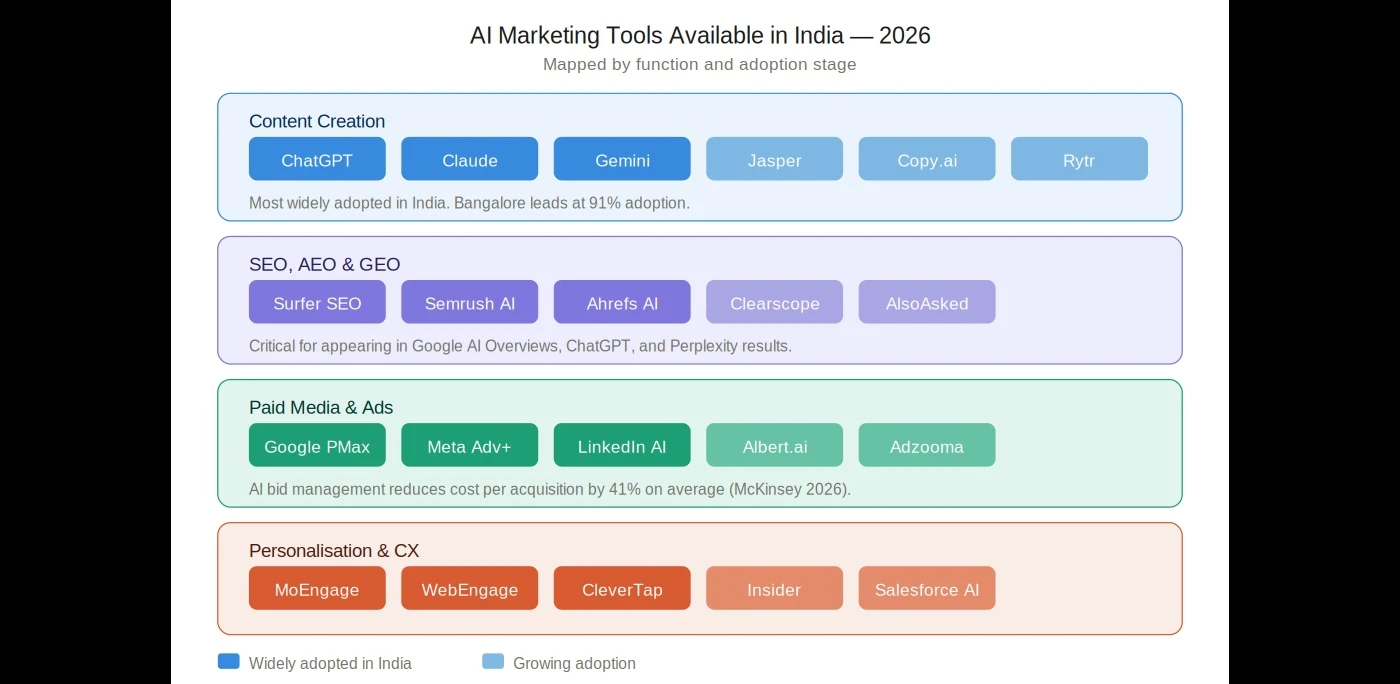
A note on Indian-built tools: MoEngage, WebEngage, and CleverTap are Bangalore-headquartered platforms that have built significant AI personalisation capabilities for Indian and global markets. These tools understand Indian consumer behaviour patterns, regional language requirements, and WhatsApp-first engagement, making them more contextually appropriate for Indian B2B and B2C marketing programmes than many global alternatives.
For B2B content and SEO specifically:
- ChatGPT (OpenAI), Claude (Anthropic), and Gemini (Google) are the three most widely used generative AI tools in Indian marketing teams
- Surfer SEO and Semrush AI are the most used AI-powered SEO tools among Indian digital agencies
- Google Performance Max and Meta Advantage+ are the dominant AI paid media tools, both are fully available and widely used in India
- Bombora and 6sense for intent data, combined with LinkedIn Campaign Manager, form the backbone of AI-enabled Account Based Marketing in India
How to build an AI marketing strategy without replacing your team
The most common fear among Indian marketing professionals about AI is that it will eliminate jobs. The data tells a different story. Junior copywriting roles are contracting; 23% of agencies reduced junior copywriting headcount in 2025 (Gartner CMO Spend Survey). But senior strategist demand is climbing. AI is not eliminating marketing; it is redefining which skills drive value.
The marketers who will thrive in an AI-first environment are those who can set strategic direction, maintain brand voice and creative standards, interpret AI outputs critically, and build the briefs and guardrails that make AI outputs useful. These are human capabilities. The brands that invest in upskilling their teams alongside AI deployment will outperform those that treat AI as a headcount replacement.
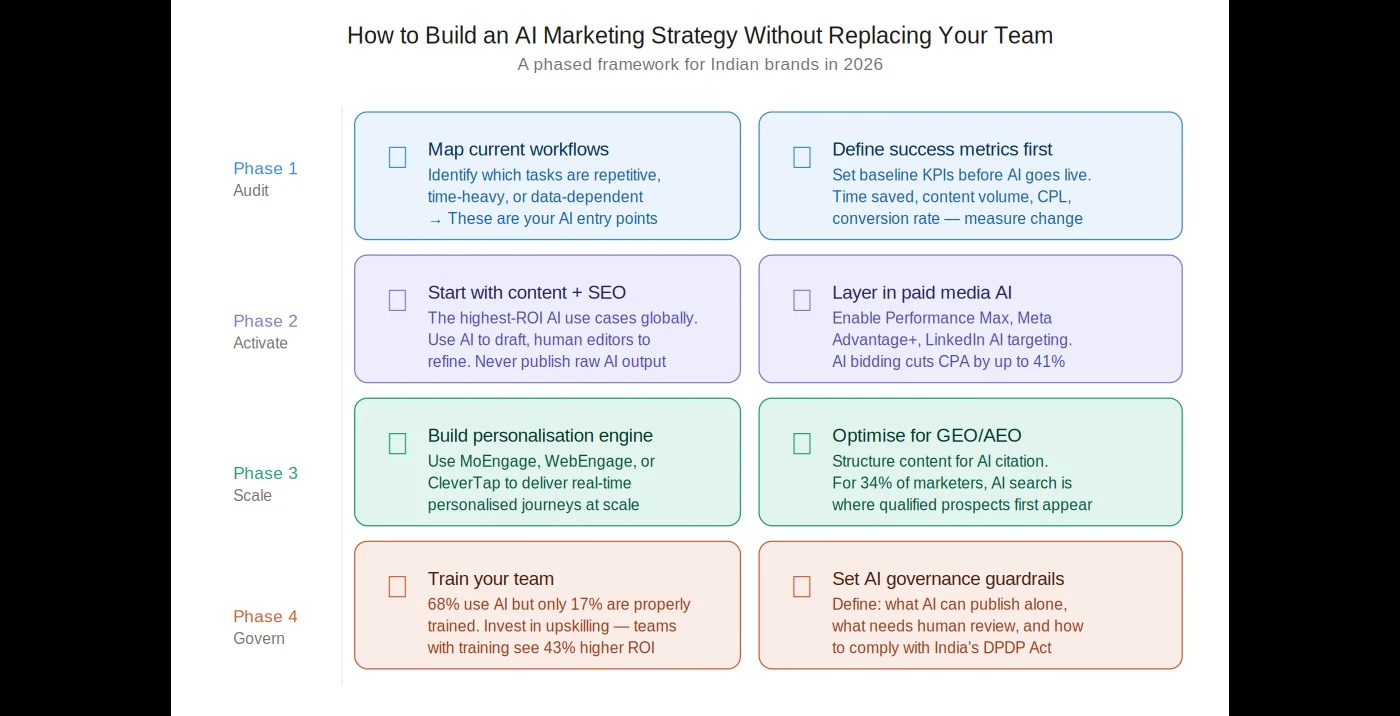
The eight-step framework above translates to a practical timeline for most Indian enterprises:
- Months 1 to 2: Workflow audit and baseline measurement. Identify AI entry points. Define success KPIs.
- Months 2 to 4: Activate content AI and paid media AI in parallel. Measure output quality, time savings, and performance versus baseline.
- Months 4 to 6: Layer in personalisation infrastructure and GEO/AEO content optimisation. Begin AI chatbot or WhatsApp agent pilots.
- Month 6 onwards: Invest in team training, formalise AI governance policies, and build compliance framework aligned with India's DPDP Act.
The single most important enabler of AI marketing success that is consistently underinvested in India is training. Only 17% of marketers using AI tools receive proper training (Loopex Digital, 2026). Teams with structured AI training achieve 43% higher success rates on AI initiatives. The ROI training is not theoretical; it is the difference between AI that produces generic content and AI that produces brand-consistent, strategically coherent output at scale.
Conclusion
AI in marketing is not a future investment; it is a present competitive requirement. The numbers are no longer ambiguous: 87% global adoption, 35% average ROI improvement, 6.1 hours saved per marketer per week. Indian brands that have not yet built a systematic AI capability are already behind, but not irreversibly so.
The window to build meaningful competitive advantage through AI is still open. The brands that will own that advantage are not the ones that adopted the most tools, they are the ones that integrated AI most thoughtfully into their content, paid media, personalisation, and search visibility strategies, while preserving the human creative direction that makes marketing resonate.
AI is the scale. Human expertise is the signal. Indian brands need both.
If you are ready to build an AI marketing strategy that connects to measurable pipeline growth, get in touch with the Langoor team at langoor.com/contact.
Frequently Asked Questions
1) How is AI used in digital marketing?
AI is used across virtually every marketing function in 2026. The most common applications are: generative AI for content creation (blog posts, ad copy, email, social), predictive analytics for lead scoring and audience segmentation, AI-powered bid management for paid media (Google PMax, Meta Advantage+), personalisation engines that dynamically adapt website and email content to individual users, and AI chatbots and voice agents for customer experience and lead qualification. These use cases closely align with the broader digital marketing trends shaping how brands engage customers and drive growth. In India, 78% of businesses now use AI for marketing in some form.
2) What are the best AI tools for digital marketing in India?
The most widely adopted AI marketing tools in India in 2026 are: ChatGPT, Claude, and Gemini for content creation; Surfer SEO and Semrush AI for search optimisation; Google Performance Max and Meta Advantage+ for paid media automation; MoEngage, WebEngage, and CleverTap for AI personalisation and CX (all India-headquartered); and HubSpot or Salesforce Einstein for predictive lead scoring. For B2B marketers, Bombora and 6sense provide intent data, while LinkedIn Campaign Manager offers AI-powered account-matched advertising.
3) Can AI replace digital marketers?
No, but AI is reshaping which marketing skills drive value. Junior copywriting and repetitive production roles are contracted as AI handles first-draft generation and content scaling. Senior strategy, brand voice, creative direction, and analytical interpretation roles are growing in demand and compensation. The marketers at most are those who use AI without developing the judgement to direct, evaluate, and edit its outputs. The same shift is transforming areas such as AI-powered demand generation, where success depends less on automation alone and more on strategic oversight, audience intelligence, and continuous optimisation. The marketers who thrive will be those who treat AI as a multiplier of their expertise, not a replacement for it. Only 17% of AI users receive proper training; that gap is the opportunity.
4) How does AI improve marketing ROI?
AI improves marketing ROI through four primary mechanisms. First, efficiency: AI reduces content production time by 60–70%, allowing teams to produce more output at the same cost. Second, optimisation: AI bid management reduces cost per acquisition by up to 41% compared to manual campaign management. Third, personalisation: AI-driven personalised experiences deliver 2.7x higher ROI than generic marketing by serving the right content to the right person at the right moment. Fourth, visibility: AI search optimisation (GEO/AEO) secures brand citations in AI-generated answers, building awareness before a buyer ever reaches your website. On average, companies see a 35% ROI improvement from AI marketing investments (McKinsey, 2026).
5) What is the difference between AI marketing and marketing automation?
Marketing automation uses predefined rules and workflows to execute repetitive tasks. If a user downloads a whitepaper, send them an email sequence. AI marketing goes further: it learns data, makes predictions, and makes decisions that were not explicitly programmed. An automation system follows rules; an AI system improves its decisions over time by analysing what worked. In practice, the best marketing technology stacks in 2026 combine both: marketing automation platforms like HubSpot and Marketo increasingly embed AI capabilities (predictive lead scoring, send-time optimisation, content recommendations) into their workflow automation infrastructure. AI and automation are not alternatives; they are layers of the same system.
This convergence highlights why marketers must continually evaluate whether does your marketing know technology, and whether their existing stack can support the intelligence, personalisation, and scale required by modern customer journeys.
You may also like this