August 4, 2026
Venugopal Ganganna
AI Overview
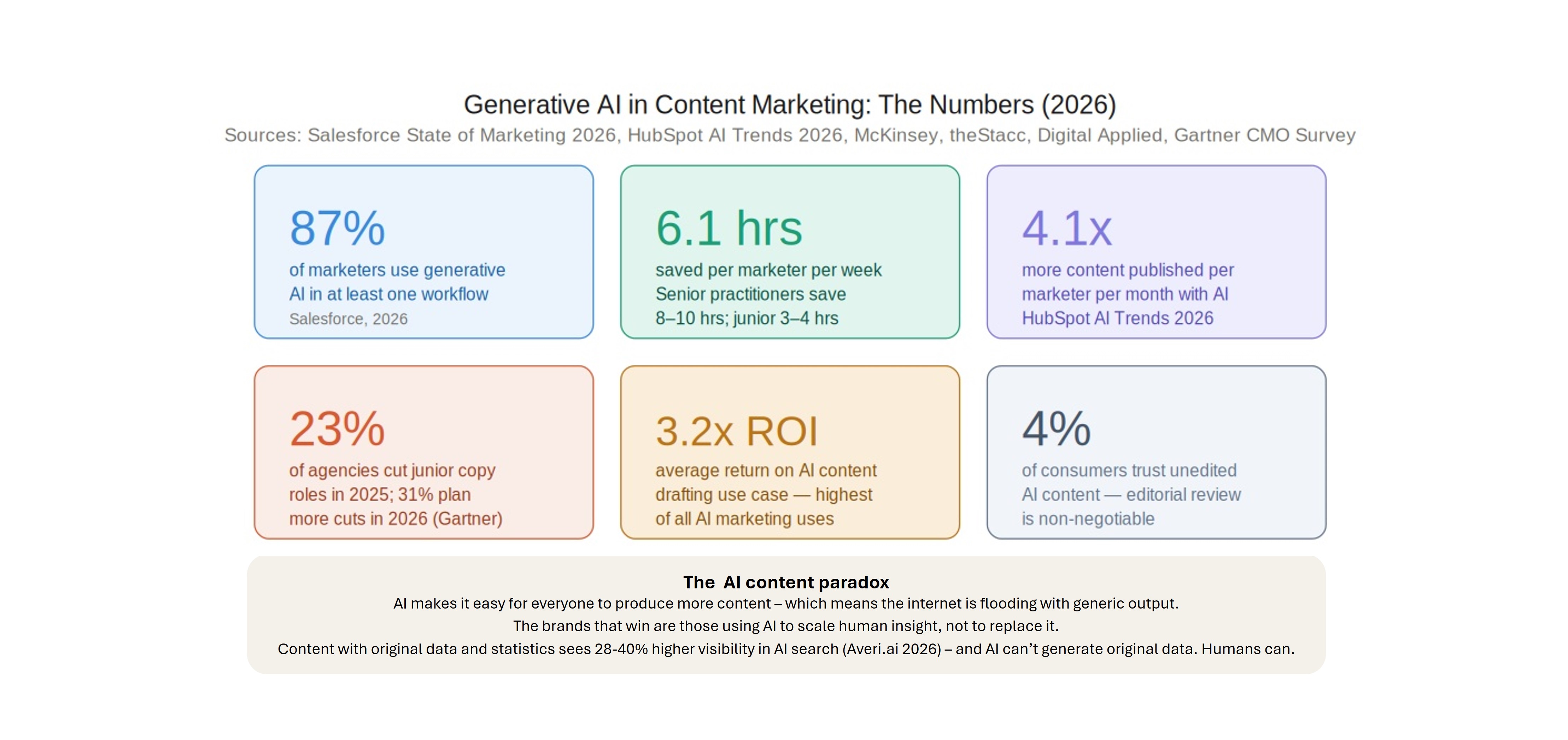
Generative AI for content marketing refers to the use of large language models, including ChatGPT, Claude, Gemini, and Jasper, to assist with content creation tasks including drafting, editing, summarising, translating, and repurposing marketing content. In 2026, 87% of marketers use generative AI in at least one workflow, up from 51% in 2024. AI content drafting delivers an average 3.2x ROI. The risk is not using AI — it is using it badly, producing generic content that sounds like everyone else.
Introduction
If you work in marketing in India in 2026, you are almost certainly already using AI in some form. Someone on your team has used ChatGPT to draft an email. Someone else used Gemini to summarise a report. Maybe you have tried generating a blog post or converting a presentation into social media content.
The question most Indian marketing teams are now grappling with is not whether to use AI, that decision has largely been made for them. It is how to use it without producing content that sounds hollow, looks generic, and fails to represent what makes their brand distinctive.
This is the right question. The risk of AI in content marketing is not that it replaces good writers, it is that it makes it easy to produce large volumes of mediocre content that dilutes your brand, undermines trust, and adds to the avalanche of forgettable material already filling the internet. The answer is not to use less AI. It is to use it more deliberately, as a collaborator that handles production tasks, while humans retain the strategy, insight, and voice that make content worth reading.
Key Takeaways
- 87% of marketers now use generative AI in at least one workflow in 2026, up from 51% in 2024. Non-adoption is now the exception (Salesforce State of Marketing 2026)
- AI content drafting delivers an average 3.2x ROI, the highest return of any AI marketing use case (McKinsey Global AI Survey 2026)
- The average marketer saves 6.1 hours per week from AI adoption; senior practitioners save 8–10 hours (HubSpot AI Trends 2026)
- Teams using AI produce 4.1x more content per marketer per month than those without it, but only 4% of consumers trust unedited AI content (HubSpot / theStacc 2026)
- 23% of agencies reduced junior copywriting headcount in 2025; 31% plan more cuts in 2026, but demand for senior strategists and editors is growing (Gartner CMO Spend Survey)
- Content with original data and statistics gets 28–40% higher visibility in AI search results, and AI cannot generate original data. That remains a distinctly human advantage (Averi.ai 2026)
- Google does not penalise AI-generated content. It penalises low-quality content that fails to help users, regardless of how it was produced (Google Search Central, confirmed 2026)
What is generative AI in the context of content marketing?
Generative AI refers to artificial intelligence systems that can create new content: text, images, audio, and video, based on instructions you give them. The most widely used tools in content marketing are large language models (LLMs): ChatGPT from OpenAI, Claude from Anthropic, Gemini from Google, and Jasper, which is purpose-built for marketing.
These tools work by predicting what text should come next based on patterns learned from billions of examples of human writing. They are very good at producing fluent, structurally correct content quickly. They are not so good at having original ideas, knowing your specific customers, understanding your brand's history, or generating insights that do not already exist somewhere on the internet.
In content marketing, generative AI is most used for:
- Writing first drafts of blog posts, articles, and guides from a brief
- Repurposing long-form content into shorter formats, turning a whitepaper into a LinkedIn post, a blog into an email, a webinar into a summary
- Generating multiple headline and subject line variations for testing
- Translating and localising content for Hindi, Tamil, Telugu, and other regional Indian languages
- Producing content briefs and outlines from a keyword or topic
- Summarising customer research, competitor analysis, or long documents
What separates brands that get genuine value from AI from those that produce mediocre output at scale is the same thing that separates good content from bad content: having something original to say and saying it in a way that reflects a clear and distinctive point of view. AI can produce words. It cannot produce genuine expertise, lived experience, or authentic brand identity. That distinction is everything.
The content that AI cannot generate — original research, India-specific benchmarks, proprietary case study data — is exactly what earns citations from AI search engines. Our GEO guide explains why original data earns 42% higher AI citation rates than generic content.
The AI content trap: Why most AI-generated content fails
There is a paradox at the heart of AI content marketing in 2026. AI makes it easy for everyone to produce more content, which means the internet is now flooded with more content than ever before; most of it is indistinguishable from everything else. The brands that thought AI would give them a content advantage are finding that their competitors have the same advantage, and the result is a sea of sameness.
The failure modes are consistent and predictable:
- No original insight: AI can only synthesise what already exists. If you ask it to write about 'B2B marketing trends in India,' it will produce a competent summary of things that have already been written about B2B marketing. It cannot tell you something new, share a proprietary perspective, or offer genuine analysis. Content that says nothing new is content that earns nothing: no links, no citations, no trust.
- No brand voice: Every AI-generated article sounds like every other AI-generated article. The same hedging phrases, the same structural patterns, the same mild and inoffensive tone. If your content sounds interchangeable with your competitors, it is not doing its job. Brand voice, the specific way your organisation thinks, speaks, and sees the world, requires human investment to define and maintain.
- Factual errors and outdated information: AI models have trained data cutoffs and regularly generate confident-sounding claims that are inaccurate, outdated, or simply fabricated. Publishing AI content without factchecking is one of the fastest ways to damage professional credibility, particularly for Indian B2B brands where accuracy and expertise are the primary trust signals.
- Producing volume instead of value: Teams that use AI primarily as a volume machine, 'let' publish 30 articles a month instead of five', typically see declining content performance, not improving. Google's algorithms in 2026 are sophisticated enough to identify thin, undifferentiated content at scale. More content without more quality is usually negative.
The solution is not to use less AI. It is to be clear about what role AI plays in your content programme, production and structure, and what role humans play: insight, voice, and editorial judgement. Only 4% of consumers trust unedited AI content. But when AI drafts are shaped by genuine human expertise, that content can perform as well as or better than purely human-written work.
How to use AI as a content collaborator, not a replacement
The most useful mental model for AI in content marketing is this: AI is a very fast, very capable junior writer. It can produce a well-structured first draft quickly, handle repetitive production tasks, and do research tasks that would take a human hour. But it needs direction, oversight, and editing, just as a junior writer does. The more experienced and specific the direction you give it, the better the output.
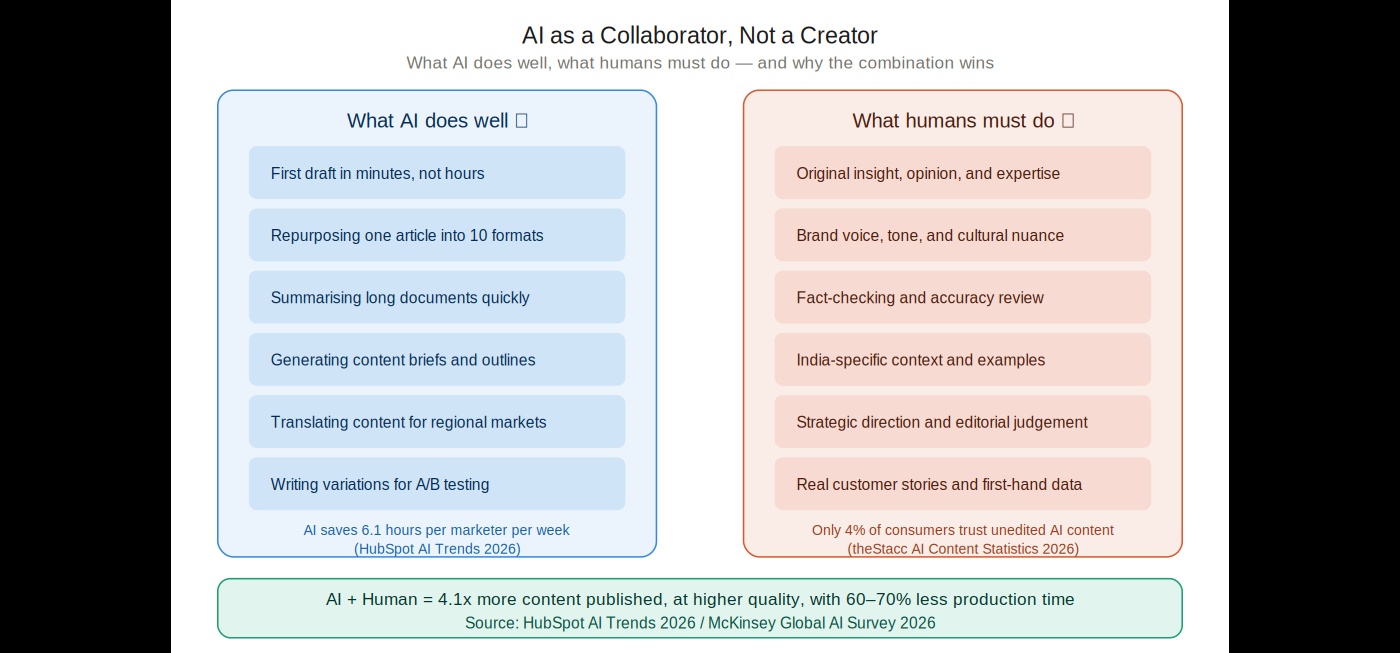
Using AI as a genuine collaborator means thinking carefully about where in the content process it adds value and where it does not:
- AI adds the most value in production: The blank page is the most expensive problem in content creation. AI eliminates it. A well-structured brief fed into ChatGPT or Claude produces a first draft in minutes that a skilled editor can refine in an hour, rather than a writer spending half a day building from scratch. This is where the 60 to 70% time saving comes from, and where the 6.1 hours per week per marketer is recovered.
- Humans add the most value in insight and editing: The difference between an AI draft and a piece of content worth publishing is usually what happens in editing: the India-specific example the human adds, the client story that grounds an abstract point, the sentence that expresses the company's genuine point of view rather than a diplomatically hedged version of it. This editing layer is non-negotiable. It is also where experienced content professionals are becoming more valuable, not less.
- Prompting is a craft: The quality of AI output is directly proportional to the quality of the brief you give it. 'Write a blog about B2B marketing' produces generic output. 'Write a 1,500-word article for Indian B2B marketing leaders about why demand generation and lead generation are different strategies, opening with a specific scenario of a Mumbai-based SaaS company whose pipeline has flatlined despite strong lead volume' produces something useful. Learning to write specific, context-rich prompts is the most valuable skill a content marketer can develop in 2026.
The practical test: before publishing any AI-assisted content, ask whether it contains at least one thing that AI could not have written, a specific client example, a proprietary data point, a genuinely original perspective, or a cultural observation grounded in firsthand experience. If the answer is no, it is not ready.
Struggling to build a consistent content programme with your current team? Langoor designs AI-assisted content operations for Indian brands, combining AI production efficiency with the human editorial rigour that makes content rank, earn citations, and build genuine brand authority. Talk to the Langoor content team at langoor.com/contact →
Generative AI for different content types: Blog posts, social media, email, and video
AI performs differently across content formats. Understanding where it is most effectively helps Indian marketing teams allocate AI and human effort more efficiently.
The pattern across all formats: AI handles structure and production; humans handle substance and voice. The formats where AI contributes least, case studies and original research, are also the formats that earn the most trust, citations, and links. This is not a coincidence. The content that takes the most human effort to produce is also the content that delivers the most commercial value.
For Indian brands specifically, regional language content is an area where AI is genuinely transforming what is possible. Producing high-quality Hindi, Tamil, Telugu, or Kannada marketing content previously required specialist writers for each language. AI translation and localisation tools have reduced that barrier significantly, though human review by a native speaker remains essential for tone, cultural appropriateness, and accuracy.
Maintaining brand voice when using AI tools
Brand voice is the single most important thing Indian marketing teams need to protect when integrating AI into their content workflow. It is also the thing AI is worst at preserving without explicit guidance.
Left to default settings, AI produces content in a generalised 'professional marketing' voice: competent, inoffensive, and completely indistinct. For brands that have invested years building a specific way of communicating with their audience, this default is actively harmful.
The practical approaches that work for maintaining brand voice with AI:
- Build a brand voice guide specifically for AI prompts: Document your brand's tone (formal vs conversational, cautious vs bold), vocabulary preferences (words you use and words you avoid), structural patterns (how your brand typically opens and closes pieces), and India-specific style conventions. Feed this guide as a system prompt or context document to AI tools before generating any content. The more specific and example-rich this guide is, the more accurate AI will reflect your voice.
- Use your best-performing content as training examples: Rather than describing your voice in the abstract, show AI what it looks like. Include two or three examples of your best existing content in the prompt and ask the AI to 'match the tone, structure, and voice of these examples. This produces significantly better output than stylistic descriptions alone.
- Create a voice audit checklist: A short list of questions your editor checks every AI-generated piece against: Does this sound like us? Does it include something a competitor could not have written? Does it avoid our banned phrases? Does it use our preferred terminology for products and services? This checklist takes ten minutes to create and saves significant editing time.
- Keep senior voices human: Executive thought leadership content, the CMO's LinkedIn posts, the CEO's LinkedIn newsletter, the founder's industry commentary, should always be human led. AI can assist with research and structure, but the final voice must be humans. These are the content assets that build the personal authority on which trust compounds.
The brands winning at AI content in 2026 are those treating brand voice as a strategic asset that requires active investment to preserve, not a natural property of content that will take care of itself. Define it explicitly. Document it thoroughly. Enforce it consistently.
Original research and human insight: The content AI cannot replicate
There is one category of content where AI contributes almost nothing, and humans contribute everything: original research and first-hand insight. And this is precisely the content that earns the most — in links, in AI citations, in trust, and in commercial impact.
Content with original data and statistics earns 28 to 40% higher visibility in AI search results compared to generic guides (Averi.ai, 2026). B2B pages with proprietary research see 42% higher citation rates in Google AI Overviews compared to content that synthesises existing sources (Infineural 2026). When an Indian brand publishes original market data: a salary survey, an industry benchmark, a buyer behaviour study, that data becomes the source that AI engines cite, that media organisations reference, and that competitors cannot replicate without conducting the same research.
The content types that AI cannot produce but that deliver the highest commercial return:
- Original survey research: A study of 200 Indian CMOs on marketing budget allocation, conducted by your team, produces data that exists nowhere else. It earns media coverage, LinkedIn shares, analyst attention, and AI citations, because it tells people something they did not already know.
- Client case studies with named outcomes: A case study that names the client, describes the specific challenge, and quantifies the specific result earns more trust than any amount of AI-generated thought leadership. The specificity is the proof. AI can write generic case studies. It cannot write true ones.
- Founder and practitioner perspectives: A CMO's genuinely held view on why a particular marketing strategy does not work in India, based on ten years of experience, is interesting in a way that a synthesised summary of existing views is not. First-hand professional experience is a non-replicable content asset.
- Cultural and market-specific insight: Content that explains how B2B buying decisions work differently in Indian family-owned conglomerates vs MNC subsidiaries, or why BFSI marketing in India requires a different playbook than BFSI marketing in Singapore, is valuable precisely because AI cannot generate it without someone who has actually operated in these markets.
The strategic implication: use AI to scale the production of content that distributes your expertise. Invest heavily in producing the original insight, research, and first-hand experience that gives that content something worth distributing. The brands that do both will compound advantages in authority, trust, and AI search visibility that brands doing only one cannot replicate.
Want original research content that earns AI citations and media coverage? Langoor's content team designs and produces India-specific research reports, from survey design and data collection through to publication, media outreach, and distribution — that build category authority competitors can't copy. Speak to Langoor about original research content at langoor.com/contact →
AI content and SEO: What Google's policies mean in 2026
The question Indian marketing teams ask most frequently about AI content is: will Google penalise it? The answer, clearly stated in Google's official Search Central documentation and confirmed by multiple independent studies in 2026, is no, not automatically.
Google's position is straightforward: it evaluates content against its E-E-A-T framework: Experience, Expertise, Authoritativeness, and Trustworthiness, and that evaluation applies equally whether a person or a language model produced the text. What Google explicitly penalises is content created to manipulate search rankings rather than help users, regardless of how it was produced.
What this means in practice:
- AI-assisted content can rank perfectly well: If it is accurate, helpful, demonstrates genuine expertise, and serves real user needs. Google's December 2025 Core Update reinforced this by targeting quality signals, thin content, lack of original insight, poor user experience, not AI authorship.
- What Google does penalise: Mass-produced thin pages built primarily to rank rather than to help. Content that says nothing new, provides no genuine value, and exists primarily to capture keyword traffic at volume. This content gets penalised whether it is AI-generated or human-written.
- E-E-A-T requires human credibility signals: The 'Experience' dimension of E-E-A-T, added to Google's framework in December 2022, specifically rewards content that shows first-hand involvement with the topic. AI content by definition cannot demonstrate personal experience. This is why human authors with verified credentials and schema attribution remain important even in an AI-assisted content world.
- Human byline matters: Google recommends human bylines, particularly Google News. AI authorship raises E-E-A-T red flags because there is no accountable human expert behind the content. Every AI-assisted article should be attributed to a named human who can stand behind its accuracy and insight.
The safe workflow, confirmed by Google's own guidance: use AI to assist with research, structure, and drafting. Add genuine human expertise, first-hand examples, and editorial judgement. Publish under a named human author with credentials. The tool used to produce a draft is irrelevant to Google. The quality and helpfulness of the finished piece is everything.
Building an AI-assisted content workflow for your marketing team
The difference between marketing teams that benefit from AI and those that are disappointed by it usually comes down to workflow design. Teams that simply hand AI a topic and publish whatever comes back get mediocre results. Teams that design a structured process, with clear AI roles, clear human roles, and clear quality checkpoints, see significant productivity and quality improvements simultaneously.
Building this workflow for your team:
- Step 1 : Define what AI handles and what it doesn't: Before deploying AI in your content process, document clearly which tasks AI will assist with and which remain human-only. First draft production: AI. Client case study content: human. Headline variants: AI. Executive thought leadership: human. Making this explicit prevents the creeping over-reliance on AI that produces bland output.
- Step 2 : Build your prompt library: The quality of AI output is determined by the quality of prompts. Build a shared library of proven prompts for your most common content types — blog posts, LinkedIn posts, email newsletters, WhatsApp summaries. Refine these prompts based on output quality. The best prompts include: the content goal, the target audience, the word count, the tone, examples of your brand voice, and specific India-market context.
- Step 3: Create an editorial checklist: Every AI-assisted piece should pass through a human editor who checks: Is this factually accurate? Does it contain at least one original insight, or does the example AI not have produced? Does it sound like our brand? Is it genuinely useful to the intended reader? Has the author's attribution and schema been added correctly? This checklist is the quality gate that separates effective AI content programmes from volume machines.
- Step 4: Measure the right things: Do not measure AI content success by volume. Measure it by organic traffic to AI-assisted posts, lead generation from content, time to draft (efficiency metric), content-influenced pipeline, and AI Overview citation rate for target queries. These metrics connect your AI content investment to commercial outcomes rather than production metrics.
- Step 5: Invest in AI training for your team: Only 17% of marketing teams using AI tools receive proper training (Loopex Digital 2026). Teams with structured AI training achieve 43% higher success rates on AI initiatives. Investing two to four hours per month in team AI upskilling, new tools, better prompting techniques, workflow refinements, compounds into significantly better content output over time.
Want to build an AI content workflow that scales your team's output without sacrificing quality? Langoor builds AI-assisted content operations for Indian B2B and consumer brands — from workflow design and prompt libraries through to training, quality governance, and performance measurement. Get in touch with the Langoor team at langoor.com/contact →
Conclusion
Generative AI is the most powerful content productivity tool available in 2026, but it is a collaborator, not a creator. The brands that win the content game will be those that use AI to scale the distribution of human insight, not to replace it.
The content that earns links, builds trust, and gets cited by AI search engines is the content that contains something AI could not have produced: original data, first-hand experience, a genuinely distinctive point of view, or a cultural observation grounded in real market knowledge. This content takes human investment to create. But AI can help it reach ten times as many people, in ten times as many formats, in a fraction of the time.
Authenticity, original research, and distinctive voice are the last true content moats. Every Indian brand that invests in these, and uses AI to distribute them at scale, is building an advantage that compounds in a world where generic AI content is becoming the noise rather than the signal.
Ready to build a content programme that scales without losing what makes your brand worth reading? Langoor's AI-assisted content team has helped Indian B2B, and consumer brands triple their content output while improving search visibility, AI citation rates, and lead quality — without compromising the brand voice and original insight that earned their audiences in the first place. Talk to Langoor today at langoor.com/contact →
Frequently Asked Questions
1) Can AI replace content writers in marketing?
Not entirely, but it is changing what content writers do. Junior copywriting roles that focus primarily on producing first drafts of standard content types are contracting: 23% of agencies reduced junior copywriting headcount in 2025, and 31% plan more cuts in 2026 (Gartner CMO Spend Survey). But demand for senior content strategists, editorial directors, and writers who can add genuine insight, original research, and distinctive voice to AI-assisted work is growing. The content professionals who thrive are those who treat AI as a production tool that frees their time for the high-value creative and strategic work that AI cannot do. Those who resist AI adoption entirely risk becoming slower and more expensive than teams that use it well.
2) Does Google penalise AI-generated content?
No, not for being AI-generated. Google's official position, stated in its Search Central documentation and confirmed in 2026, is that it evaluates content against its E-E-A-T framework (Experience, Expertise, Authoritativeness, Trustworthiness) regardless of how that content was produced. What Google penalises is low-quality content created primarily to manipulate search rankings rather than help users, and this applies equally to human-written and AI-generated content. Well-crafted AI-assisted content that provides genuine value, demonstrates real expertise, and serves actual user needs can rank perfectly well. Thin, generic AI content produced at scale to capture keyword traffic will be penalised.
3) How do I use AI for content marketing without losing quality?
The key is treating AI as a production tool, not a content creator. Use AI for the tasks it does well: generating first drafts from a detailed brief, repurposing long-form content into shorter formats, creating multiple headline variations, and structuring outlines. Then apply human expertise for what AI cannot do: adding original insight, fact-checking claims, applying your brand voice, including India-specific examples, and ensuring the finished piece contains something genuinely useful that a competitor could not have produced. Every AI-assisted piece should go through a human editorial review before publication. The metric track is not volume, it is content performance: organic traffic, time-on-page, leads generated, and AI search citations.
4) What is the best AI tool for content marketing in India?
The most widely used and most capable general-purpose AI content tools for Indian marketing teams in 2026 are ChatGPT (OpenAI), Claude (Anthropic), and Gemini (Google). For SEO-integrated content production, Surfer SEO and Semrush AI add keyword optimisation alongside content generation. For regional Indian language content, Google Translate has improved significantly for business use, though DeepL and AI-assisted translation workflows with human native speaker review produce the most accurate results. The best tool for your team depends on your content type, workflow, and the integrations that matter most, most Indian teams use a combination of two or three rather than one platform exclusively.
5) How do I maintain brand voice when using AI content tools?
Maintaining brand voice with AI requires deliberate investment, not just good intentions. The three most effective approaches are: first, build an explicit brand voice guide specifically written for use as AI context, including tone descriptors, example phrases, words to avoid, and structural preferences. Second, include two or three examples of your best-performing existing content in every AI prompt and ask it to match that style. Third, create an editorial checklist that every AI-assisted piece must pass before publication, with 'Does this sound like us?' as a non-negotiable question. Executive thought leadership content, founder LinkedIn posts, CEO columns, leadership commentary, should remain primarily human-written even if AI assists with research and structure.
You may also like this