July 23, 2026
Medini Mangala
Choosing a digital marketing agency in India involves evaluating the agency's experience in your industry, its approach to measurement and transparency, the specific services offered, pricing structure, and team composition. In 2026, with India's digital marketing ecosystem more fragmented than ever, over 10,000 agencies operate nationally, the selection process requires a structured evaluation framework beyond pitch decks and client logos.
Why most brands pick the wrong agency (and how to avoid it)
Most brands choose a digital marketing agency the wrong way. They shortlist based on a referral, sit through two or three pitch presentations, and sign with whoever had the most impressive slides. Six months later they are in a difficult conversation about underdelivered results, unreachable account managers, and KPIs that do not connect to actual business outcomes.
This is not a coincidence. It is a structural problem with how agency evaluation works in India.
India's digital marketing agency landscape in 2026 is the most competitive and fragmented it has ever been. Estimates put the number of agencies operating nationally at over 10,000, from large global networks like WPP and Publicis, to homegrown full-service shops, to highly specialized boutiques focused on a single channel or vertical. Choosing between them without a structured framework is how brands end up misaligned, over-billed, and under-served.
The ten questions in this guide are the evaluation framework that should precede any agency signing. They are designed to separate agencies that can perform from agencies that can only present.
Question 1: Does the agency have experience in your industry and target audience?
Industry experience is not nice to have. It is the difference between an agency that already understands your buyer's decision-making process and one that is learning it at your expense.
An agency experienced in BFSI will understand that financial product marketing in India involves regulatory constraints, long consideration cycles, and multi-stakeholder household decisions. An agency experienced in B2B enterprise technology will know how to reach CIOs through LinkedIn, how to produce content that passes procurement scrutiny, and how to measure pipeline influence rather than just click-through rates.
What to ask:
- Which brands in my industry have you worked with, and for how long?
- Can you walk me through a campaign for a comparable brand, not the outcome, but the strategy and the decisions you made?
- Who on your team has direct experience in this category?
A credible agency will answer these questions specifically. An agency without relevant experience will pivot to generic capability statements.
Question 2: Can they show you results, not just case studies?
Case studies are marketing material. They are curated, selectively presented, and structured to show the agency at its best. They are a starting point, not evidence.
What you need behind any case study is access to actual performance data: the before metrics, the after metrics, the timeline, what drove the results, and crucially, what did not work and why.
The best agencies are comfortable showing you real numbers, including the dips. That narrative demonstrates analytical capability, transparency, and a learning culture, the three things that determine whether an agency will actually improve your marketing over time.
What to ask:
- Can you share the actual performance data behind this case study, not the headline number, the full dashboard?
- What has gone wrong with a client's engagement, and how did you handle it?
- What would a current client say if I called them right now?
Ask for three client references. Call all of them.
Question 3: What is their approach to measurement and attribution?
Measurement is where most Indian marketing agencies fall short. Most still report on vanity metrics, impressions, reach, follower growth, engagement rate, that look good in a monthly report but do not connect to pipeline, revenue, or customer acquisition.
In 2026, an agency working with any serious brand must be able to demonstrate multi-touch attribution: the ability to track how a prospect moved from first exposure through multiple touchpoints to a conversion or revenue event.
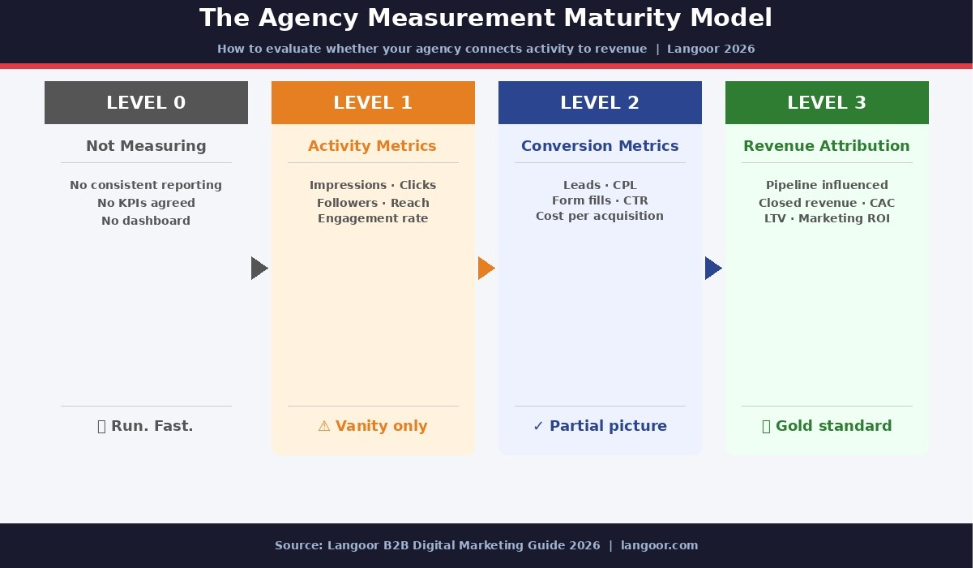
There are three levels of measurement maturity to evaluate against:
- Level 1: Activity Metrics: Impressions, clicks, followers. Every agency can do this. It tells you nothing about business impact.
- Level 2: Conversion metrics: Leads, cost per lead, form completions. Better, but still disconnected from revenue.
- Level 3: Revenue attribution: Pipeline influenced, closed revenue, CAC, LTV. This is what matters to a CFO and a board.
An agency that cannot explain how they connect marketing activity to revenue is not the right partner for a serious marketing investment.
What to ask:
- How do you measure the ROI of your marketing activity?
- What attribution model do you use, and why?
- Can you show me an example of how you present performance to a client at C-suite level?
Question 4: Who will actually be working on your account?
This is one of the most important and most consistently overlooked questions in agency evaluation. In every pitch, you will meet the senior team: the MD, the Head of Strategy, the Creative Director. These are the people who built the agency's reputation. They are rarely the people who will be working on your account day to day.
Most agency accounts in India are serviced by relatively junior teams. The quality of your day-to-day account management determines the quality of your marketing more than the seniority of anyone in the pitch room.
What to ask:
- Who specifically will be my day-to-day account manager, and can I meet them before we sign?
- What is your average account manager's tenure?
- What happens to my account if the assigned manager leaves?
- What is your escalation process when I am unhappy with results or responsiveness?
The answers tell you more about the working relationship than the pitch ever will.
Question 5: Do they offer SEO, AEO, and GEO, not just social?
In 2026, digital marketing has expanded well beyond social media, paid search, and email. The most important emerging capability, and the one most Indian agency do not yet offer credibly, is visibility in AI-generated search results.
Google AI Overviews now appear on 30 to 40% of searches. ChatGPT Search, Perplexity, and Gemini are increasingly the first stop for B2B buyers researching vendors. If your agency cannot build content and technical signals that get your brand cited in these AI-generated answers, your organic visibility will decline regardless of how well your traditional SEO performs.
The three disciplines to evaluate:
- SEO (Search Engine Optimisation): Technical health, keyword strategy, content architecture, link authority, and the foundations.
- AEO (Answer Engine Optimization): Structuring content to win featured snippets, People Also Ask, and AI Overview citations through direct-answer blocks, FAQ-Page schema, and question-based content.
- GEO (Generative Engine Optimization): Building entity authority, E-E-A-T signals, and structured data so AI engines like ChatGPT and Gemini cite your brand as a trusted source.
What to ask:
- Do you offer AEO and GEO services, and can you show examples of brands you have helped achieve AI Overview visibility?
- How do you balance SEO, AEO, and GEO in your content strategy?
- What percentage of your team's time goes to organic search versus paid channels?
Question 6: How do they handle AI and marketing automation?
AI is no longer a differentiator for marketing agencies; it is a baseline of expectation. An agency in 2026 that is not using AI for content drafting, keyword research, audience segmentation, performance optimization, and reporting is operating at a significant disadvantage.
But AI usage is not uniform. There is a meaningful difference between an agency that uses AI tools opportunistically and one that has built AI into systematic workflows that improve output quality, speed, and cost efficiency at scale.
Similarly, marketing automation, building and managing lead nurture workflows, behavioral email sequences, lead scoring systems, and CRM integrations, is now a core competency for any agency working with B2B brands or high-consideration B2C categories.
What to ask:
- Which AI tools do you use, and how are they integrated into your standard workflows?
- Do you have marketing automation capability in-house, or do you partner with platforms like HubSpot, Marketo, or Mo-Engage?
- Can you show me an automated lead nurture workflow you have built for a client?
Question 7: What is their content strategy approach?
Content is the foundation of every effective digital marketing strategy in 2026. SEO, ABM, lead nurturing, and brand authority all depend on it. An agency without a rigorous content strategy of capability is structurally limited in what it can achieve.
The best agencies approach content strategically: audience research first, then a content architecture aligned to the buyer journey, content produced to serve both human readers and AI engines, and performance measured against pipeline contribution rather than traffic alone.
Content strategy red flags:
- The agency leads with volume ("we will publish 20 posts per month") rather than quality and strategic fit.
- They cannot explain how content connects to lead generation or pipeline.
- Their samples feel generic, keyword-stuffed, or interchangeable across industries.
What to ask:
- How do you develop a content strategy for a new client, what is the process from brief to published article?
- How do you ensure content quality at scale?
- Can you show me three recent pieces you are proud of and explain why each was strategically correct for that client?
Question 8: How transparent is their pricing?
Agency pricing in India is notoriously opaque. Retainer models, project fees, performance fees, platform markups, and production costs are often presented in ways that make it difficult to understand what you are paying for.
There are four common pricing models in the Indian agency market:
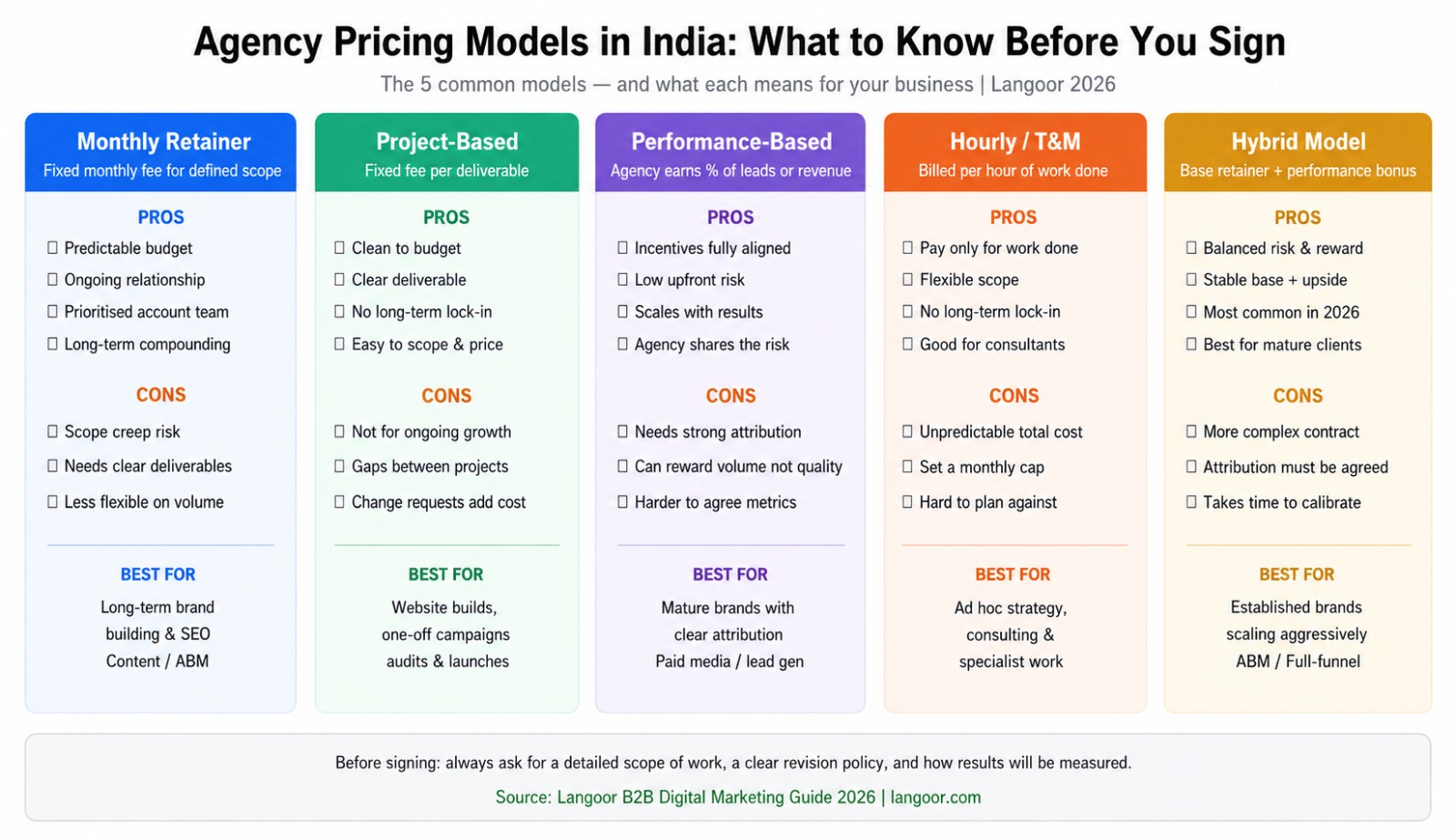
Monthly retainer: A fixed monthly fee covering a defined scope. Predictable for both sides but watch for scope creep, where work expands without the fee increasing.
Project-based: A fixed fee for a defined deliverable. Clean budget, but it does not support the ongoing, iterative work that digital marketing requires.
Performance-based: The agency earns a percentage of revenue or leads generated. Aligns incentives well but requires strong attribution infrastructure agreed upfront.
Hybrid: A base retainer plus a performance component. The most common model for mature agency, client relationships where both parties have established trust and measurement clarity.
What to ask:
- What exactly is included in the retainer, and what would be charged as an additional cost?
- Do you markup third, party platform costs (media spend, software licenses)? By how much?
- What happens if I need to work outside the agreed scope?
Question 9: Do they have a proven onboarding process?
The first 90 days of an agency relationship determine the quality of the next 12 days. Agencies without a structured onboarding process waste those 90 days getting oriented. By the time they are producing real work, the client is already questioning the investment.
A well, structured onboarding for a new B2B client should include:
- Brand and business immersion: Understanding your products, customers, competitors, and sales processes.
- Audience research: Building or validating buyer personas through interviews or data.
- Audit: A technical, content, and channel audit of your existing digital marketing before making recommendations.
- 90, day roadmap: A specific, prioritized plan for the first quarter, not a general strategy document.
- Reporting setup: GA4, CRM integration, attribution model, and dashboard configuration before the first campaign goes live.
What to ask:
- Can you walk me through your onboarding process step by step?
- How long is the contract signing to first campaign live?
- What do you need from our team to onboard effectively, and what happens if we are slow to provide it?
Question 10: Can they scale with your business?
The agency that is right for you at ₹15 lakh per month may not be the right agency at ₹60 lakh per month. As your marketing investment grows, your needs change: more channels, more markets, more sophisticated measurements, more senior strategic input, larger production volumes.
Evaluate not just where the agency is today, but whether they have the infrastructure, team depth, and strategic capability to grow with you. An agency that has only ever serviced clients at a certain investment level will struggle to step up when you need them to.
What to ask:
- What is the largest marketing budget you currently manage for a single client?
- What additional capability becomes available as our investment grows?
- Do you have multicity or international capability, or partnerships in markets we may want to enter?
- How do you handle multimarket campaigns? Do you have offices or partners outside your primary city?
Red flags to watch for when evaluating agencies
Beyond the ten questions, there are behaviors in the pitch process that signal deeper problems in the engagement.
.png)
- They guarantee specific rankings or lead volumes. No credible agency guarantees SEO rankings or lead counts; too many variables sit outside agency control.
- They cannot explain how they will measure your success. If an agency cannot describe their measurement approach concretely, they are not measuring effectively.
- The pitch team and the execution team are entirely different people. Always meet the people who will work on your account before signing.
- They push you to sign quickly. Pressure to close before due diligence is complete is a commercial red flag, not a sign of demand.
- Their own digital presence is weak. An agency whose website ranks poorly and whose content is thin has not demonstrated what they claim to offer clients.
- They cannot name a limitation or weakness. Every agency has things they are not best at. One that claims otherwise is not being honest.
- They inflate team size or in, house capability. Verify via LinkedIn. Understand what is genuinely in, house versus outsourced.
- Case studies lack specifics. If the client is always unnamed and the outcome is always directional ('significantly improved'), the case study is not credible.
Agency Evaluation Scorecard: 10 Questions at a Glance
How Langoor approaches digital marketing partnerships
Langoor's approach to new client partnerships is built on four commitments:
Radical measurement transparency: Every Langoor client has access to a live dashboard connecting marketing activity to CRM outcomes. We do not present curated monthly slide reports; we provide direct access to the data.
Dedicated senior account leadership: Every client is assigned as an Account Director with a minimum of six years of relevant industry experience, supported by specialist teams in SEO, content, paid media, automation, and creative.
Structured 90-day onboarding: Our onboarding moves from brand immersion to audience research to technical audit to 90-day roadmap in a documented sequence; clients see real work within the first four weeks.
Full-spectrum digital capability: SEO, AEO, GEO, content marketing, paid media, ABM, marketing automation, CRO, and analytics, all in-house. We do not white-label work from third parties.
1) How do I choose a digital marketing agency in India?
Start with a structured evaluation framework rather than a shortlist based on referrals or pitch decks. Evaluate each agency across ten dimensions: industry experience, proven results, measurement approach, account team composition, organic search capability (including AEO and GEO), AI and automation skills, content strategy quality, pricing transparency, onboarding process, and scalability. Ask for client references and call them. Consistency across all ten dimensions is a far more reliable signal than strength in one or two.
2) How much does a digital marketing agency cost in India?
Agency retainers in India in 2026 typically range from ₹3,5 lakh per month for basic social and paid media engagements, to ₹15,40 lakh per month for a full-service B2B programme covering SEO, content, ABM, automation, and paid channels. The right investment level depends on your customer acquisition economics. Specifically, what a new customer is worth and how much you need to justify the spend. B2B enterprise programmes typically benchmark at 8,12% of target pipeline contribution.
3) What should I look for in a B2B digital marketing agency?
For B2B specifically, prioritize agencies with experience in long-cycle, multi-stakeholder sales environments. Critical capabilities include LinkedIn marketing and Account Based Marketing, SEO and content for complex technical buyers, marketing automation and CRM integration, and multi-touch attribution connecting marketing activity to pipeline and closed revenue. B2B is fundamentally different from B2C, an agency that primarily serves consumer brands will not have the right playbooks for enterprise buying journeys.
4) What is the difference between a boutique and a network agency?
Network agencies (WPP, Publicis, Dentsu, IPG) offer global scale, cross-market coordination, and access to proprietary data and technology platforms. They typically work with larger budgets and have structured account management hierarchies. Boutique agencies offer more specialized expertise, faster decision-making, more direct access to senior talent, and often better value at mid-market investment levels. The right choice depends on your complexity, budget, and whether you need global coordination or focused specialist execution.
5) How do I evaluate a digital marketing agency's case study?
Treat case studies as a starting point, not evidence. Ask for the actual performance data behind any case study presented: before metrics, specific actions taken, timeline of results, and what did not work. Request to speak directly with the client. If the agency cannot provide data access or live references, the case study should carry little weight in your evaluation. The strongest evidence is a current or former client speaking candidly about the working relationship, not a branded PDF.
The right digital marketing agency in India is not the biggest, the cheapest, or the one with the most impressive pitch deck. It is the one that understands your business goals, can demonstrate results in your category, treats your marketing budget with the same rigour as their own, and has the infrastructure to grow with you as your needs evolve.
India's agency market in 2026 is large enough and diverse enough that the right partner exists for almost every brand and budget. The problem is not supplying; it is the evaluation process. Brands that take shortcuts in selection pay for them in wasted spend, missed pipeline, and the significant disruption of switching agencies mid-year.
Use the ten questions in this guide. Speak to references. Meet the execution team before you sign up. And choose an agency that is as serious about measurement as you are about growth.
If you want to understand how Langoor approaches digital marketing partnerships for Indian enterprises, with transparency, measurement rigor, and full-spectrum digital capability, get in touch at langoor.com/contact.
Choosing a digital marketing agency in India involves evaluating the agency's experience in your industry, its approach to measurement and transparency, the specific services offered, pricing structure, and team composition. In 2026, with India's digital marketing ecosystem more fragmented than ever, over 10,000 agencies operate nationally, the selection process requires a structured evaluation framework beyond pitch decks and client logos.
- Over 10,000 digital marketing agencies operate in India in 2026, structured evaluation is essential to choose correctly.
- Always ask to meet the day-to-day account team before signing; pitch teams and delivery teams are rarely the same people.
- Measurement of maturity separates agencies: demand revenue attribution, not just impressions and lead counts.
- In 2026, SEO alone is not enough, evaluate for AEO and GEO capability to maintain AI search visibility.
- Call at least three client references; a polished case study of PDF is marketing material, not evidence.
- Pricing transparency is non-negotiable: understand what is in scope, what is charged extra, and whether media is marked up.
- Red flags in the pitch process are reliably predictive of problems in the engagement, take them seriously.
- The first 90 days determine the next 12: a structured onboarding process is a mark of an operationally mature agency.
You may also like this