August 25, 2026
Manmohan Singh
Indian marketing leaders are under pressure to turn paid-media investment into visible commercial progress - not simply more impressions, clicks or campaign activity. The question, “Which digital marketing ad agency in India handles PPC and social ads efficiently?”, is best answered by looking beyond a partner’s channel certifications or media-spend claims. An efficient digital marketing ad agency relationship is built on a shared commercial brief, direct access to platforms and data, disciplined optimisation, and reporting that connects channel activity to business outcomes.
This matters because paid media now operates across a more fragmented decision journey. Search can capture active demand, while social platforms can create familiarity, build consideration and re-engage previous visitors. A digital marketing ads agency should therefore manage media as an integrated learning system, with decisions informed by customer experience, conversion quality and revenue signals rather than isolated platform metrics.
What does efficient paid-media delivery actually mean for a growth team?
Efficiency is not the ability to spend a budget quickly. It is the ability to make timely, evidence-based decisions that improve the probability of achieving a defined commercial objective. For a B2B enterprise, that may mean increasing sales-accepted opportunities; for a consumer brand, it may mean acquiring profitable first-time customers or improving repeat purchase signals.
Decision speed is one part of the equation. If an agency identifies a weak landing page, irrelevant search demand or a declining creative response but cannot secure approvals for two weeks, media efficiency is constrained by operating design rather than platform performance. Clear roles, pre-agreed guardrails and accessible performance data reduce this delay.
Learning quality is equally important. A strong partner distinguishes between a temporary fluctuation and a meaningful pattern by examining audience segments, search queries, conversion paths and the quality of downstream outcomes. This is especially important when upper- and mid-funnel activity supports outcomes that cannot be attributed to a last-click conversion alone; demand-creation activity can influence future revenue by expanding the pool of potential buyers.
Finally, efficient delivery reduces avoidable waste. Waste can include spend on irrelevant queries, duplicate audience exposure, unqualified lead sources, broken forms, slow pages or campaigns that continue after their underlying offer has changed. The agency should not merely report this waste after the fact; it should create a routine for detecting, prioritising and resolving it.
Which business inputs should be agreed before campaigns are activated?
Paid media performs best when the agency begins with a commercial brief, not a channel checklist. A search campaign cannot compensate for an unclear offer, and a social campaign cannot reliably generate demand when the intended audience, buying context and conversion definition remain uncertain. Before launch, brand, agency, sales and analytics stakeholders should agree on the following inputs.
This preparation also helps marketing leaders evaluate whether they need a specialist partner, an integrated agency or an extension of an in-house team. Langoor’s guide on how to choose a digital marketing agency in India provides a useful wider framework, but paid media should always be assessed against the operating realities of the specific growth plan.
How should paid search and social advertising play different roles in the same plan?
Search and social are often placed in separate budget silos, which can encourage channel-level optimisation at the expense of business results. A more effective approach assigns each channel a clear job while allowing budget to move when evidence supports it. The exact balance will vary by category, offer maturity, sales cycle and the strength of existing demand.
| Planning area | Paid search | Paid social | Integrated decision |
| --- | --- | --- | --- |
| Primary role | Captures demand from people actively looking for a solution, brand or category. | Creates demand and reaches relevant audiences before they search. | Use search to convert existing intent and social to expand or shape future intent. |
| Audience signal | Search terms, location, device, time and previous site behaviour. | First-party audiences, engagement, professional attributes, interests and lookalike modelling where available. | Compare not only volume but subsequent lead quality and conversion progression. |
| Retargeting | Re-engages visitors with high-intent queries or incomplete actions. | Sequences proof, education, product value and reminders across audience groups. | Control overlap and frequency so the same user is not repeatedly chased across channels. |
| Creative testing | Tests message relevance through ad copy, extensions and landing-page alignment. | Tests formats, visual concepts, hooks, offers and audience-message fit. | Feed social creative learning into search messaging and landing-page experiments. |
Paid search is particularly valuable when demand already exists, and query language reveals the buyer’s immediate need. However, low-funnel metrics alone can conceal an overreliance on existing category demand or branded searches. Social advertising can create a broader set of future buyers by reaching audiences before they express intent, which aligns with research on mid-funnel activity strengthening both brand and performance outcomes.
For Indian B2B brands, LinkedIn may be useful for reaching defined professional audiences, while Meta, YouTube and other social environments can support scale, video engagement and retargeting depending on the buying journey. The important question is not whether one platform is universally “better,” but whether each platform has a measurable role in the customer journey. Teams should also account for the differences between long-consideration B2B demand generation and faster B2C conversion cycles, as explored in Langoor’s overview of the difference between B2B and B2C digital marketing.
What should a digital marketing ads agency’s optimisation cadence look like?
Optimisation should be a documented operating rhythm rather than a vague promise to monitor campaigns. Daily observation may be appropriate for major delivery failures, sudden budget changes or a time-sensitive promotion, but many meaningful choices require enough data to distinguish a trend from noise. The agency should explain what it reviews, who decides, what action follows and how each decision is recorded.
Weekly operating rhythm
Start with delivery and measurement checks. Review pacing, spend anomalies, disapproved ads, conversion tracking continuity, landing-page availability and material changes in lead flow. These checks protect data integrity before the team makes performance judgements.
Next, assess search terms and audience signals. Search-term reviews should identify irrelevant demand, new high-intent themes, negatives to add and queries that deserve dedicated copy or landing pages. On social platforms, the team should compare audience cohorts, placements, frequency, engagement quality and progression to meaningful actions rather than selecting winners solely by click-through rate.
Then make bid, budget and creative decisions. Changes should be linked to a stated hypothesis, such as “reducing spend on this query cluster will improve qualified-lead rate” or “this customer proof message may outperform feature-led copy for mid-market buyers.” A short weekly decision log gives both client and agency a record of what changed, why it changed and what result is expected.
Monthly operating rhythm
Monthly reviews should move from campaign management to commercial learning. The agency should connect paid-media results to CRM stages, sales feedback, revenue indicators and the quality of the customer experience after the click. This is where teams decide whether to scale a winning approach, redesign an offer, shift a channel role or pause a test that lacks business value.
Creative refreshes also need a monthly plan, particularly in social environments where audiences can become overexposed to the same message. Instead of replacing assets randomly, build a test backlog covering value propositions, proof formats, audience objections, calls to action and landing-page variants. The value of this discipline is reflected in the wider agency focus on measurable effectiveness: the IPA argues that an effectiveness culture depends on embedding evidence and learning into decisions.
Escalations should not wait for the monthly meeting. A broken conversion event, sharp fall in lead quality, unapproved campaign, legal concern, sales-capacity constraint or change in product availability should have a named escalation owner and agreed response time. Fast escalation is often the clearest practical indicator of agency accountability.
Which platform-access and ownership rules prevent avoidable risk?
Platform access is a governance issue, not an administrative detail. The brand should own its Google Ads, Meta Business Manager, LinkedIn Campaign Manager, analytics properties, tag-management containers, pixel configurations and audience assets wherever platform rules allow. An agency should receive role-based access needed to operate efficiently, but the underlying account history and billing relationship should remain visible to the client.
Use this governance checklist before launching activity:
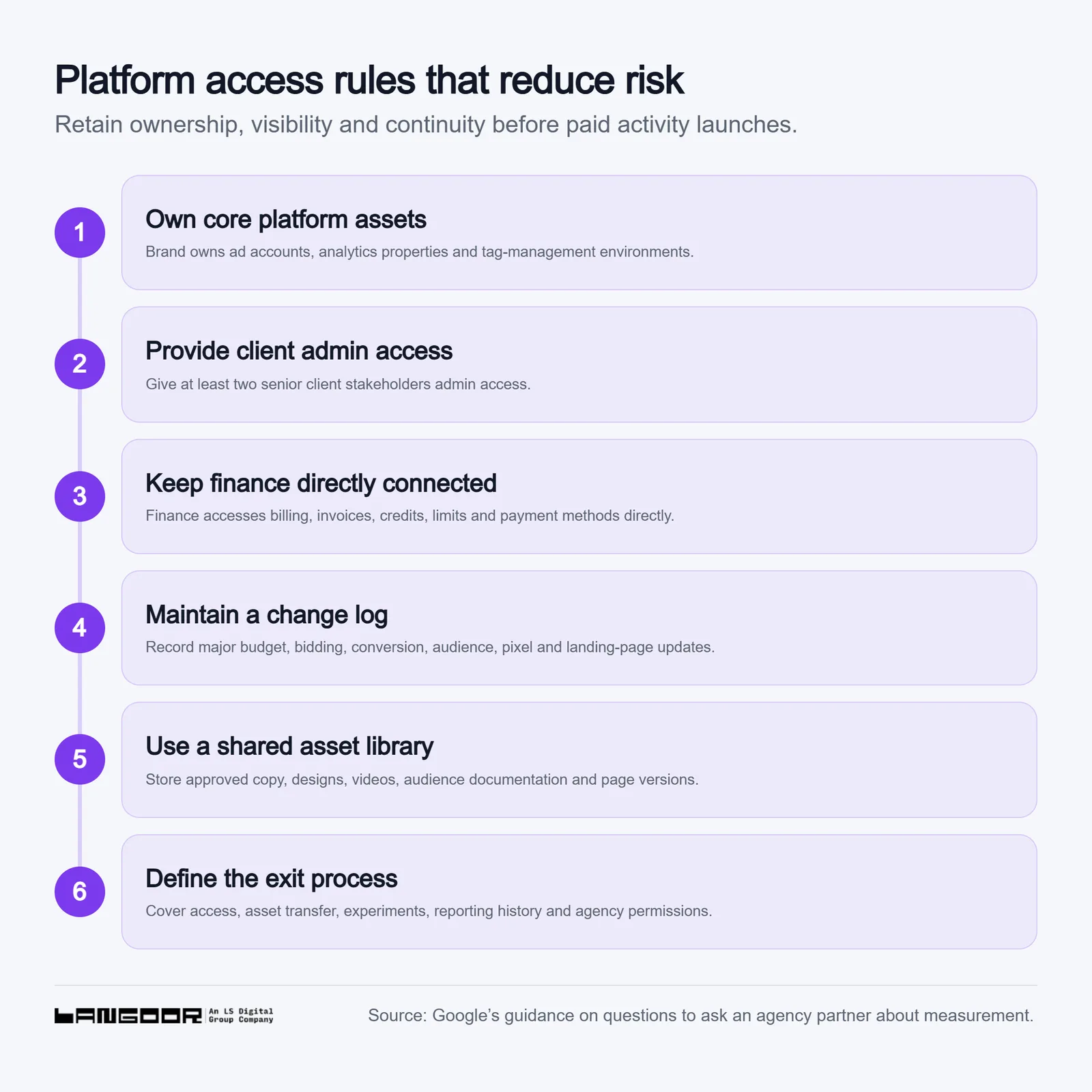
These controls do not signal distrust. They allow the agency to work with clarity while ensuring the brand retains continuity if people, platforms or commercial arrangements change. They also support stronger measurement conversations; Google’s guidance on questions to ask an agency partner about measurement emphasises the need for transparency around data, methods and accountability.
How can teams judge whether paid media is producing useful business results?
A useful report should tell leaders what happened, what it means, what is uncertain and what decision comes next. It should not force executives to infer commercial performance from reach, clicks or a single cost-per-lead figure. Platform metrics remain useful diagnostics, but they are not sufficient measures of business value.
The report should explain movement. If cost per lead increased but the sales-qualified rate rose sharply, the right decision may be to protect the higher-quality source rather than cut it. Conversely, a low cost per lead may be a warning sign if sales acceptance, opportunity creation or expected margin is weak.
No report removes all uncertainty, especially in categories with long buying cycles and multiple customer touchpoints. But a shared data strategy can improve the quality of decisions; Google’s perspective on measurement and ROI agency partnerships highlights the importance of aligning data, business questions and partner collaboration. The practical objective is not perfect attribution, but a consistent evidence base for deciding what to continue, change or stop.
What evidence should a prospective agency show before being appointed?
A capable agency should be comfortable demonstrating how it works, not only presenting polished outcome charts. Ask for evidence relevant to your sector, channel mix, buying cycle and measurement maturity. A partner with strong consumer-app experience may still be valuable, but it should articulate how its operating model will adapt to enterprise lead qualification or complex regional requirements.
Use the following evaluation checklist during the selection process:
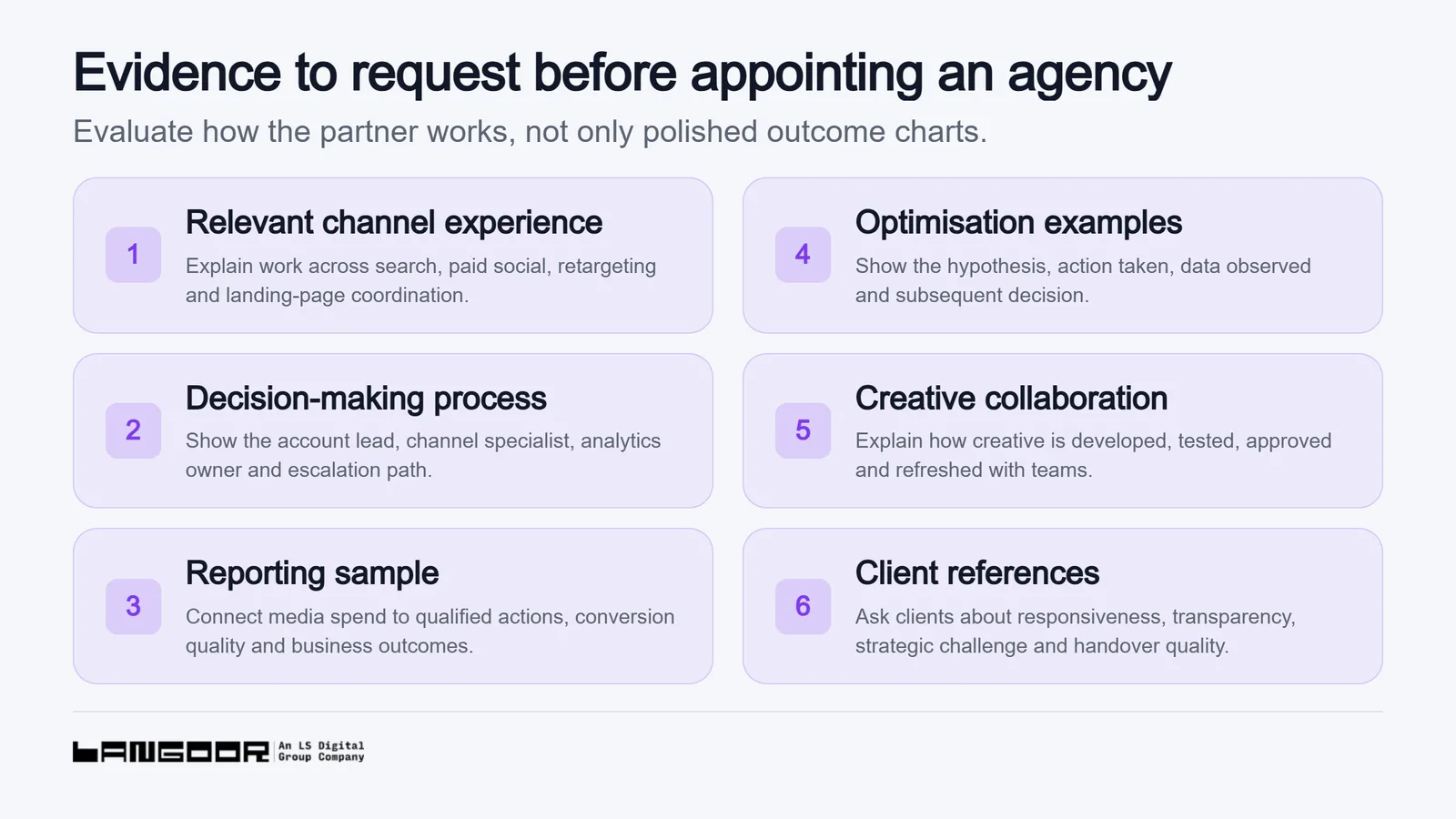
Benchmark data can provide context, but it should never replace an understanding of your own unit economics and conversion process. Broad advertising benchmarks vary significantly by industry, audience, platform and objective, so channel benchmark figures should be treated as directional comparisons rather than universal targets. The best prospective partner will be candid about this variability and will propose a plan for establishing your baseline.
What should happen in the first 30 days of the relationship?
The first month should establish the systems that make later performance improvements possible. It is not reasonable to expect every campaign to be fully mature within 30 days, especially where learning periods, sales cycles and creative production introduce delays. It is reasonable to expect validated measurement, a prioritised test plan and a working operating rhythm.
What should happen in week one?
The agency and client should confirm objectives, unit economics, conversion definitions, access permissions, stakeholders and approval pathways. They should audit advertising accounts, tracking implementations, CRM handoffs, landing pages, existing creative and historical performance where available. The result should be a written baseline and a list of risks that could compromise reporting or launch quality.
What should happen in weeks two and three?
The team should validate events from ad interaction through to the relevant downstream system, including form completion, lead routing and qualification status where feasible. It should launch or refine priority campaigns using a limited number of clear hypotheses rather than scattering budget across too many audiences and messages. A test backlog should also identify what will be assessed next, who owns each dependency and what signal will determine success.
What should happen by day 30?
The first formal review should cover delivery, data quality, early audience and query learning, creative response, lead quality and operational blockers. The agency should present recommendations for the next 30 to 60 days, including budget changes only where the evidence justifies them. Both teams should also revisit the commercial brief, because launch learning may reveal that the original audience, offer or conversion definition needs adjustment.
Build a partnership around operating evidence
An efficient paid-media partnership is not defined by the number of campaigns launched or dashboards delivered. It is defined by how quickly the team can turn reliable data into commercially sensible action, while protecting account ownership and keeping every stakeholder aligned on what quality looks like.
Turn the evaluation checklist in this guide into a short paid-media briefing document. Use it to compare prospective partners on their operating evidence - access model, decision cadence, measurement approach, creative process and escalation discipline - rather than on promises alone. For brands seeking a data-intelligent approach that connects demand generation, customer experience and measurable innovation, Langoor can help shape the next stage of your digital growth.
_Assess evidence of operating discipline, measurement transparency and collaboration._
You may also like this